6.1.3(c)-(d) - DNA profiling and PCR
DNA profiling compares selected regions of DNA so that samples can be matched, excluded, or interpreted for risk. PCR, the polymerase chain reaction, is different: it is the method used to amplify a specific DNA sequence so there is enough DNA to analyse. In this lesson you will learn the principles of both techniques, and how to use them carefully in forensic and disease-risk contexts.
DNA Profiling And PCR Are Different
A DNA profile is a pattern or set of results from selected regions of a person's DNA. The principle is that individuals vary in some DNA regions, especially repeated non-coding regions, so comparing several regions can help decide whether two DNA samples are likely to come from the same person or a close relative.
PCR is not the profile itself. PCR is a technique that makes many copies of a chosen DNA sequence. It is especially useful when only a small amount of DNA is available, such as a forensic sample from a crime scene.
DNA Profiling
DNA profiling is the analysis and comparison of selected DNA regions to identify similarities or differences between DNA samples.
The profile is the evidence pattern that can be compared. The next definition names the copying technique that often makes the analysis possible.
PCR
PCR, or polymerase chain reaction, is a laboratory technique used to amplify a specific DNA sequence, producing many copies for analysis.
[DIAGRAM: dna_profiling_workflow: Lesson 151: DNA profiling and PCR - diagram 01; asset_slug: 151_m06_1_3_dna_profiling_and_pcr__diagram_01; recommended_method: drawn_biology; description: A deterministic 16:9 workflow showing sample collection, DNA extraction, PCR amplification of variable regions, production of a DNA profile, comparison to reference profiles, and two OCR uses: forensics and analysis of disease risk.]
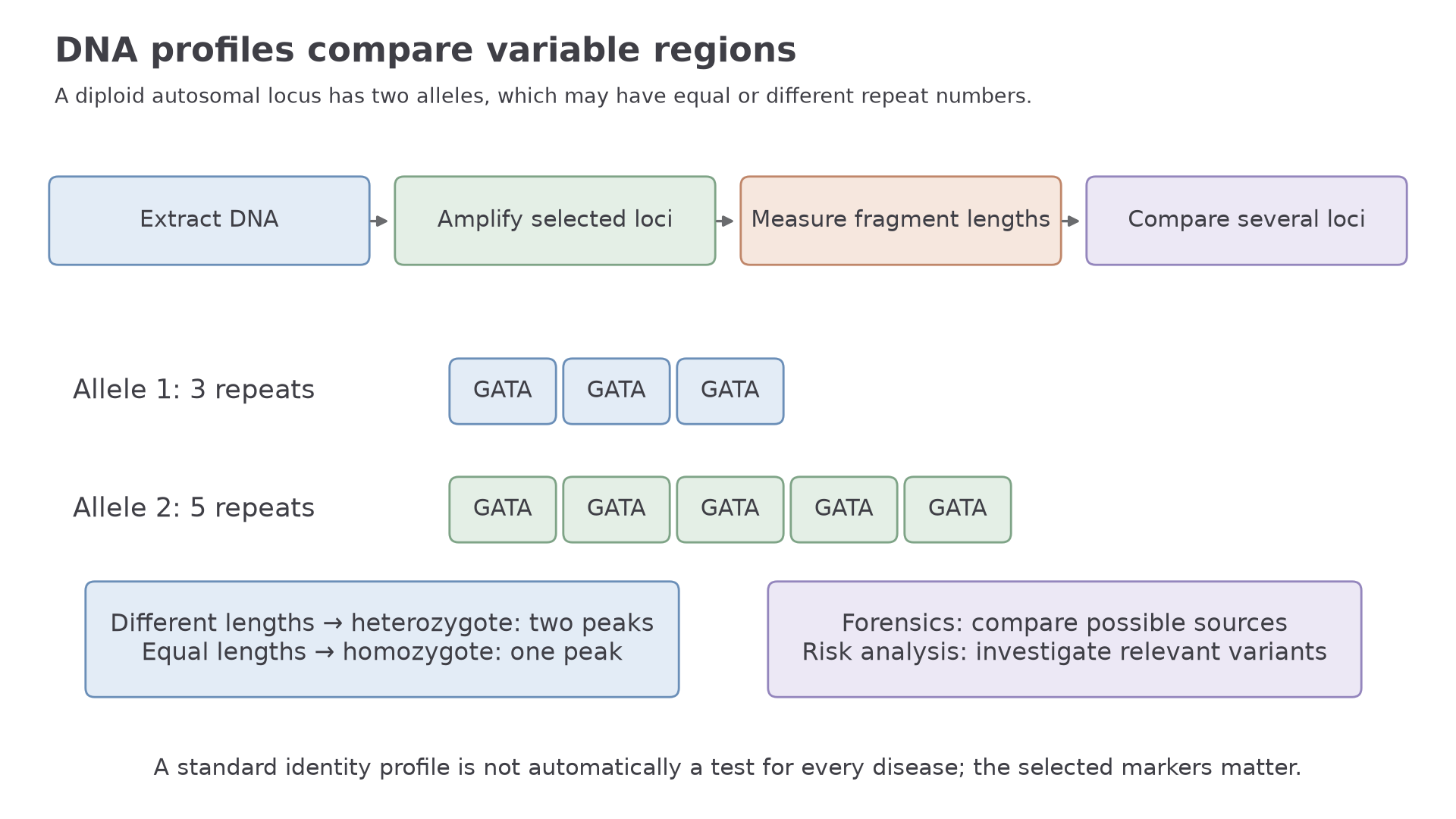
The route is usually:
- Obtain a biological sample, such as blood, saliva, hair root cells, or a cheek swab.
- Extract DNA from the cells.
- Use PCR to amplify selected DNA regions if the sample is small or if specific regions need to be copied.
- Produce a DNA profile from the selected regions.
- Compare the profile with another sample, a database entry, or known disease-risk markers.
This lesson keeps the focus on the profiling and PCR principles. The detailed separation of fragments by electrophoresis is the next lesson, so here you only need the idea that the profile lets DNA samples be compared.
PCR Components And Specificity
PCR copies only the DNA region selected for amplification. That specificity mainly comes from primers.
Primer
A primer is a short single-stranded DNA sequence that binds to a complementary sequence on the template DNA and provides a starting point for DNA synthesis.
A PCR reaction needs:
| Component | Role in PCR |
|---|---|
| Template DNA | The original DNA containing the target sequence to be copied. |
| Primers | Bind at either side of the target region and define the sequence to be amplified. |
| Free DNA nucleotides | Used to build new complementary DNA strands. |
| Heat-stable DNA polymerase | Joins nucleotides to make new DNA strands during the extension stage. |
| Buffer and suitable ions | Maintain conditions for the enzyme to work. |
A commonly used enzyme is Taq polymerase. It comes from a thermophilic bacterium and is sufficiently heat-stable to survive the repeated high-temperature stages. Its high optimum temperature permits rapid strand synthesis around 72 °C. Heat resistance explains survival at the denaturation step; the optimum explains the extension temperature. This matters because PCR cycles through high and lower temperatures many times.
Two primers bind to opposite template strands at the flanks of the target, with their 3′ ends pointing into the target. Polymerase extends each primer in the 5′ to 3′ direction. If the primers point away from one another, the desired region will not undergo the intended exponential amplification.
Specificity is important in DNA analysis. If primers bind only to the intended target region, PCR amplifies that region rather than copying random DNA. In DNA profiling, primers can target variable DNA regions so that the amplified products help distinguish one person's profile from another.
When explaining PCR, name the role of primers. They do not just "start PCR"; they bind to complementary target sequences and provide the starting point for DNA polymerase.
The PCR Temperature Cycle
PCR is a repeated cycle of temperature changes. Each cycle has three core stages.
| Stage | Approximate temperature | What happens |
|---|---|---|
| Denaturation | About 95 °C | Hydrogen bonds between complementary bases break, separating the two DNA strands. |
| Annealing | About 50-65 °C | Primers bind to complementary sequences on the single-stranded DNA templates. |
| Extension | About 72 °C | Heat-stable DNA polymerase adds complementary nucleotides, synthesising new DNA strands. |
[DIAGRAM: pcr_cycle: PCR stages, strand direction and repeated amplification; asset_slug: 151_m06_1_3_dna_profiling_and_pcr__diagram_02; recommended_method: drawn_biology; description: Separate template strands at95degrees, inward-facing primers at annealing and complementary synthesis at72degrees.]
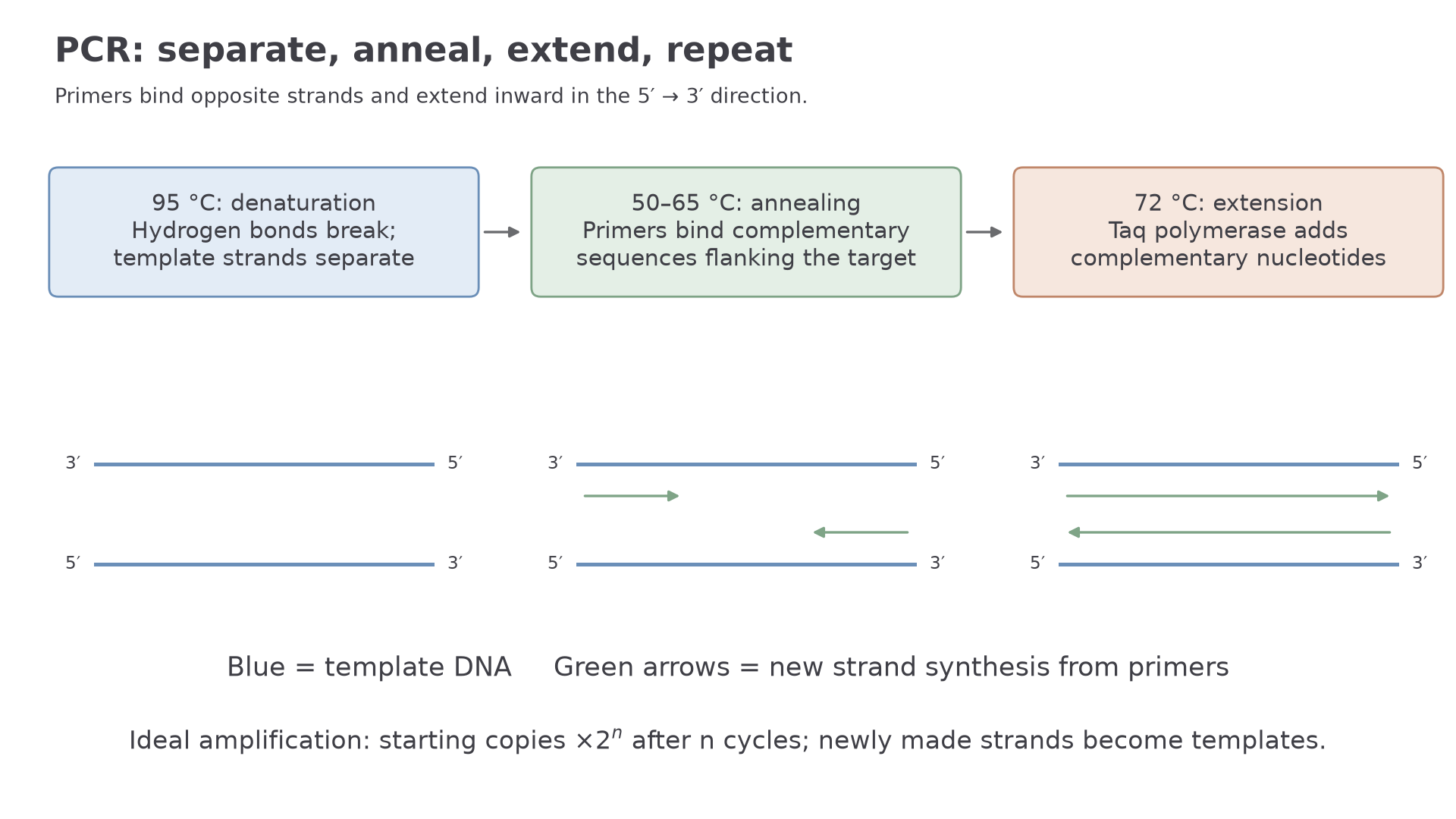
After one ideal PCR cycle, one double-stranded target DNA molecule can produce two double-stranded copies. After two cycles, there can be four. After many cycles, the amount increases rapidly because newly made DNA can also act as a template.
Ideal PCR Copy Number
This is an idealised model, but it is a useful way to see why repeated cycles make PCR powerful.
Continue this lesson.
You’re previewing NovaLearn without an account. Create a free account to read the rest.
Create free account