2.1.6(e)-(f) - Significance of mitosis and meiosis in life cycles
Living organisms have two linked problems to solve. They need to make more cells for growth, repair and some forms of reproduction, while keeping the genetic instructions stable. In sexual life cycles they also need to make haploid cells and create genetic variation, so meiosis has a different significance from mitosis.
The life-cycle problem
A life cycle is the sequence of stages through which an organism passes from one generation to the next. Cell division sits inside that sequence. The important question is not only "what happens to the chromosomes?" but "why is this type of division useful at this point in the life cycle?"
Diploid
A diploid cell has two sets of chromosomes, with chromosomes arranged as homologous pairs.
Haploid
A haploid cell has one set of chromosomes, with only one chromosome from each homologous pair.
Mitosis and meiosis solve different life-cycle tasks. Mitosis preserves chromosome number and usually produces genetically identical daughter cells. Meiosis reduces chromosome number and produces haploid cells that are genetically varied.
[DIAGRAM: life_cycle_mitosis_meiosis: Lesson 047: Significance of mitosis and meiosis in life cycles - diagram 01; asset_slug: 047_m02_1_6_significance_of_mitosis_and_meiosis_in_life_cycles__diagram_01; recommended_method: drawn_biology; description: 16:9 NovaLearn-style flow diagram showing diploid body cells undergoing mitosis for growth, tissue repair and asexual reproduction, and diploid cells undergoing meiosis to form haploid genetically varied cells, with fertilisation restoring a diploid zygote.]
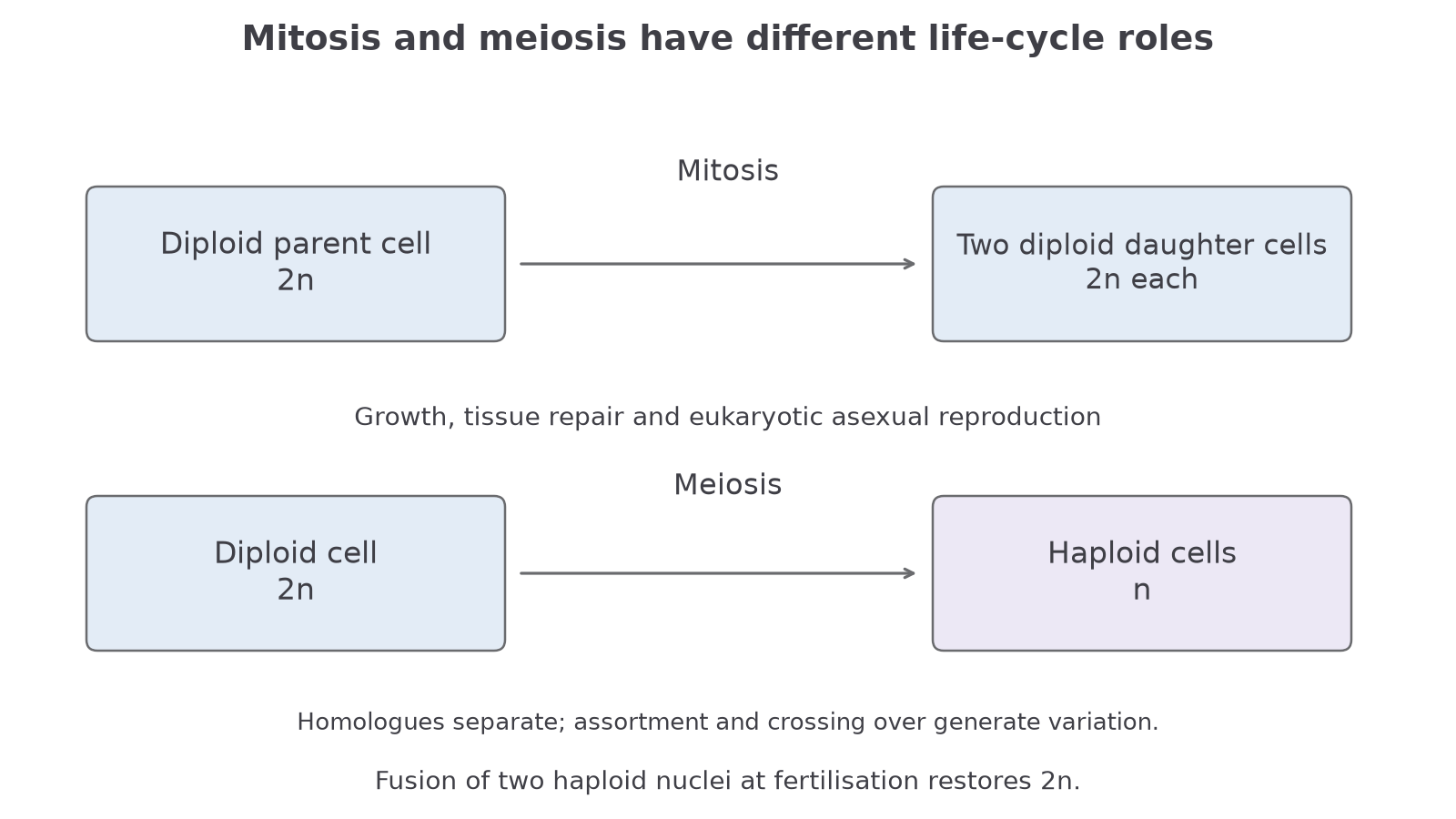
Use the diagram as a map for the lesson. The mitosis route stays within the same chromosome-number state; the meiosis route links chromosome-number reduction to the next generation in a sexual life cycle.
Mitosis is mainly significant because it preserves genetic information during cell multiplication. Meiosis is significant because it makes haploid, genetically varied cells.
Mitosis preserves information
Mitosis is nuclear division that produces daughter nuclei with the same chromosome number as the parent nucleus. After cytokinesis, the daughter cells are normally genetically identical to each other and to the original cell, apart from rare mutation.
That preservation is the reason mitosis is useful in life cycles. A multicellular organism can begin as one cell, then use repeated mitotic divisions to increase the number of cells without changing the genetic instructions in each new body cell. Growth here means an increase in cell number, not simply one cell becoming larger.
Mitosis also supports tissue repair. If cells are lost from a tissue, nearby dividing cells or tissue stem cells can produce replacement cells. The repair is a tissue-level effect: mitosis makes new cells to replace lost or damaged cells; it does not "fix" the DNA of one damaged cell.
In asexual reproduction, one parent produces offspring without fusion of gametes. Because mitosis preserves the genetic information, asexual reproduction can produce genetically identical offspring. OCR's examples include plants, animals and fungi:
| Group | Asexual reproduction example | Why mitosis matters |
|---|---|---|
| Plants | New plants from runners, bulbs or other vegetative structures | Mitotic divisions produce genetically identical plant tissues |
| Animals | Budding in animals such as Hydra | The bud grows by mitosis before separating or remaining attached |
| Fungi | Budding in yeast or asexual fungal spores | Mitotic nuclear division helps produce genetically identical new fungal cells or spores |
Do not use bacterial binary fission as an example of mitosis. Bacteria are prokaryotes and do not have a nucleus, so their cell division is not mitosis.
Meiosis makes haploid cells
Meiosis is significant because it reduces chromosome number. In a diploid cell, chromosomes occur as homologous pairs. During meiosis, homologous chromosomes are separated so that the resulting cells are haploid: each has one chromosome from each homologous pair.
This matters in sexual life cycles. If two diploid cells fused at fertilisation, chromosome number would double every generation. Instead, meiosis produces haploid cells. Fertilisation then combines two haploid nuclei to form a diploid zygote, restoring the diploid chromosome number for the new organism.
The key comparison is:
| Feature | Mitosis | Meiosis |
|---|---|---|
| Chromosome number in daughter cells | Same as parent cell | Half the parent cell number |
| Genetic similarity | Usually genetically identical | Genetically varied |
| Life-cycle significance | Growth, tissue repair, asexual reproduction | Haploid-cell production and variation in sexual life cycles |
For a meiosis significance answer, do not stop at "makes gametes". Link the idea to chromosome number: meiosis produces haploid cells, so fertilisation can restore the diploid number rather than doubling it each generation.
Continue this lesson.
You’re previewing NovaLearn without an account. Create a free account to read the rest.
Create free account