3.1.1(f) - Insect ventilation and tracheal gas exchange
Insects exchange gases through a tracheal system: a branching network of air-filled tubes that opens to the outside through spiracles. This lets oxygen reach respiring tissues directly, without needing blood to carry oxygen around the body. In this lesson you will learn the route gases take, how body movements ventilate the tubes, and why tracheal fluid matters at the final exchange surface.
Direct air tubes
An insect has a waterproof exoskeleton, so gases cannot simply pass rapidly across the whole outer surface. The solution is an internal tracheal system. Air enters and leaves through spiracles, which are openings in the body wall, then moves through larger tubes called tracheae and into finer branches called tracheoles.
Tracheal system
The internal insect gas exchange system made of branching air-filled tubes that carry gases between spiracles and body tissues.
The route is:
- Air enters through spiracles.
- Air passes along tracheae.
- Air reaches very fine tracheoles close to respiring cells.
- Oxygen diffuses from the tracheoles into cells, while carbon dioxide diffuses in the opposite direction.
[DIAGRAM: asset_name: Spiracle, branching tracheae and tracheoles alongside tissues, with fluid withdrawal during activity; asset_slug: 057_m03_1_1_insect_ventilation_and_tracheal_gas_exchange__diagram_01; description: Spiracle, branching tracheae and tracheoles alongside tissues, with fluid withdrawal during activity.]
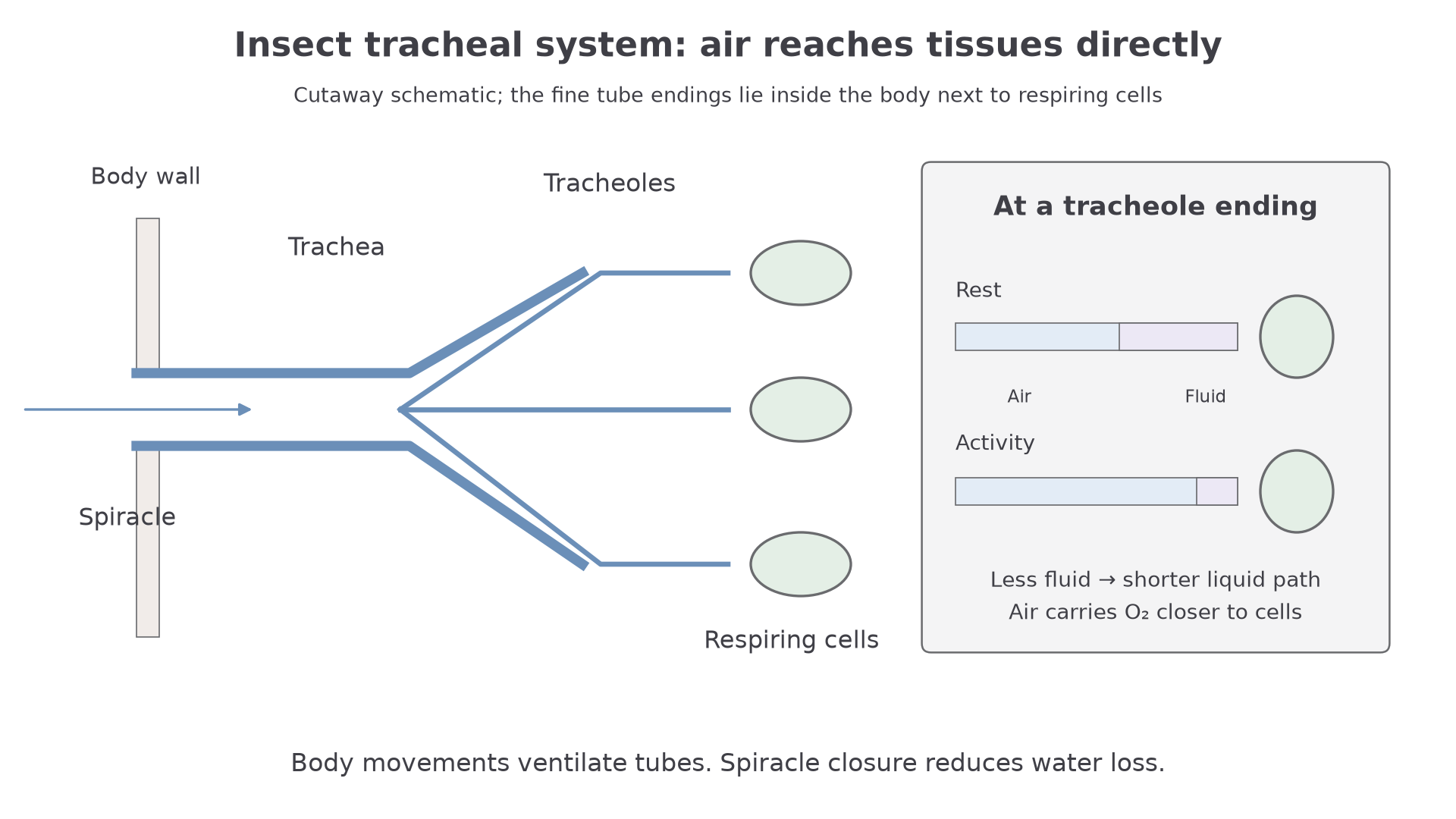
This is a direct system. Insects have haemolymph rather than blood like a mammal, and haemolymph is not the main carrier of oxygen. The tracheal tubes bring air close enough to cells for diffusion to do the final exchange.
Be precise with the word trachea. In mammals, the trachea is the windpipe. In insects, tracheae are part of a branching tube system inside the body.
Surface area and diffusion
Gas exchange is efficient only when gases have a large surface area for diffusion and a short diffusion distance. In the insect tracheal system, these features come mainly from the branching tubes.
The larger tracheae carry air from the spiracles into the body. The tracheae branch into many smaller tracheoles, so there are many tube endings close to body cells. That branching provides a large surface area for diffusion, and the thin tracheole endings reduce the distance between air and respiring tissue.
If asked how the insect tracheal system provides a large surface area, use "many branched tracheae or tracheoles". Do not rely on "many spiracles" as the surface-area explanation.
The concentration gradient is maintained by respiration. Cells use oxygen in aerobic respiration, so oxygen concentration stays lower in the cells than in the tracheoles. Cells produce carbon dioxide, so carbon dioxide concentration stays higher in the cells than in the tracheoles. Both gases diffuse down their concentration gradients.
Ventilation by body movement
Diffusion alone can supply gases over very short distances, but active insects need faster replacement of air in the tracheal system. Ventilation means moving the external medium over or through the exchange system so concentration gradients are maintained. In insects, the external medium is air.
Insects ventilate the tracheal system by thoracic and abdominal movements. When muscles in the thorax and abdomen contract and relax, they change the volume of the body and the tracheal tubes. A volume change produces a pressure change:
Continue this lesson.
You’re previewing NovaLearn without an account. Create a free account to read the rest.
Create free account