5.2.2(l) - Respirometers and factors affecting respiration rate
Respiration rate is not just a pathway idea; it can be investigated by measuring a physical change over time. In this lesson, you will learn how respirometers are used to estimate oxygen uptake, how to design fair investigations into temperature, substrate concentration and substrate type, and how to process the data as rates with suitable graphs and statistics.
What Respirometers Measure
A respirometer is an apparatus used to measure gas-volume changes caused by respiration. In a common school respirometer, living organisms such as germinating seeds or small invertebrates are sealed in a tube connected to a capillary tube containing coloured fluid. As the organisms respire aerobically, they use oxygen.
The key design feature is the carbon dioxide absorber, usually soda lime or potassium hydroxide solution. Respiring organisms produce carbon dioxide, but if that carbon dioxide is absorbed, the total gas volume in the experimental tube falls because oxygen has been removed from the air. This pressure change pulls the coloured fluid along the capillary tube.
Respiration rate
Respiration rate is the amount of respiratory gas used or produced per unit time, often measured as oxygen uptake per minute in a respirometer.
The control tube contains non-respiring material, such as glass beads or killed seeds, with the same volume as the organisms. The control helps show whether fluid movement is really due to oxygen uptake rather than temperature or pressure changes affecting the gas in both tubes.
[DIAGRAM: respirometer_control_and_experimental_tubes: Lesson 135: Respirometers and factors affecting respiration rate - diagram 01; asset_slug: 135_m05_2_2_respirometers_and_factors_affecting_respiration_rate__diagram_01; recommended_method: drawn_biology; description: A 16:9 NovaLearn-style line diagram of an experimental respirometer and matched control tube in a thermostatically controlled water bath, showing living organisms, glass beads, soda lime separated by a barrier, airtight seals, capillary fluid movement, syringe reset and rate logic.]
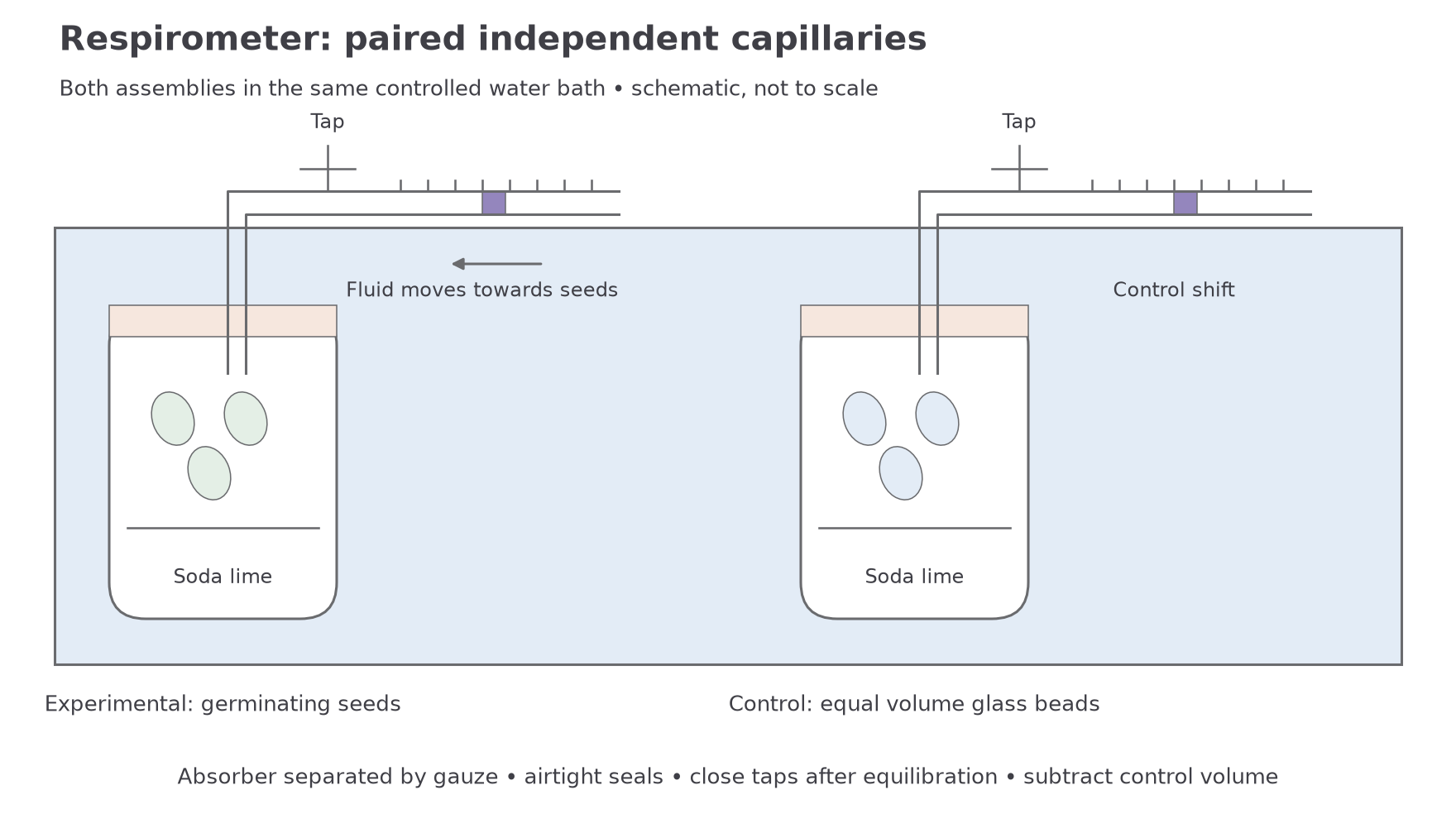
The apparatus must be airtight. A leak would allow air to enter or leave the apparatus, so capillary movement would no longer represent oxygen uptake by the organisms. The carbon dioxide absorber must also be kept away from living organisms because it is caustic and could harm them.
Distinguish two arrangements. In paired, independent capillary respirometers, subtract the signed volume change in the matched non-living control from the experimental change. In a differential manometer joining the experimental and control chambers, the fluid displacement already reflects their pressure difference: do not subtract the control a second time. For converting a distance with πr²l, use a calibrated volume-displacement capillary of known radius, not an uncalibrated pressure reading.
Designing A Fair Investigation
The independent variable is the factor deliberately changed. In this lesson, the important examples are temperature, substrate concentration and type of respiratory substrate. The dependent variable is the respiration rate, usually calculated from oxygen uptake per unit time.
Control variables keep the comparison fair. A change in capillary movement should be due to the independent variable, not a hidden difference in the organisms or apparatus.
| Investigation | Independent variable | Important control variables |
|---|---|---|
| effect of temperature | water-bath temperature | mass and species of organisms, time, apparatus volume, freshness of soda lime, equilibration time |
| effect of substrate concentration | concentration of glucose or another substrate supplied | yeast volume or seed mass, temperature, pH, oxygen availability, total solution volume |
| effect of substrate type | named substrate, such as glucose, sucrose or maltose | concentration of substrate, organism population, temperature, time, oxygen availability |
Before timing starts, allow the apparatus to equilibrate. This means giving the organisms, tube and gas in the apparatus time to reach the chosen temperature. If timing starts immediately after the apparatus is moved into a water bath, some capillary movement may be caused by gas warming or cooling rather than by respiration.
In investigations using living animals, the method must be ethical and low-risk. Use the fewest organisms that still gives reliable data, prevent contact with soda lime, avoid harmful temperatures or oxygen deprivation, and follow the practical risk assessment. Germinating seeds avoid many animal-ethics issues, but they still need a fair comparison of mass, age and germination stage.
For practical-design answers, pair each method point with its purpose. "Use a water bath" is weaker than "use a thermostatically controlled water bath so temperature is controlled while the rate is measured."
For temperature work, the strongest controls are the ones that stop the apparatus itself changing the reading while the organisms are being compared.
Use several suitable temperatures, for example 15–35 °C, with separate matched samples or randomised run order to reduce confounding by time and substrate depletion. Equilibrate with the tap open to atmospheric pressure, then close it, start the timer and record a zero reading. Reset between short runs and replenish oxygen; longer observation is useful only while oxygen and substrate remain sufficient. Record actual bath temperatures and observations rather than assuming the thermostat setting is exact. Carry out independent repeats at each condition.
Calculating Respiration Rate
Capillary movement is a distance. Respiration rate usually needs a volume per unit time. If the capillary is cylindrical, the gas volume represented by a movement of coloured fluid can be calculated from the cross-sectional area of the capillary and the distance moved.
Volume moved in a capillary
In this formula, is the radius of the capillary and is the distance moved by the coloured fluid. Units must match. If the radius and length are in cm, the volume is in cm³.
Respiration rate
If different masses of organisms are compared, the rate should be standardised per gram. This makes the comparison fairer because a larger mass of seeds would usually use more oxygen simply because there is more living tissue.
Calculating rate from capillary movement
A respirometer capillary has a radius of 0.050 cm. The coloured fluid moves 4.2 cm in 6.0 minutes. The tube contains 2.0 g of germinating seeds.
First calculate volume:
Then calculate rate:
Then standardise using the unrounded value:
The answer should not be reported to too many significant figures because the original measurements limit the precision.
Now apply the same calculation route: distance moved to volume, then volume to rate.
Do not round intermediate results unnecessarily: , which is 0.0027 cm³ min⁻¹ g⁻¹ to two significant figures. Rounding volume to 0.033 too early would incorrectly give 0.0028 at the final step.
For independent experimental/control capillaries of equal radius, an inward movement of 5.0 mm in the experimental tube and 0.8 mm in the control gives a corrected displacement of 4.2 mm. Convert it to 0.42 cm before combining it with a radius in cm. If the control moves in the opposite direction, use signed values when subtracting.
The radius is half the internal diameter. Since volume is proportional to radius squared, doubling radius multiplies the estimated volume by four. A 1% radius error gives approximately 2% volume error before considering distance or timing uncertainty.
The final rate 0.0027 cm³ min⁻¹ g⁻¹ is cm³ min⁻¹ g⁻¹ in standard form. Both retain two significant figures.
Continue this lesson.
You’re previewing NovaLearn without an account. Create a free account to read the rest.
Create free account