3.1.2(f) - Cardiac cycle and cardiac output
Every heartbeat is a repeated mechanical sequence: chambers relax, fill, contract, and push blood into the arteries. In this lesson the key idea is that blood moves because of pressure differences, while valves make that movement one-way. You will also use the OCR formula for cardiac output, which links the volume pumped each beat to the number of beats each minute.
The Cycle As A Pressure Sequence
The cardiac cycle is the sequence of events in one complete heartbeat. It is usually described using two words:
Systole
Contraction of heart muscle that raises pressure in a chamber.
The opposite state is relaxation, when chamber pressure falls.
Diastole
Relaxation of heart muscle that lowers pressure and allows a chamber to fill.
The chambers do not all contract at once. A useful sequence is:
- During cardiac diastole, the atria and ventricles are relaxed. Blood returns to the atria from the veins and flows into the ventricles.
- During atrial systole, the atria contract, giving a final push of blood into the ventricles.
- During ventricular systole, the ventricles contract, ventricular pressure rises, and blood is forced into the arteries.
- During the return to diastole, the ventricles relax, ventricular pressure falls, and the cycle can begin again.
This lesson is about the mechanical cycle. The electrical control of heart action, such as the SAN and AVN, belongs to the next specification point, so it is not the mechanism being rewarded here.
In the cardiac cycle, the important question is always: which chamber or vessel has the higher pressure at this moment?
Valves Make Flow One Way
Valves do not actively pull blood through the heart. They open or close because the pressure on one side becomes greater than the pressure on the other side.
There are two main valve groups in this lesson:
| Valve group | Position | Main role |
|---|---|---|
| Atrioventricular valves, or AV valves | Between atria and ventricles | Prevent backflow from ventricles into atria |
| Semilunar valves | Between ventricles and arteries | Prevent backflow from arteries into ventricles |
The left AV valve is the bicuspid, or mitral, valve. The right AV valve is the tricuspid valve. The semilunar valves are the aortic valve and pulmonary valve.
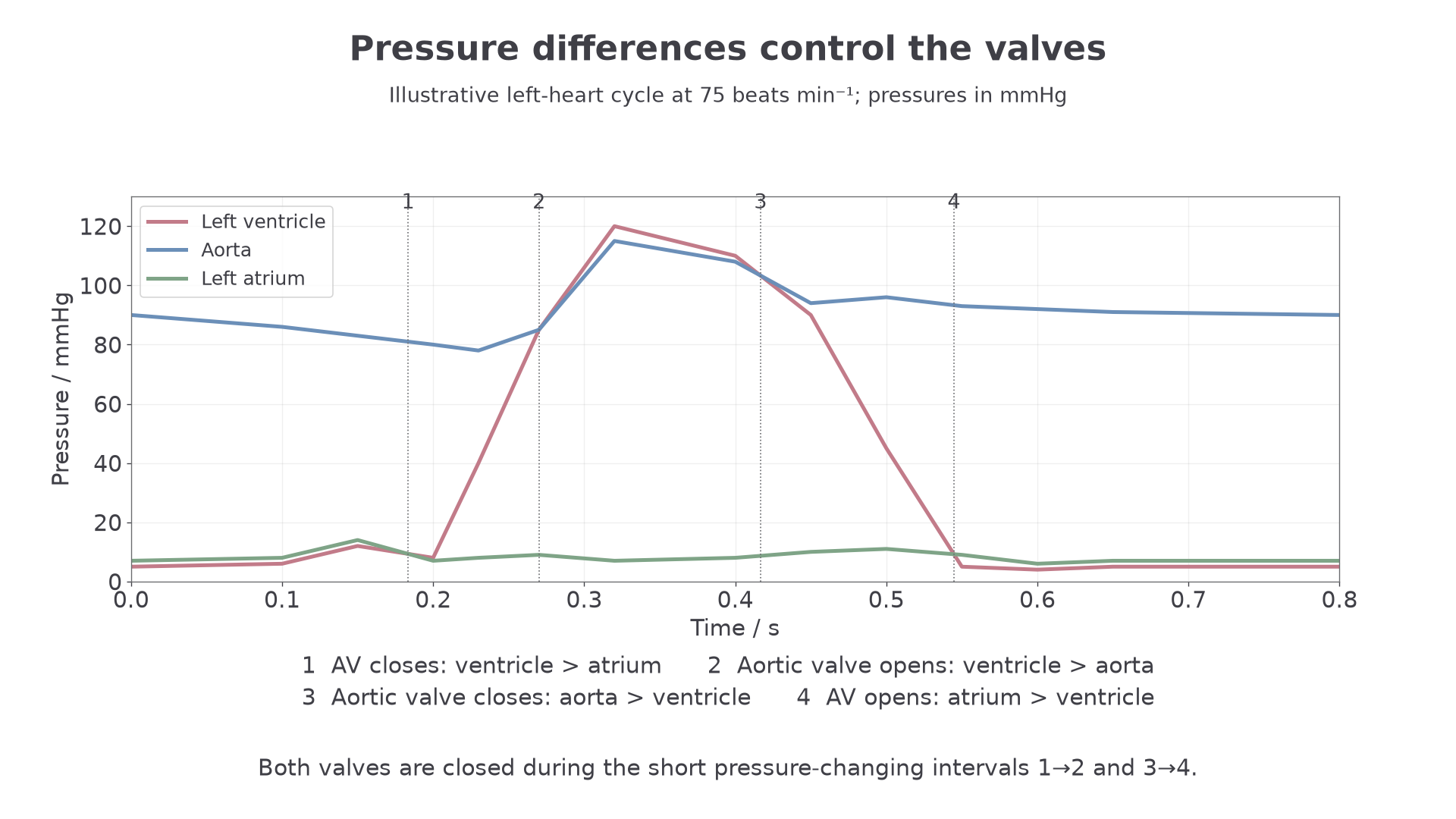
During ventricular filling, atrial pressure is greater than ventricular pressure, so the AV valves are open. When ventricular systole begins, ventricular pressure rises above atrial pressure, so the AV valves close. When ventricular pressure rises above arterial pressure, the semilunar valves open and blood is ejected into the aorta and pulmonary artery. When the ventricles relax, arterial pressure becomes greater than ventricular pressure, so the semilunar valves close and prevent arterial backflow.
[DIAGRAM: cardiac_cycle_pressure_valves: Lesson 062: Cardiac cycle and cardiac output - diagram 01; asset_slug: 062_m03_1_2_cardiac_cycle_and_cardiac_output__diagram_01; recommended_method: drawn_biology; description: Deterministic 16:9 pressure-and-valve schematic showing left atrium, left ventricle and aorta pressure changes through diastole, atrial systole, ventricular systole and early diastole, with AV and semilunar valve states.]
Pressure Changes Through The Heart
The OCR wording asks for pressure changes in the heart and associated vessels. A good way to keep the sequence straight is to follow the left side first, then remember that the right side works in the same sequence at lower pressure.
Blood returns from the pulmonary veins to the left atrium. While the ventricle is relaxed, left atrial pressure is slightly higher than left ventricular pressure, so blood moves through the bicuspid valve into the left ventricle. Atrial systole briefly increases atrial pressure and tops up ventricular volume.
When the left ventricle contracts, its pressure rises steeply. At first, both sets of valves are closed: the bicuspid valve has closed because ventricular pressure is greater than atrial pressure, but the aortic valve has not opened until ventricular pressure exceeds pressure in the aorta. Once left ventricular pressure is greater than aortic pressure, the aortic semilunar valve opens and blood is ejected into the aorta.
As the ventricle relaxes, left ventricular pressure falls below aortic pressure. The aortic valve closes, preventing blood in the aorta from flowing back into the ventricle. When ventricular pressure falls below atrial pressure, the bicuspid valve opens again and ventricular filling restarts.
Continue this lesson.
You’re previewing NovaLearn without an account. Create a free account to read the rest.
Create free account