6.1.2(h)(i)-(ii) - Artificial selection, breeding and ethics
Artificial selection is evolution directed by human choice rather than by the environment alone. In this lesson you will learn how selective breeding works, why it is useful in plants and animals, why genetic resources including wild types matter, and how to make a balanced ethical judgement about extreme breeding.
Human Choice In Selection
Artificial selection is also called selective breeding. It means humans choose which organisms reproduce because those organisms show a desirable heritable characteristic. The chosen parents are bred together, and offspring with the desired characteristic are selected again in the next generation.
Artificial selection
Artificial selection is the human selection of organisms with desired heritable characteristics for breeding, so those characteristics become more common in future generations.
The key word is heritable. A characteristic can be selected only if genetic differences help produce it and it can be passed to offspring. A cow that gives more milk because of its alleles can pass relevant alleles to offspring; a cow that gives more milk only because it was fed better for one season has not passed on the feeding condition.
Artificial selection and natural selection both change populations over generations, but the selecting force is different. In natural selection, environmental selection pressures affect survival and reproductive success. In artificial selection, humans decide which individuals are allowed or encouraged to breed.
Selective breeding does not make organisms mutate because humans need a trait. Breeders work mainly with variation already present in the population, or with variation introduced by crossing with another line or variety.
Selective breeding changes the frequency of existing alleles and combinations. New alleles originate through mutation; selection does not direct useful mutations to occur.
The Selective Breeding Cycle
A selective breeding programme is a repeated cycle. The same logic can be used for crop plants, farm animals, working animals or companion animals.
[DIAGRAM: artificial_selection_cycle_gene_pool: Lesson 148: Artificial selection, selective breeding and ethics - diagram 01; asset_slug: 148_m06_1_2_artificial_selection_selective_breeding_and_ethics__diagram_01; recommended_method: drawn_biology; description: Deterministic 16:9 flow diagram showing existing heritable variation, human selection of parents with desired phenotype, breeding, selecting offspring over generations, increased desired phenotype frequency, and how repeated use of few parents can narrow the gene pool while wild types can supply useful alleles.]
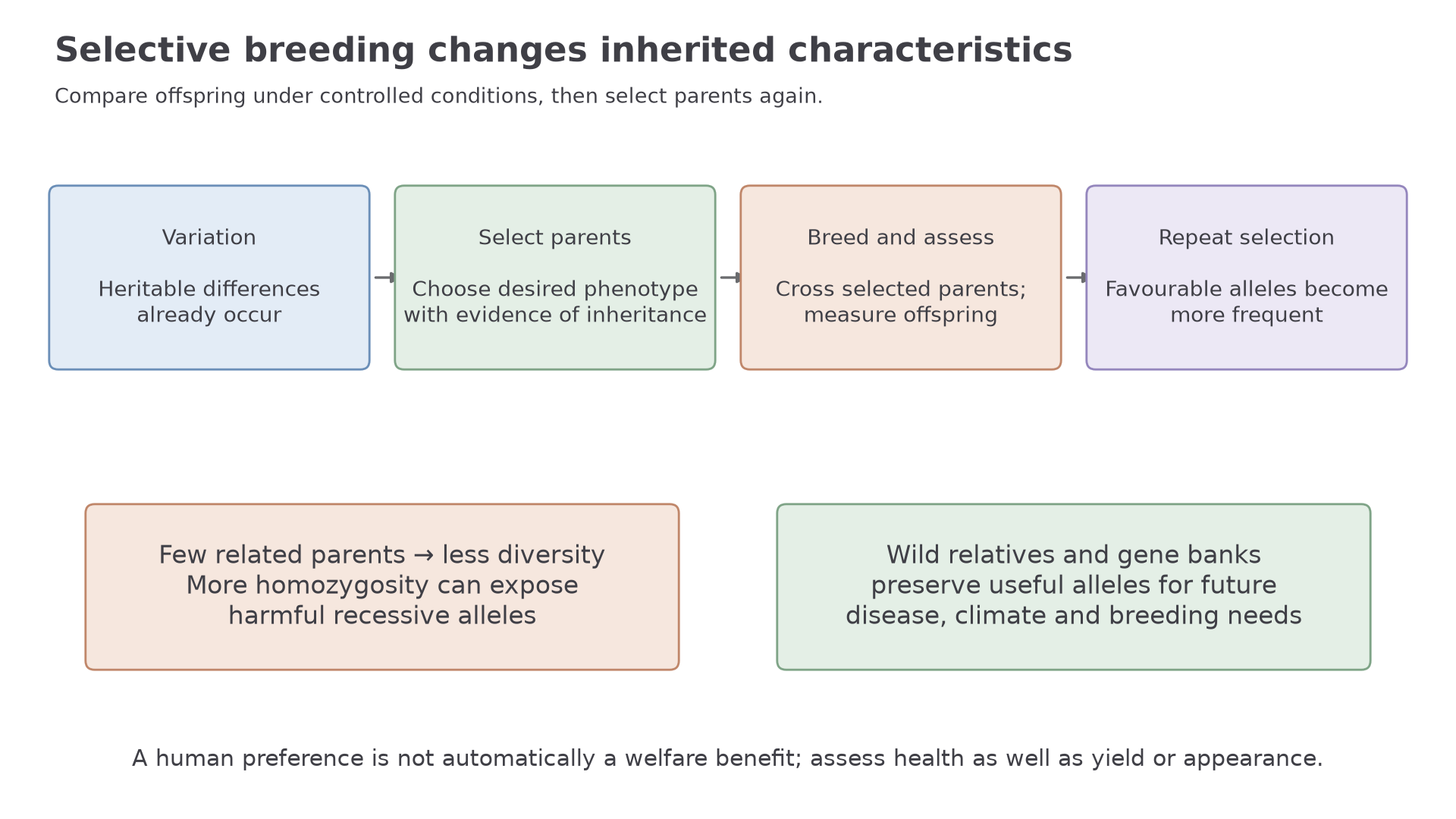
The cycle usually follows this route:
- Identify individuals that show the desired phenotype, such as high yield, disease resistance, docility or a particular body shape.
- Breed those selected individuals together.
- Screen the offspring and keep only those that show the desired characteristic most strongly.
- Breed those offspring in the next generation.
- Repeat for many generations so alleles contributing to the desired phenotype become more common in the selected line.
In plants, controlled pollination can prevent unwanted crosses: remove anthers before they release pollen, transfer pollen from the chosen parent to the stigma, and cover flowers to exclude other pollen. Grow the resulting seeds and compare offspring under the same conditions, with replication, so environmental differences are less likely to be mistaken for inherited improvement. In animals, it may involve choosing mating pairs or using stored gametes from selected individuals. The biological principle is the same: reproductive success is controlled by humans.
Breeding a disease-resistant crop line
A breeder wants wheat plants that are resistant to a fungal disease.
First, the breeder grows many wheat plants and identifies individuals that remain healthy when exposed to the disease under controlled conditions. Those plants are crossed. In the next generation, the breeder grows the offspring and selects the individuals that combine disease resistance with acceptable yield. This is repeated over several generations.
The result is not that the fungus "teaches" the plants to become resistant. The breeder increases the frequency of alleles associated with resistance by repeatedly choosing which plants reproduce.
Uses In Plants And Animals
Humans use artificial selection because it can make domesticated populations more useful for human purposes. The selected characteristic may increase food production, improve crop quality, change animal behaviour, or produce a desired appearance.
| Context | Possible selected characteristic | Why humans may select it |
|---|---|---|
| crop plants | higher yield, larger seeds, sweeter fruits, disease resistance, drought tolerance | more reliable food production or easier farming |
| farm animals | higher milk yield, faster growth, more eggs, leaner meat, calmer temperament | more efficient food production or easier handling |
| working animals | herding behaviour, scent detection, speed or strength | specialised tasks |
| domestic pets | coat type, size, face shape or temperament | appearance, companionship or breed standards |
Continue this lesson.
You’re previewing NovaLearn without an account. Create a free account to read the rest.
Create free account