5.2.1(f) - Uses of triose phosphate and RuBP regeneration
Triose phosphate is the point where photosynthesis becomes useful cell chemistry. In the Calvin cycle, carbon dioxide is fixed and reduced to make TP; in this lesson you will track what that TP can become. The important balance is that some TP is used as a starting material for synthesis, while some TP is recycled to regenerate RuBP so carbon fixation can continue.
TP As A Branch Point
The previous step in photosynthesis produces triose phosphate, usually shortened to TP. A triose is a three-carbon sugar, and the phosphate group shows that the molecule is phosphorylated. Glyceraldehyde 3-phosphate, G3P, is one triose phosphate; use the specification term TP for this overview.
Triose Phosphate
Triose phosphate is a three-carbon phosphorylated sugar produced in the light-independent stage of photosynthesis and used as a starting material for synthesis or recycled to regenerate RuBP.
Think of TP as a branch point rather than as the final product of photosynthesis. Once TP has been made, a plant cell can use its fixed carbon in several ways:
- to synthesise carbohydrates
- to synthesise lipids
- to synthesise amino acids
- to regenerate RuBP
[DIAGRAM: tp_branch_point: Lesson 126: Uses of triose phosphate and RuBP regeneration - diagram 01; asset_slug: 126_m05_2_1_uses_of_triose_phosphate_and_rubp_regeneration__diagram_01; recommended_method: drawn_biology; description: A deterministic 16:9 branch-point diagram with TP in the centre and arrows to carbohydrate synthesis, lipid synthesis, amino acid synthesis and recycling to regenerate RuBP.]
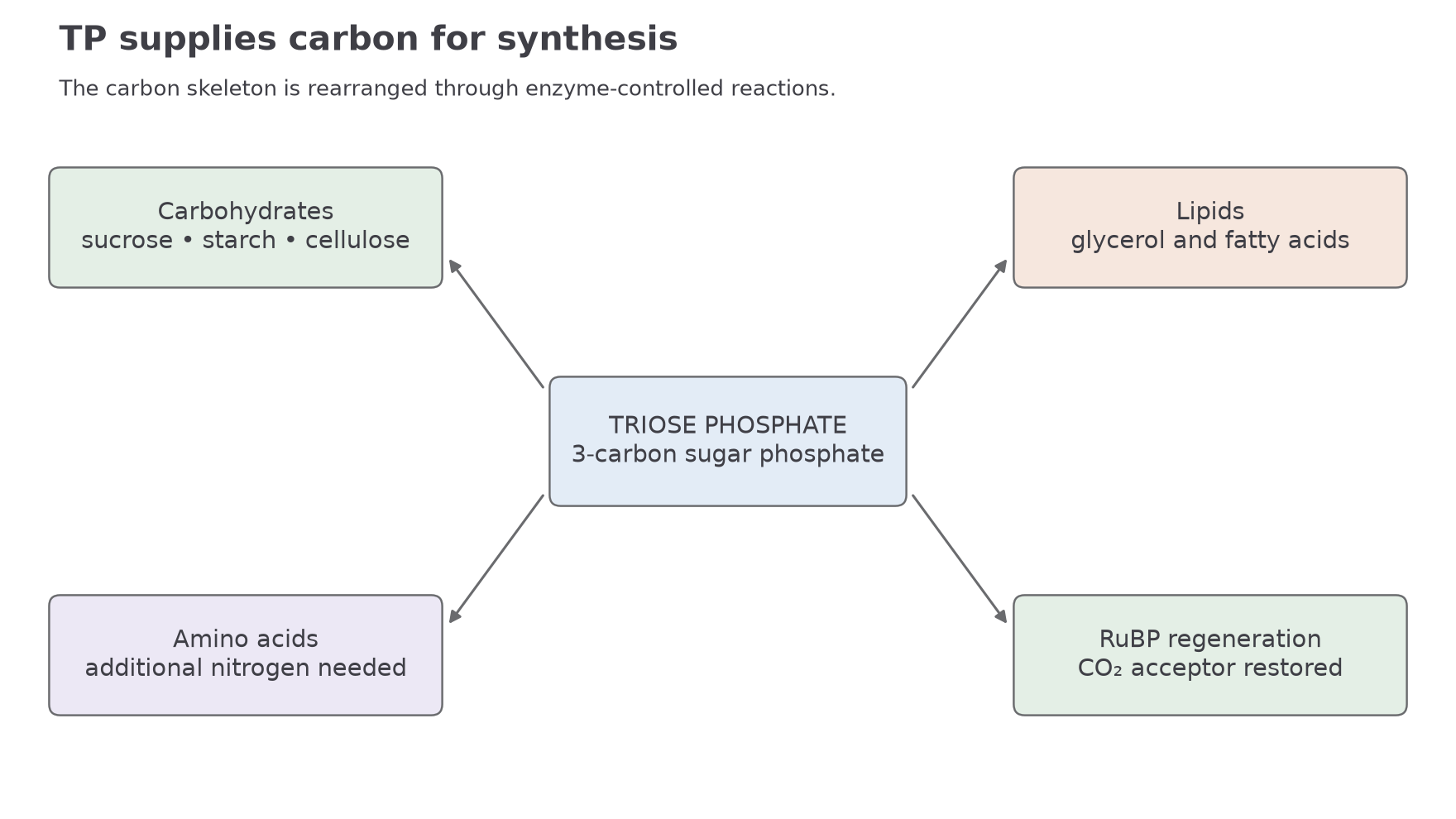
The word synthesis matters. TP is not just "used up"; its carbon atoms are built into other organic molecules or rearranged to keep the Calvin cycle supplied with RuBP.
Biosynthesis From TP
TP carries fixed carbon from carbon dioxide in a reactive, usable form. Cells can rearrange and combine these carbon skeletons to make larger biological molecules.
| Product group | How TP contributes | Examples of useful products |
|---|---|---|
| Carbohydrates | TP molecules can be converted into sugar phosphates and then into larger carbohydrates | glucose, sucrose, starch, cellulose |
| Lipids | Carbon from TP can contribute to glycerol and fatty acid synthesis | membrane lipids, plant oils |
| Amino acids | Carbon skeletons from TP and related intermediates can combine with nitrogen-containing groups | amino acids used to build proteins |
This is why photosynthesis is not only about making "glucose". Glucose is a useful simplified summary product, but plant cells need many organic molecules. TP provides fixed carbon that can be directed into storage, transport, cell walls, membranes, enzymes and other proteins.
From fixed carbon to plant tissues
A growing leaf needs cellulose for cell walls, phospholipids for new membranes and proteins for enzymes. TP supplies carbon for all three, but different routes and additional elements are needed. Carbon skeletons can be converted to sugars for cellulose or to glycerol and fatty acids for lipids. Nitrogen absorbed as nitrate or ammonium is needed to make amino acids. Carbon fixation alone cannot supply that nitrogen.
Continue this lesson.
You’re previewing NovaLearn without an account. Create a free account to read the rest.
Create free account