4.1.1(c)-(d) - Plant defences and primary animal defences
Pathogens only cause disease if they enter living tissue, survive there, and spread far enough to damage the organism. In this lesson you will learn how plants limit pathogen spread and how animals use primary non-specific defences before a pathogen-specific immune response is needed. The main skill is causal explanation: name the defence, describe what it does, and link that action to reduced pathogen entry or spread.
Primary non-specific defence
A defence is primary if it acts at, or very close to, the point where a pathogen first tries to enter or spread. It is non-specific if it acts against many possible pathogens rather than recognising one named antigen.
Primary non-specific defence
A broad defence that helps prevent pathogens entering or spreading before a pathogen-specific immune response is needed.
That idea matters because plant and animal defences look very different, but they solve similar problems. A plant cell cannot move away from an infection and plants do not have circulating phagocytes like animals. Instead, a plant can make antimicrobial or toxic chemicals and can isolate infected tissue. An animal can use intact surfaces, mucus, reflexes, clotting, wound repair and inflammation to reduce entry and spread.
The useful exam chain is:
| Problem caused by pathogen | Defence logic |
|---|---|
| Pathogen has not entered yet | keep it outside with a surface barrier |
| Pathogen is on an exposed surface | trap it or remove it |
| Pathogen enters through a wound | seal the wound and begin repair |
| Pathogen is inside plant tissue | produce chemicals and isolate the infected region |
Keep this lesson separate from the later immune-response lessons. Phagocytosis, B cells, T cells, antibodies, clonal selection and immune memory are not the focus here.
Plant chemical defences
Plants recognise molecules associated with pathogens and can increase production of antimicrobial substances near an infection. Some chemicals disrupt pathogen membranes; others inhibit enzymes or growth. Local production concentrates defence where it is needed rather than exposing every healthy cell to the same high concentration.
Antimicrobial chemicals are one layer of defence. A waxy cuticle and cell walls reduce entry before infection; induced chemicals act on pathogens that reach tissues. Killing or inhibiting the pathogen reduces its reproduction and the number of cells it can colonise.
Plant spread-limiting responses
If a pathogen has already entered plant tissue, stopping spread can be as important as killing the pathogen. Callose deposition is one such response.
Callose
A beta-1,3-glucan polysaccharide that can be deposited by plants at cell walls and plasmodesmata during defence responses.
Plasmodesmata are tiny channels between neighbouring plant cells. They normally allow substances to pass from cell to cell. During a pathogen attack, callose can be deposited around plasmodesmata and at the cell wall near the attack site. This narrows or blocks routes between cells and can strengthen the wall locally, so pathogens or pathogen material are less able to move into neighbouring cells.
[DIAGRAM: plant_defence_isolation: Lesson 072: Plant defences and primary animal defences - diagram 01; asset_slug: 072_m04_1_1_plant_defences_and_primary_animal_defences__diagram_01; recommended_method: drawn_biology; description: 16:9 deterministic schematic of adjacent plant cells showing an infected cell, callose plugs at plasmodesmata, local chemical production and tissue isolation responses that limit pathogen spread.]
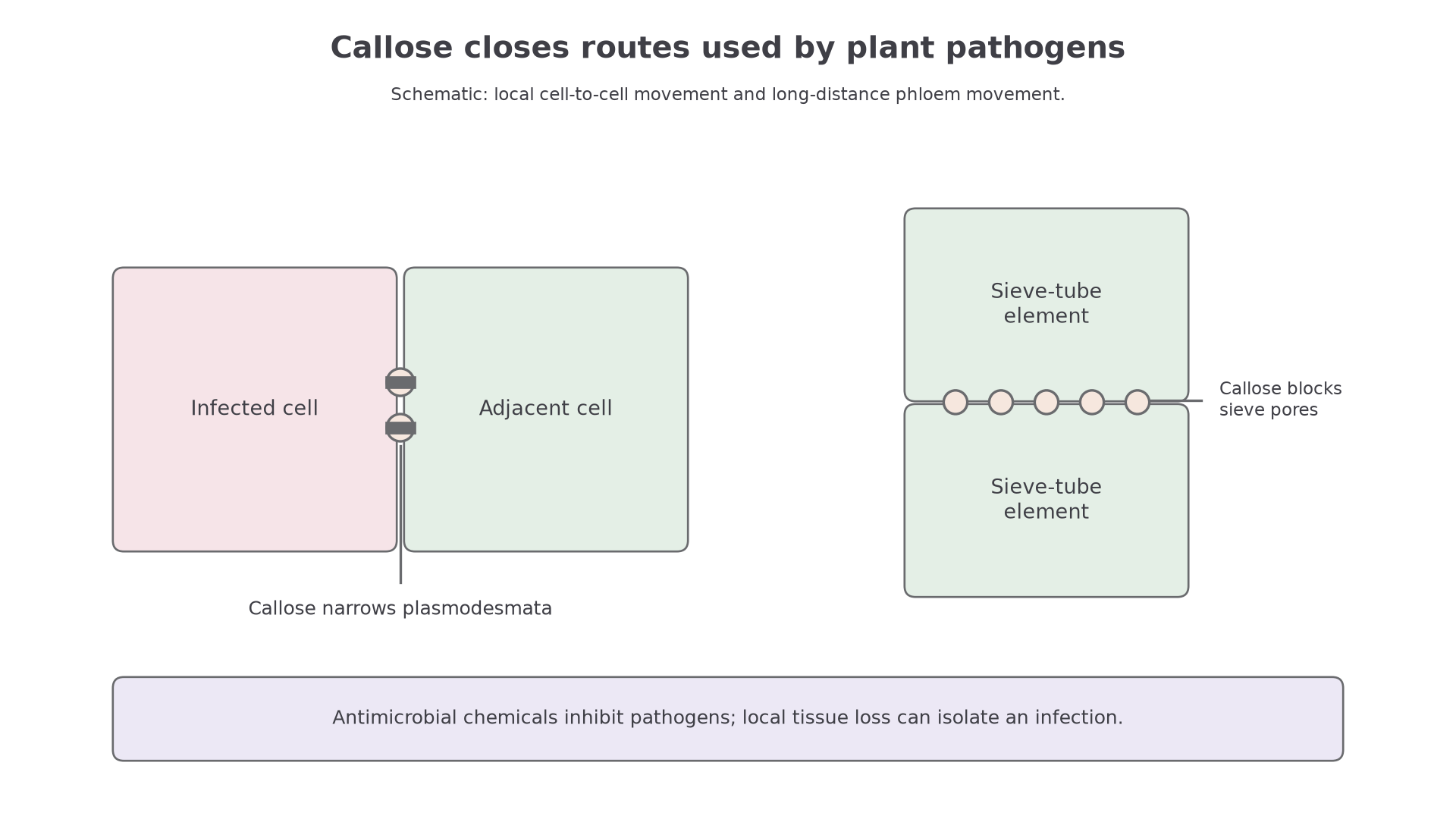
Callose is not the only spread-limiting response. Local cell death, often described as necrosis or a hypersensitive response, can deprive a pathogen of living tissue and isolate the infection. Leaf abscission can remove infected tissue from the rest of the plant. Lignin deposition or tyloses may also be credited in suitable contexts when they are clearly linked to blocking pathogen spread.
This response is local: surrounding healthy tissue survives while the infected region is isolated.
Callose can also block sieve pores, the small openings in the sieve plates between phloem sieve-tube elements. Closing these openings restricts movement along the phloem, reducing spread to distant regions. This differs from blocking plasmodesmata, which restricts movement between adjacent cells. A sieve plate is the perforated end wall; the pores are its openings.
Local cell death is especially effective against pathogens that require living host cells. It is not a universal solution: a pathogen that feeds on dead tissue may benefit from tissue death. Defence effectiveness depends on the pathogen's biology.
Continue this lesson.
You’re previewing NovaLearn without an account. Create a free account to read the rest.
Create free account