6.1.3(g) - Ethical issues in genetic manipulation
Genetic manipulation can change the characteristics of animals, humans, plants and microorganisms, so the biology quickly becomes a question about who benefits, who might be harmed, and who controls the technology. In this lesson you will learn how to discuss both positive and negative ethical issues using examples: insect-resistant genetically modified soya, pharming, genetically modified pathogens for research, and patenting or technology transfer. The goal is not to memorise a single opinion, but to build a balanced biological argument from evidence, risk, benefit and fairness.
Benefits, harms and affected groups
An ethical issue is a question about whether an action is right, acceptable or responsible when it affects humans, other organisms or the environment. In genetic manipulation, the same biological technique can raise different ethical issues depending on the organism, the aim and the safeguards.
Genetic manipulation
The deliberate alteration of an organism's genetic material to change a characteristic or produce a useful product.
An ethical decision connects the biological outcome to the people and organisms affected:
| Point to consider | What it asks | Example of precise wording |
|---|---|---|
| intended benefit | What good outcome is the manipulation meant to produce? | increased crop yield, reduced disease, production of a medicine |
| possible harm | What could be damaged or put at risk? | animal welfare, human safety, biodiversity, farm income |
| affected groups | Who or what experiences the benefit or risk? | patients, farmers, consumers, future children, wild organisms |
| safeguards | What could reduce the risk or make access fairer? | regulation, containment, monitoring, technology transfer |
[DIAGRAM: ethical_decision_grid: Lesson 154: Ethical issues in genetic manipulation - diagram 01; asset_slug: 154_m06_1_3_ethical_issues_in_genetic_manipulation__diagram_01; recommended_method: drawn_biology; description: 16:9 NovaLearn-style decision grid comparing humans, pharmed animals, insect-resistant GM soya and GM pathogens across intended benefit, possible harm, affected groups and safeguards.]
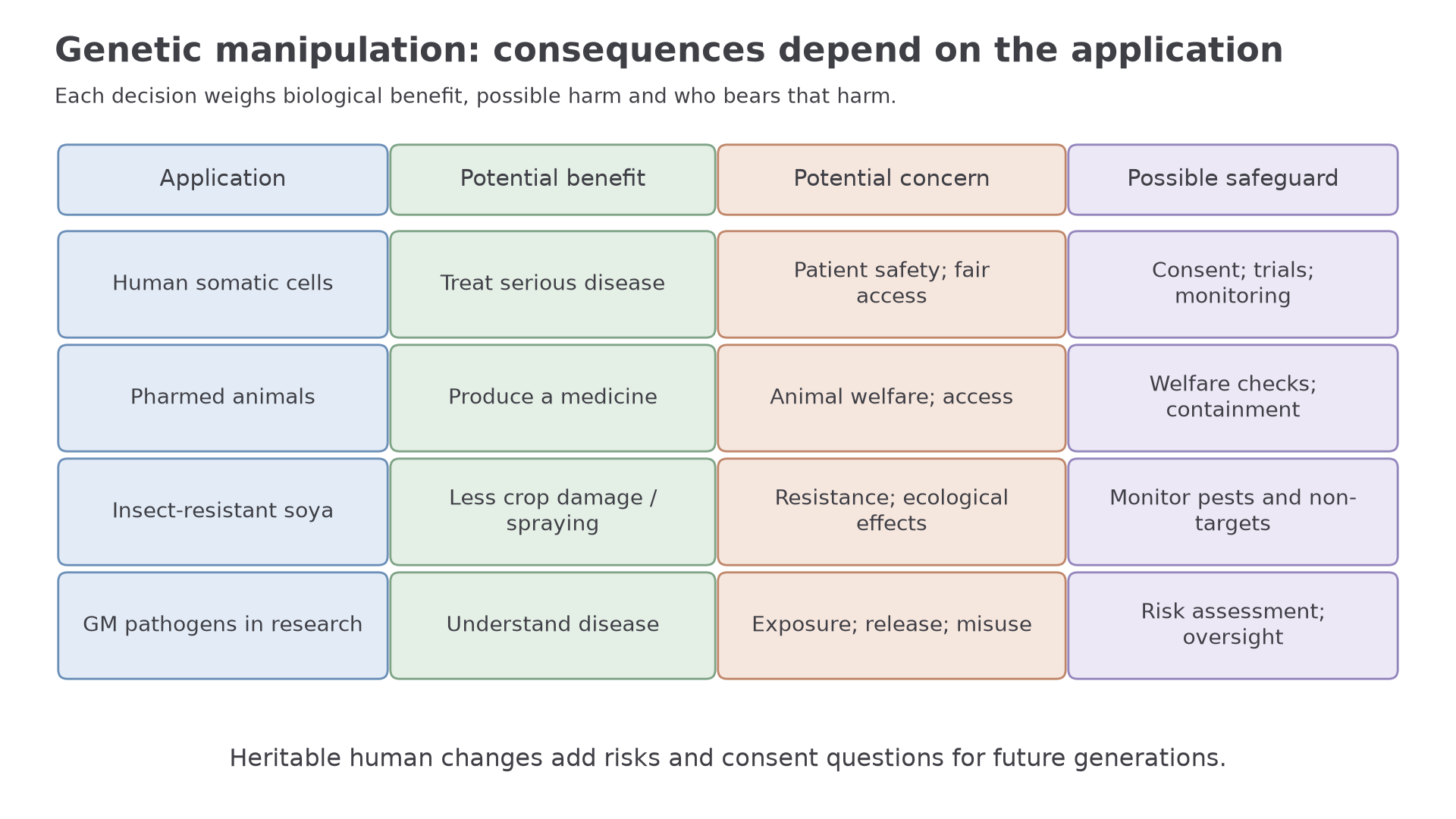
A modified plant, a modified pathogen and a modified human embryo have different possible consequences. A crop can affect food webs beyond the field; an altered human germ line can affect future generations. The fact that both involve DNA does not make their risks or benefits equivalent.
When a question asks about ethical issues, give both sides where possible. Link each side to a specific consequence, such as reduced insecticide use, animal welfare, accidental pathogen release, or unequal access to seed.
Animals and humans
Genetically manipulated animals can be used to produce useful human products. In pharming, an animal is genetically modified so that it produces a pharmaceutical protein, often in a fluid such as milk. The drug can then be purified and used for medicine. Milk can be collected repeatedly during lactation using less invasive methods than repeated blood sampling. This can provide substantial volumes while reducing collection-related harm; it does not guarantee that the modification or husbandry is harmless, and the protein still requires purification and safety checks.
Pharming
The use of genetically modified animals or plants to produce pharmaceutical products.
The positive ethical argument is that pharming may produce useful proteins in large amounts and help patients who need medicines that are difficult or expensive to make in other ways. If the product treats disease or prevents serious complications, the benefit is not just commercial; it can improve human health.
The negative ethical argument is that the animal is being used as a production system. This raises questions about welfare, the number of animals created, whether animals suffer from the genetic modification, and whether they are kept only because they are useful to humans. There are also containment and ownership questions: a modified animal line may be patented, expensive or controlled by a company.
Humans add a different ethical layer. Genetic manipulation of human cells may be considered for preventing or treating disease, but it also raises concerns about consent, safety, fairness and effects on future generations. A change to a body cell affects the treated person. A heritable change in gametes or an early embryo could affect future children who cannot consent.
For a consenting adult receiving a somatic treatment, direct benefits and risks primarily concern that patient. Heritable changes introduce an additional responsibility because future people cannot agree to the intervention, and an unexpected effect could persist across generations.
| Application | Possible positive issue | Possible negative issue |
|---|---|---|
| pharming in animals | produces medicines for patients | animal welfare and treating animals as tools |
| manipulation of human body cells | may treat or prevent serious disease | safety, cost and unequal access |
| heritable human alteration | could reduce inherited disease in future generations | future person cannot consent; risk of social inequality or non-medical enhancement |
Plants and seed access
One plant example is insect resistance in genetically modified soya. A gene can be inserted so that the soya plant produces a protein that affects target insect pests. This can reduce insect damage to the crop and may reduce the need for spraying some insecticides.
The positive ethical case for insect-resistant GM soya is strongest when it connects biology to people and environment:
- less crop damage can increase harvestable yield;
- reduced use of some insecticides may reduce harm to farm workers and non-target organisms;
- more reliable production may support food or animal-feed supply.
The negative case is about uncertainty, control and ecological consequences:
- target insects may evolve resistance if the crop is used poorly or without resistance management;
- non-target organisms and food webs must be monitored rather than assumed safe;
- farmers may become dependent on bought seed or licensing agreements;
- consumers may want clear information about how food or feed is produced.
Resistance evolves through natural selection: insects differ genetically, resistant individuals survive the crop protein more often, and their offspring inherit resistance alleles. Repeated widespread exposure can increase the frequency of those alleles. Resistance management, such as refuges of non-resistant crops, aims to slow this process.
Continue this lesson.
You’re previewing NovaLearn without an account. Create a free account to read the rest.
Create free account