5.1.3(b) - Sensory, relay and motor neurones
Neurones are specialised cells that carry nerve impulses so an animal can detect a change, process information and produce a response. In this lesson you will learn how sensory, relay and motor neurones differ in structure and function, and why myelin changes the speed of impulse transmission. The focus is the neurone types themselves; the detailed ion movements of action potentials and the chemistry of synapses come in later lessons.
The Route Of A Nerve Impulse
A nerve impulse is an electrical event that travels along a neurone. In a coordinated response, impulses usually move through a route rather than through one isolated cell.
Neurone
A neurone is a specialised nerve cell adapted to transmit nerve impulses.
The basic route is:
- A receptor detects a stimulus.
- A sensory neurone carries impulses from the receptor towards the central nervous system.
- A relay neurone passes impulses within the central nervous system.
- A motor neurone carries impulses from the central nervous system to an effector.
- An effector, such as a muscle or gland, produces a response.
The central nervous system, or CNS, is the brain and spinal cord. Sensory and motor neurones link the CNS with the rest of the body. Relay neurones are different because they are found within the CNS and connect neurones to each other.
A sensory receptor may be a separate specialised cell or a specialised ending of a sensory neurone. Distinguish detection at the receptor region from transmission along the sensory neurone.
Use the direction carefully. Sensory neurones do not "make the response"; they carry information inwards from receptors. Motor neurones do not detect the stimulus; they carry impulses outwards to effectors.
Three Neurone Types
The names sensory, relay and motor describe function, but each function is supported by structure. A neurone has a cell body containing the nucleus, cytoplasmic extensions that receive or carry impulses, and terminal regions that connect with another cell.
[DIAGRAM: neurone_type_comparison: Lesson 103: Sensory, relay and motor neurones - diagram 01; asset_slug: 103_m05_1_3_sensory_relay_and_motor_neurones__diagram_01; recommended_method: drawn_biology; description: Deterministic comparison diagram showing sensory, relay and motor neurones with direction of impulse, cell body position, dendron or dendrites, axon and receptor/CNS/effector context.]
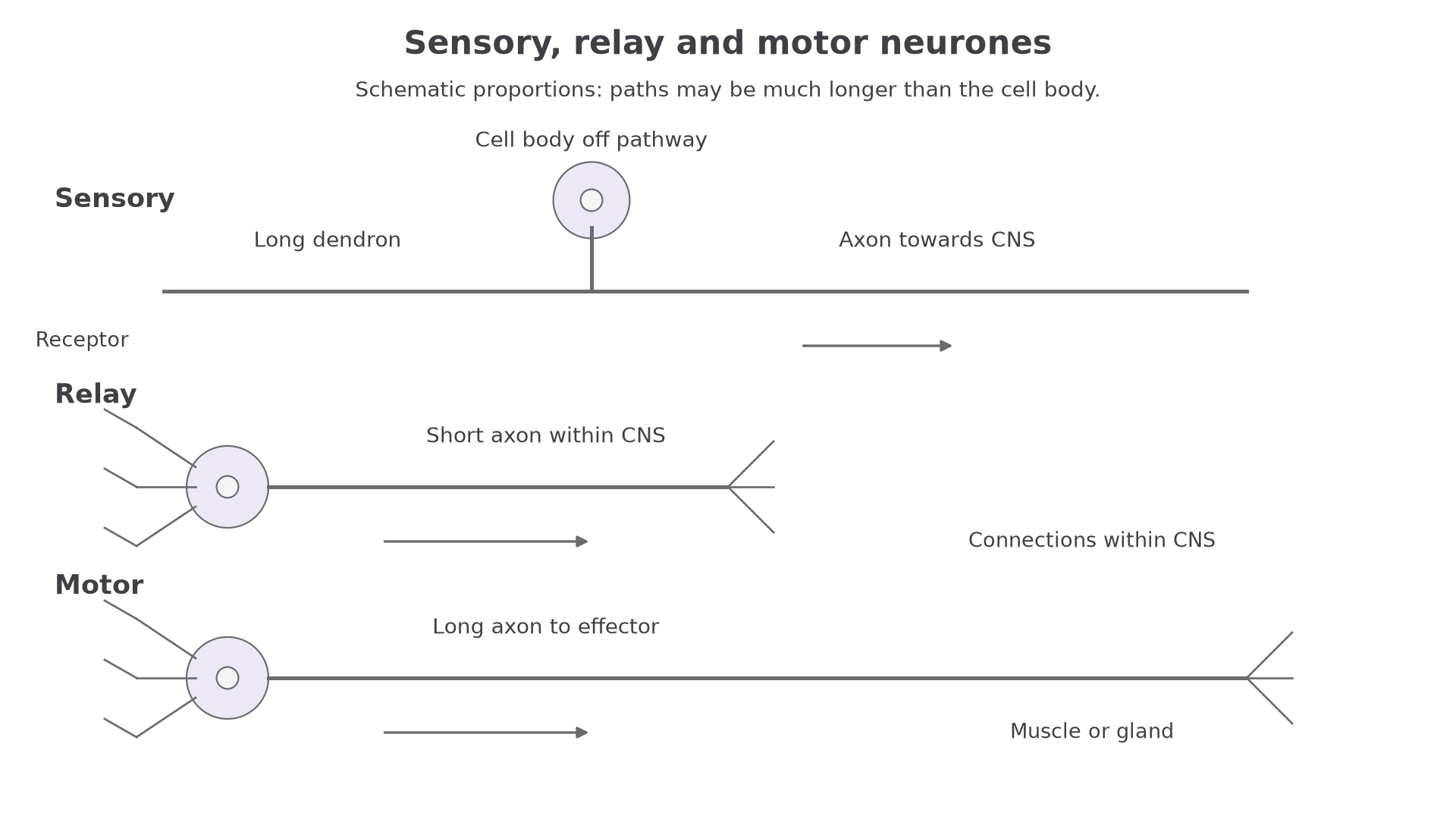
| Neurone type | Main function | Key structural features |
|---|---|---|
| Sensory neurone | Carries impulses from a receptor towards the CNS. | Long dendron from receptor region towards the cell body; cell body often lies off the main pathway; axon carries impulses into the CNS. |
| Relay neurone | Carries impulses between neurones within the CNS. | Usually many short dendrites and a relatively short axon; located in the brain or spinal cord. |
| Motor neurone | Carries impulses from the CNS to an effector. | Cell body at one end in the CNS; many dendrites; long axon carries impulses to a muscle or gland. |
Dendron and dendrite
A dendron is a long cytoplasmic extension that carries impulses towards the cell body. Dendrites are shorter branched extensions that carry impulses towards the cell body.
The sensory neurone is adapted for carrying impulses from a receptor over distance. Its cell body is not usually at the receiving end; it is positioned part-way along the route, commonly off to the side. This helps explain why a sensory neurone is often drawn with a long dendron leading from the receptor and an axon leading into the CNS.
The relay neurone is adapted for connection inside the CNS. Its short branches allow it to receive impulses from one neurone and pass impulses to another. In a simple pathway, this means a relay neurone can connect a sensory neurone to a motor neurone.
The motor neurone is adapted for output. Its cell body is in the CNS, where it can receive input from relay neurones. Its long axon carries the impulse away from the CNS to an effector, such as muscle tissue.
Continue this lesson.
You’re previewing NovaLearn without an account. Create a free account to read the rest.
Create free account