3.1.3(d) - Water movement through plants
Water does not drift randomly through a plant. It follows a connected route from soil, into root cells, across root tissue, up the xylem, across the leaf and finally into the air surrounding the leaf. In this lesson, you will learn the two named tissue pathways OCR requires, and the mechanism that makes water move upwards without a heart-like pump.
The Whole-Plant Water Gradient
The safest way to think about water movement is to follow water potential. Water moves from a region of higher water potential to a region of lower water potential. In plant cells and tissues, "higher" often means less negative, and "lower" often means more negative.
Water potential
Water potential is the tendency of water molecules to move from one region to another. Water moves down a water-potential gradient, from higher water potential to lower water potential.
At the start of the pathway, soil water usually has a higher water potential than the contents of root hair cells. Water therefore enters root hair cells by osmosis, because it crosses a partially permeable cell surface membrane. From there, water continues across the root and into the xylem because each next region has a lower water potential.
At the end of the pathway, water leaves the leaf. Evaporation from wet mesophyll cell walls and diffusion of water vapour through stomata help keep the water potential of the leaf air spaces and surrounding air low. This maintains the gradient from root to leaf.
The direction of water movement is not "up because plants need water"; it is from higher water potential towards lower water potential.
For example, water moves from soil at −0.10 MPa towards root cells at −0.30 MPa. Dissolved salt can lower soil water potential enough to reduce or reverse this gradient, so wet soil need not supply water effectively.
Apoplast And Symplast Pathways
Once water has entered the root, it can move across the cortex by two OCR-required pathways: the apoplast pathway and the symplast pathway. These are routes through tissue, not two different kinds of water.
Apoplast pathway
The apoplast pathway is movement through cell walls and intercellular spaces, outside the cell surface membranes.
That means apoplast movement stays outside cell membranes until the route is forced inward.
Symplast pathway
The symplast pathway is movement through the cytoplasm of living cells, connected from cell to cell by plasmodesmata.
In the apoplast pathway, water does not cross cell surface membranes as it moves through the cell walls. This is a low-resistance route across much of the cortex. In the symplast pathway, water has crossed a cell surface membrane and then moves through cytoplasm from one cell to the next through plasmodesmata. After initial membrane entry, movement through plasmodesmata connects neighbouring cytoplasm without repeatedly crossing cell surface membranes. The driving force remains a water-potential gradient; osmosis specifically describes water crossing a partially permeable membrane.
[DIAGRAM: root_pathways: Lesson 068: Water movement through plants - diagram 01; asset_slug: 068_m03_1_3_water_movement_through_plants__diagram_01; recommended_method: drawn_biology; description: Monochrome root cortex pathway diagram showing soil water entering a root hair, apoplast movement through cell walls, symplast movement through cytoplasm and plasmodesmata, endodermis forcing water into living cells, and entry to xylem.]
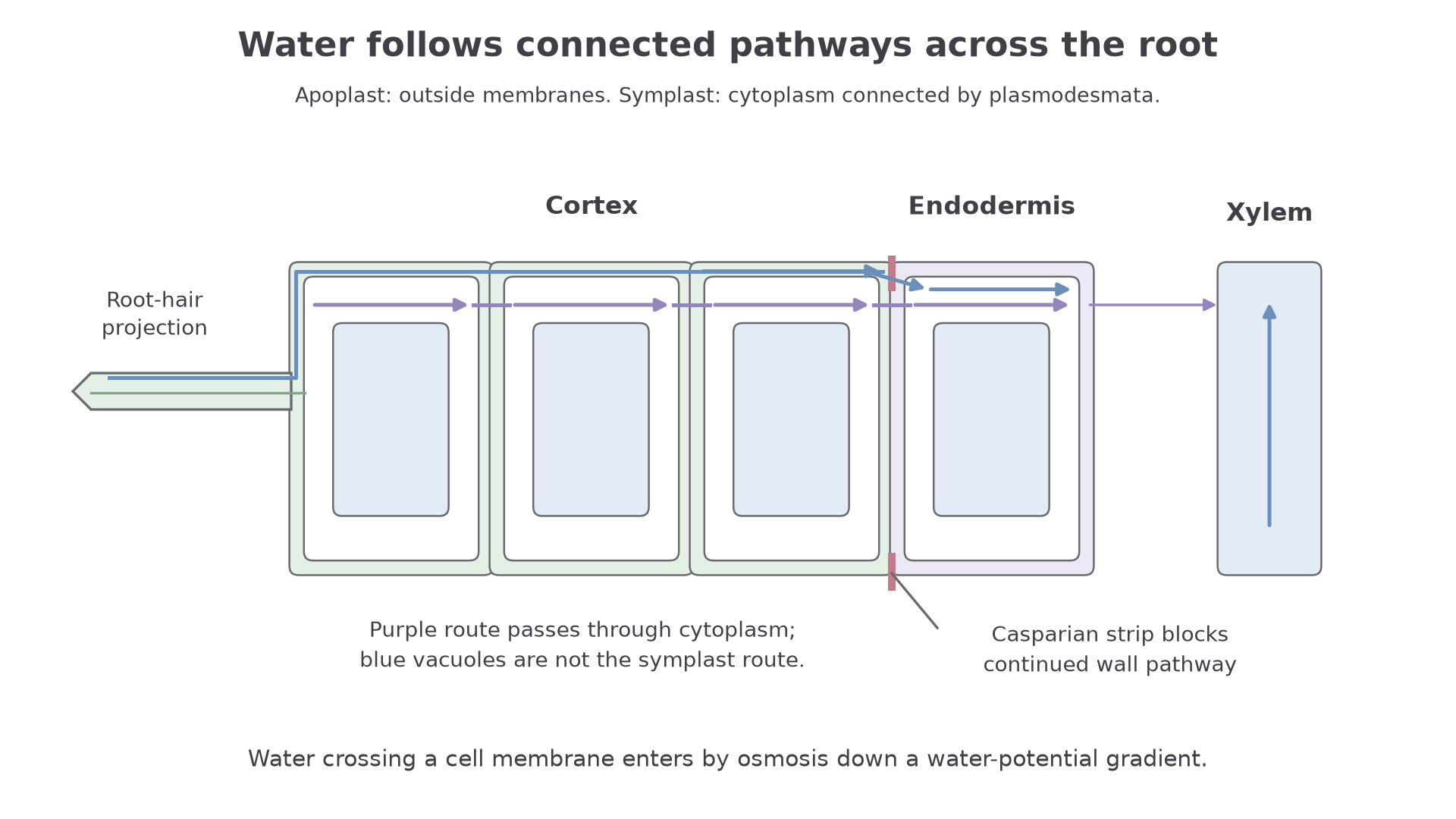
A useful root detail is the endodermis. The Casparian strip, a waterproof band containing suberin in endodermal cell walls, blocks continued apoplast flow, so water that has been travelling in cell walls must enter living cells before reaching the xylem. Crossing an endodermal cell membrane allows selective control of mineral-ion entry before water reaches the xylem.
If an answer says water moves "through cells", be more precise. OCR can distinguish movement through cytoplasm by the symplast pathway from movement through cell walls by the apoplast pathway.
Now identify the route from its defining feature.
Continue this lesson.
You’re previewing NovaLearn without an account. Create a free account to read the rest.
Create free account