4.2.2(h) - Natural selection changing population characteristics
Natural selection is one mechanism that can make a population look different over time. In this lesson you will learn the causal sequence: genetic variation, selection pressure, reproductive success or failure, and an increased proportion of individuals with advantageous characteristics. You will also practise using percentages to describe that change without slipping into common misleading wording.
Variation Is The Starting Point
For selection to produce inherited change over generations, individuals must differ genetically in ways that affect reproductive success. A population is a group of organisms of the same species living in the same area at the same time. Within that population, some individuals may possess a characteristic that gives them an advantage in a particular environment.
Genetic variation
Genetic variation is heritable difference between individuals caused by differences in genetic information.
The word heritable matters. If a plant is taller only because it grew in a nutrient-rich patch of soil, that extra height may not be passed to its offspring. If some plants are genetically more able to grow deeper roots, that characteristic can be inherited. Natural selection changes populations over generations only when the advantageous characteristic has a genetic basis.
An advantageous characteristic is not always the same in every environment. A shell colour that helps a snail avoid predators on pale rock may be less useful on dark soil. A trait is advantageous only relative to the selection pressure acting at the time.
Selection pressure
A selection pressure is an environmental factor that affects an organism's chance of surviving and reproducing.
Examples of selection pressures include predation, competition, disease, temperature, drought and availability of food. You do not need to memorise a special example for this specification point; you need to explain the mechanism clearly in any suitable context.
The Selection Mechanism
Natural selection is not a single event. It is a sequence of cause and effect that happens across generations.
[DIAGRAM: natural_selection_mechanism: Lesson 091: Natural selection changing population characteristics - diagram 01; asset_slug: 091_m04_2_2_natural_selection_changing_population_characteristics__diagram_01; recommended_method: drawn_biology; description: Deterministic 16:9 flow diagram showing genetic variation, selection pressure, differential survival, reproductive success, inheritance and increased population proportion.]
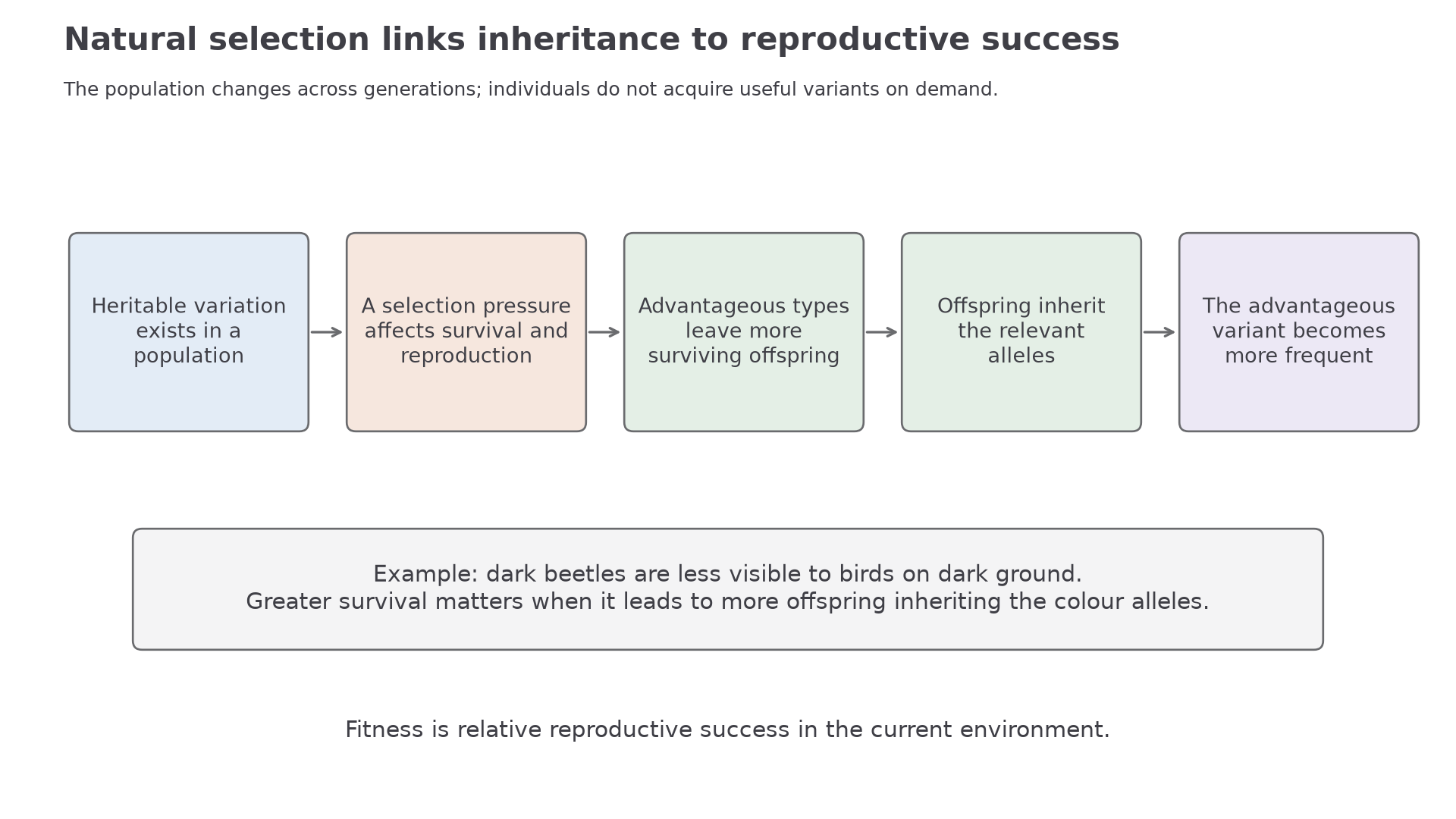
First, genetic variation exists. Some individuals possess a characteristic that is advantageous under the current selection pressure. For example, in a model population of ground beetles, some beetles may be genetically darker than others. If the ground becomes darker after repeated fires, darker beetles may be less visible to predators.
Second, there is differential survival. Differential means "different between individuals". The individuals with the advantageous characteristic are more likely to survive long enough to reproduce. Individuals without the characteristic are more likely to die before reproducing, or may produce fewer offspring.
Third, there is differential reproductive success: survival alone does not change the next generation unless it affects reproduction. An individual that survives but produces no offspring does not pass its genetic information into the next generation.
Reproductive success
Reproductive success is the ability of an organism to produce offspring that survive, so its genetic information is passed on.
Fourth, the offspring inherit the genetic information for the advantageous characteristic more often. After several generations, a larger proportion of the population possesses that characteristic. The population has changed, even though no individual organism changed because it "needed" to.
Natural selection changes the proportion of characteristics in a population over generations; it does not make one organism deliberately change during its lifetime.
Proportions Over Generations
Ratios, fractions and percentages describe how common a characteristic is in a population. The key is to compare proportions, not just raw numbers.
In the model population below, the advantageous characteristic becomes more common over four generations. The total population is treated as 100% each time, so the graph focuses on the relative proportion possessing the characteristic.
[DIAGRAM: advantageous_characteristic_proportion_graph: Lesson 091: Natural selection changing population characteristics - diagram 02; asset_slug: 091_m04_2_2_natural_selection_changing_population_characteristics__diagram_02; recommended_method: drawn_biology; description: Deterministic 16:9 stacked percentage bar graph showing an advantageous characteristic increasing from 20% to 70% of a population over four generations.]
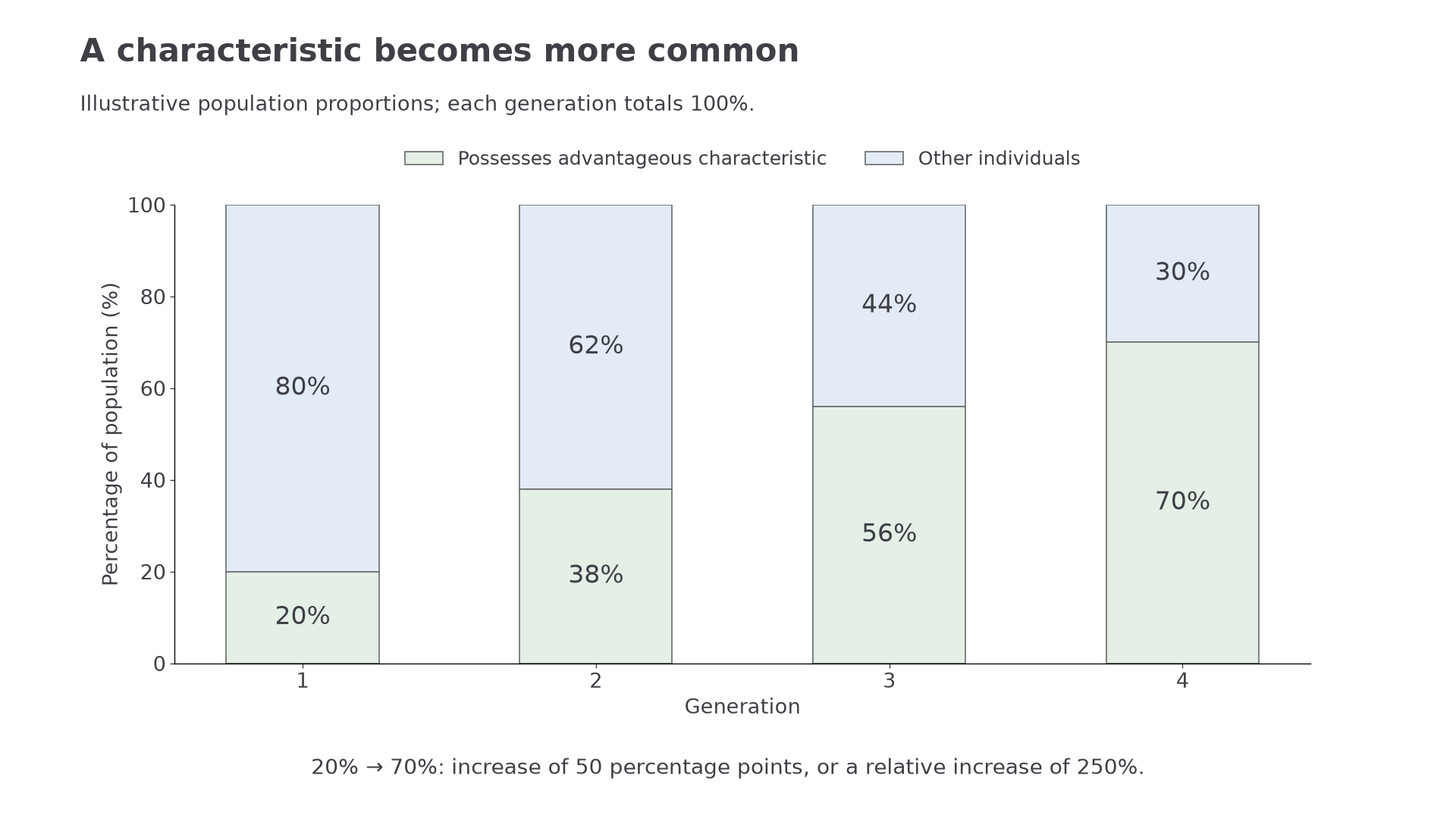
Suppose a selection pressure favours a heritable characteristic in a population. In generation 1, 24 out of 120 individuals possess it. In generation 4, 91 out of 130 possess it.
Percentage of a population
Apply the formula to the two generations.
Continue this lesson.
You’re previewing NovaLearn without an account. Create a free account to read the rest.
Create free account