5.1.5(k) - Hormonal and nervous control of heart rate
Your heart is myogenic, so each normal beat begins within the heart itself. The rate of those beats is still adjustable: hormones and autonomic nerves can make the sino-atrial node start waves of excitation more often or less often. In this lesson, you will connect the biology of heart-rate control to practical pulse-rate measurements, sensor data and safe investigation design.
The Pacemaker Target
Heart rate is the number of heart beats per minute. This can be written as beats min⁻¹ or “bpm”. A resting value might be around 70 bpm, but the exact value varies between people and with fitness, stress, recent activity, caffeine intake and health.
The heart does not need a nerve impulse from the brain to start each beat. Cardiac muscle is myogenic: the stimulus for contraction originates in the heart. The key target for heart-rate control is the sino-atrial node, or SAN, a region of specialised tissue in the wall of the right atrium.
Sino-atrial node
The sino-atrial node, or SAN, is the heart's natural pacemaker because it initiates the wave of excitation that spreads across the atria and starts each normal heartbeat.
Hormones and nerves do not usually replace the SAN. They alter how often the SAN starts a wave of excitation. If the SAN generates waves more frequently, the heart beats faster. If it generates waves less frequently, the heart beats more slowly.
This matters during exercise. Active skeletal muscles need more oxygen and respiratory substrate for respiration, and carbon dioxide must be removed. Increasing heart rate helps increase blood flow, so useful substances reach muscles faster and waste products are removed faster.
Avoid writing that nerves "make the heart beat" as if the heart is not myogenic. More precisely: nerves or hormones change the rate at which the SAN generates waves of excitation.
Use the pacemaker distinction in the check below.
Hormonal Effects
The main hormone to know here is adrenaline. Adrenaline is released from the adrenal medulla during fight-or-flight responses, stress and intense activity. It travels in the blood, so it can reach many target tissues at the same time.
The SAN has receptors that can respond to adrenaline. When adrenaline acts on the SAN, the SAN generates waves of excitation more frequently. Heart rate increases. This helps prepare the body for action because blood circulates more quickly to tissues such as skeletal muscle.
Adrenaline effects can persist after a stimulus ends because hormone already circulating continues to act until it is broken down or removed. The route is:
- adrenaline is released into the blood;
- adrenaline is carried to the heart;
- adrenaline acts on target cells in the SAN;
- the SAN increases the frequency of waves of excitation;
- heart rate increases.
Noradrenaline may also be mentioned in wider physiology as a sympathetic neurotransmitter, but for this specification point the hormone effect can be kept centred on adrenaline. Do not blur the routes: adrenaline is a blood-borne hormone, while sympathetic and parasympathetic effects are nervous mechanisms.
Nervous Mechanisms
Nervous control of heart rate uses the autonomic nervous system. The autonomic nervous system controls involuntary responses, including changes in heart rate. Two branches have opposite effects on the SAN.
| Nervous route | Nerve | Effect on SAN | Effect on heart rate |
|---|---|---|---|
| sympathetic | accelerator nerve | SAN generates waves of excitation more frequently | increases heart rate |
| parasympathetic | vagus nerve | SAN generates waves of excitation less frequently | decreases heart rate |
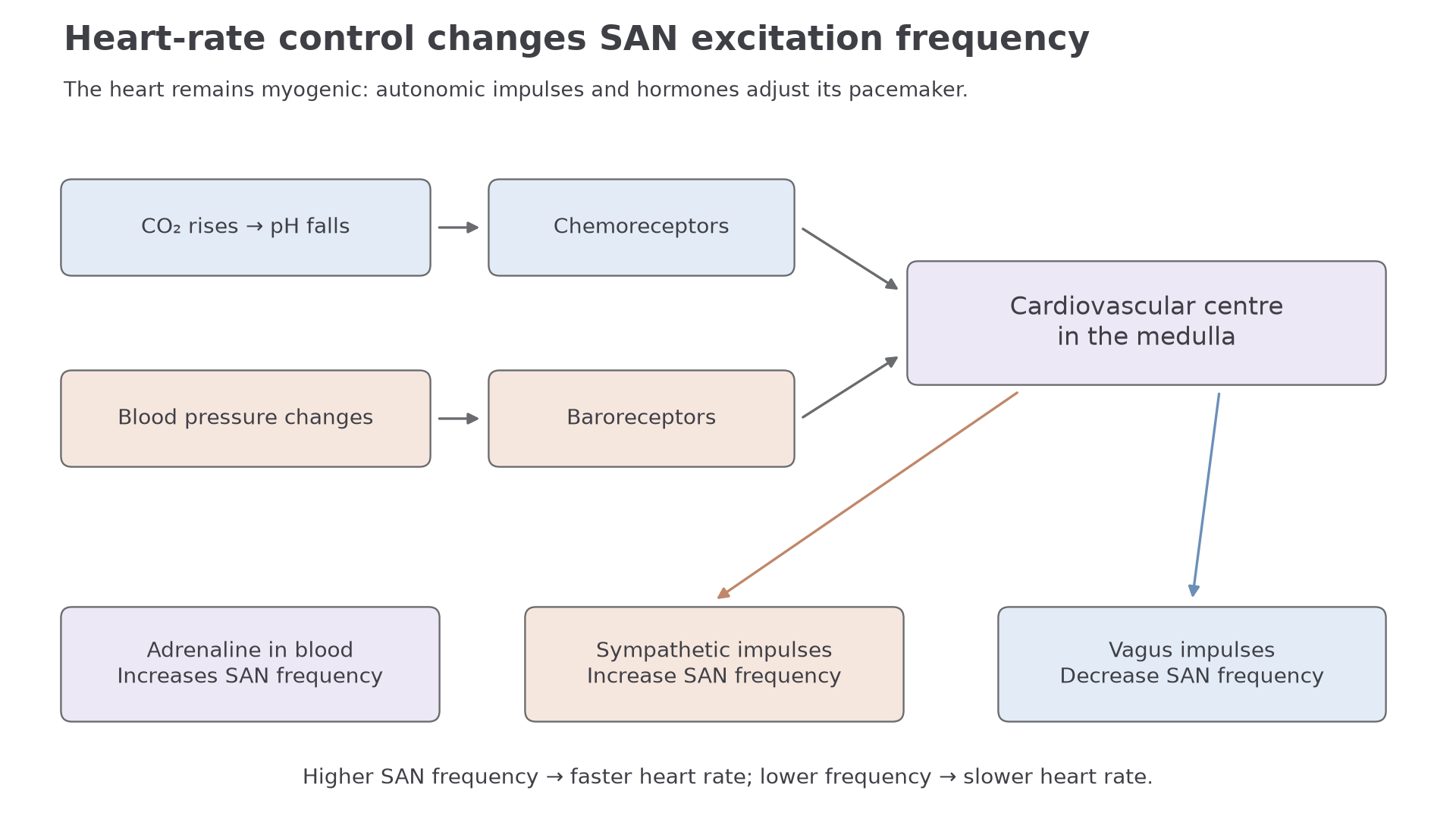
The coordinator is the cardiovascular centre in the medulla oblongata. It receives information from receptors and adjusts the balance of sympathetic and parasympathetic impulses to the heart.
Chemoreceptors detect changes in the chemical composition of the blood. During exercise, muscle cells respire faster. More carbon dioxide is produced. Carbon dioxide dissolves in blood and contributes to a fall in pH, which can also be described as an increase in H⁺ ion concentration. Peripheral chemoreceptors in the carotid and aortic bodies detect blood chemistry. Central chemoreceptors in the medulla detect changes in the pH of surrounding fluid caused by carbon dioxide crossing from the blood. The cardiovascular centre responds by sending more impulses along sympathetic/accelerator nerves to the SAN. The SAN increases the rate at which it generates waves of excitation, so heart rate increases.
Baroreceptors are different. They detect stretch caused by changes in blood pressure in regions such as the carotid sinus and aortic arch. If blood pressure is high, baroreceptor input can lead to increased parasympathetic/vagus effect and reduced sympathetic effect, so heart rate decreases. If blood pressure is low, the opposite balance helps increase heart rate.
[DIAGRAM: heart_rate_control_pathways: Lesson 119: Effects of hormones and nervous mechanisms on heart rate - diagram 01; asset_slug: 119_m05_1_5_effects_of_hormones_and_nervous_mechanisms_on_heart_rate__diagram_01; recommended_method: drawn_biology; description: A clean grey-on-white mechanism map showing exercise increasing carbon dioxide and lowering pH, chemoreceptors, blood-pressure baroreceptors, the cardiovascular centre in the medulla, sympathetic/accelerator and parasympathetic/vagus routes to the SAN, and adrenaline increasing SAN excitation rate.]
When exercise ends, carbon dioxide production falls towards its resting rate. Reduced chemical stimulation and withdrawal of the exercise response alter autonomic balance: sympathetic stimulation falls and parasympathetic influence increases, slowing SAN excitation. The exact blood-pressure response varies, so a fall in heart rate should not automatically be attributed to high blood pressure.
Distinguish what the receptors detect. Chemoreceptors are for chemical changes such as CO₂, pH and H⁺ concentration. Baroreceptors are for pressure or stretch. If an answer says "baroreceptors detect low pH", it has used the wrong receptor.
Continue this lesson.
You’re previewing NovaLearn without an account. Create a free account to read the rest.
Create free account