5.1.4(e)-(f) - Diabetes mellitus causes and treatments
Diabetes mellitus is a blood-glucose control disorder, but the two main types have different causes and therefore different treatment logic. In this lesson you will learn how Type 1 and Type 2 diabetes mellitus differ, why insulin from genetically modified bacteria matters, and why potential stem-cell treatments have to be evaluated carefully rather than described as a simple cure.
The shared blood-glucose problem
Blood glucose concentration must remain within a suitable range because cells need glucose for respiration, but persistently high blood glucose can damage tissues. In a healthy control system, insulin helps lower blood glucose after a meal by increasing glucose uptake by target cells and promoting storage of glucose as glycogen in the liver and muscles. That regulation mechanism belongs mainly to the previous lesson; here the focus is what happens when the insulin system cannot control blood glucose effectively.
Diabetes mellitus
Diabetes mellitus is a condition in which blood glucose concentration remains too high because insulin secretion or insulin response is inadequate.
The term for high blood glucose is hyperglycaemia. Both Type 1 and Type 2 diabetes mellitus can cause hyperglycaemia, but they do not arise in the same way. A strong answer therefore starts with the cause before naming a treatment.
[DIAGRAM: diabetes_type_comparison: Lesson 109: Diabetes mellitus causes and treatments - diagram 01; asset_slug: 109_m05_1_4_diabetes_mellitus_causes_and_treatments__diagram_01; recommended_method: drawn_biology; description: 16:9 deterministic comparison flowchart contrasting Type 1 autoimmune beta-cell destruction with Type 2 insulin resistance, linked to hyperglycaemia and treatment logic.]
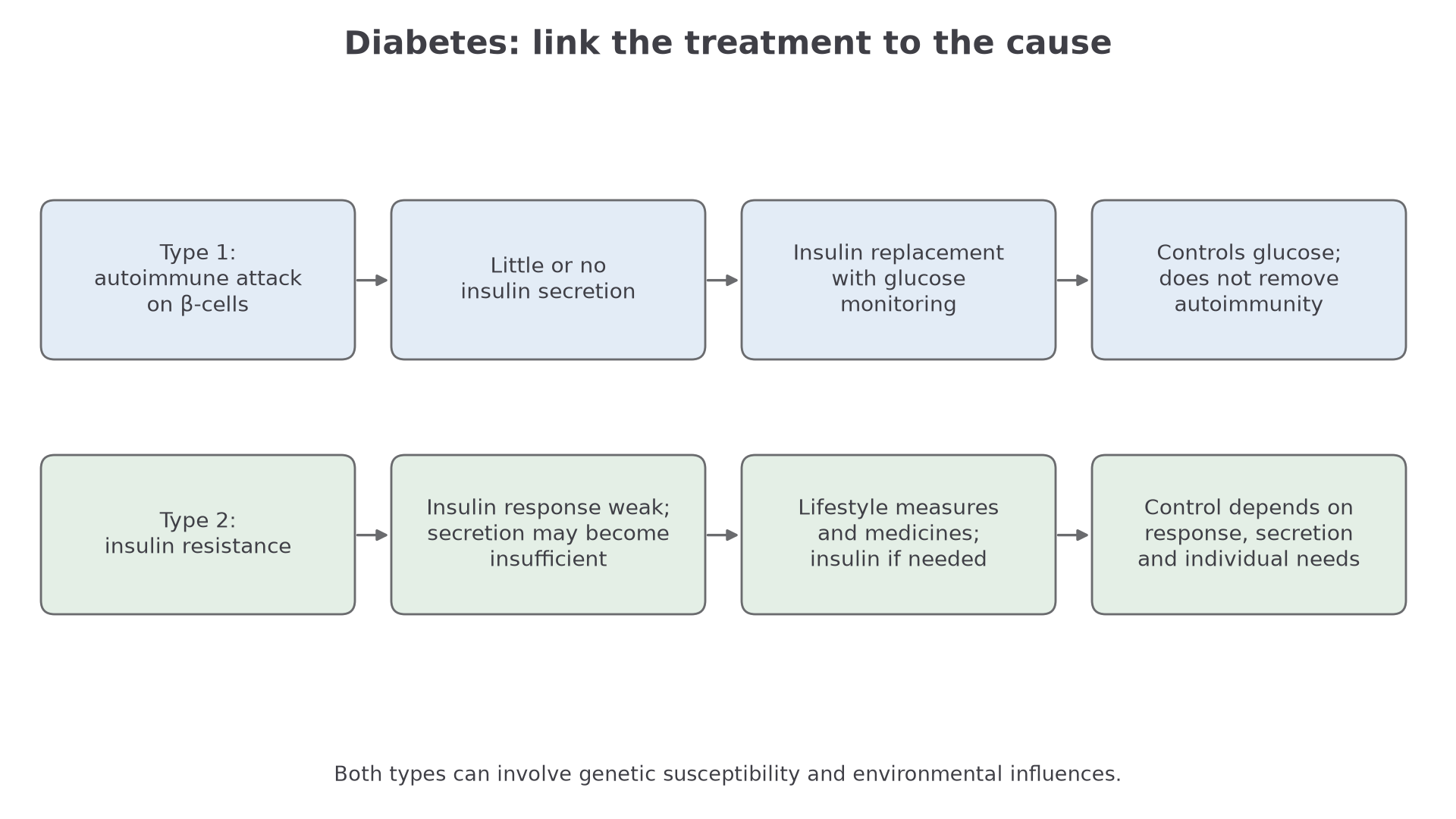
Use the diagram as a cause-and-treatment map. Type 1 is mainly a failure to secrete enough insulin. Type 2 is mainly a failure of target cells to respond properly to insulin, especially in the earlier stages. That distinction is the anchor for the rest of the lesson.
When comparing the two types, do not write only "one is genetic and one is lifestyle". OCR-style answers need the biological cause: beta-cell destruction for Type 1 and insulin resistance for Type 2.
Type 1 diabetes mellitus
Type 1 diabetes mellitus is usually caused by an autoimmune response. The immune system attacks and destroys beta cells in the islets of Langerhans in the pancreas. Beta cells normally secrete insulin, so their destruction means little or no insulin can be released when blood glucose rises.
Without enough insulin, many target cells take up less glucose from the blood, and the liver is less strongly stimulated to convert glucose into glycogen. Blood glucose can therefore remain high after meals. Because the missing hormone is the central problem, treatment usually depends on insulin replacement.
Insulin can be given by injection, insulin pen or pump. The dose has to be matched to blood glucose level, carbohydrate intake and activity because too much insulin can lower blood glucose too far, causing hypoglycaemia. Monitoring blood glucose is therefore part of treatment, not an optional extra.
Lifestyle choices such as healthy eating and physical activity can help overall control and reduce health risks, but they do not make destroyed beta cells secrete insulin again. This is why saying that Type 1 diabetes can be treated by lifestyle alone is not biologically accurate.
Insulin is a protein. Swallowing ordinary insulin would expose it to digestive proteases, which hydrolyse its peptide bonds; injected insulin enters the body without passing through that digestive route. Insulin replacement controls the consequence of beta-cell loss but does not remove the underlying autoimmune process.
Type 2 diabetes mellitus
Type 2 diabetes mellitus is different because insulin may still be produced, especially early in the condition. The main early problem is insulin resistance: target cells, such as liver and muscle cells, respond less effectively to insulin. A normal amount of insulin then produces a weaker effect on glucose uptake and glycogen storage.
The pancreas may initially compensate by secreting more insulin. Over time, beta cells may not secrete enough insulin to meet the body's demand, so hyperglycaemia becomes harder to control. That is why some people with Type 2 diabetes eventually need insulin, even though the starting problem was resistance to insulin rather than complete absence of insulin.
Risk factors for Type 2 diabetes include family history, age, ethnicity, body mass, diet and physical activity. These factors affect risk; they do not make it fair or accurate to describe Type 2 diabetes as simply "the person's fault". For Biology, the key causal language is insulin resistance and insufficient control of blood glucose.
Treatment usually starts by trying to reduce insulin resistance and reduce the glucose load on the control system. This can include changes to diet, physical activity and body mass where appropriate, as well as medicines. Metformin is a common example of a medicine used in Type 2 diabetes because it reduces liver glucose production and can improve insulin sensitivity. Other medicines, and sometimes insulin, may be used if blood glucose is not controlled well enough.
| Feature | Type 1 diabetes mellitus | Type 2 diabetes mellitus |
|---|---|---|
| Main cause | Autoimmune destruction of beta cells | Insulin resistance, with possible later insufficient insulin secretion |
| Insulin secretion | Little or none | Often still present at first |
| Typical treatment logic | Replace missing insulin | Improve insulin response, reduce glucose load, use medicines or insulin if needed |
| Common misconception | It can be treated by lifestyle alone | It means no insulin is made |
Both genetic susceptibility and environment can contribute to both types. In a hypothetical twin study, concordance of 40% in identical twins and 12% in non-identical twins would support genetic influence because the more genetically similar pairs have higher concordance. Identical-twin concordance below 100% suggests that identical DNA does not guarantee the same outcome. Shared environments, age and sample sizes must be considered before assigning exact causal contributions. Read the study’s actual data rather than assuming Type 1 is purely genetic and Type 2 purely environmental.
Continue this lesson.
You’re previewing NovaLearn without an account. Create a free account to read the rest.
Create free account