6.2.1(i) - Immobilised enzymes in biotechnology
Immobilised enzymes are enzymes held in one place while their substrates and products move around them. Biotechnology uses this idea to turn enzyme reactions into controlled production processes, such as making lactose-reduced milk or converting glucose to fructose. In this lesson you will learn the main immobilisation methods, how to evaluate them, and how to use data from an immobilised-enzyme process.
Why Immobilise Enzymes?
An enzyme in solution can catalyse a reaction effectively, but it is mixed with the reactants and products. That causes a problem in biotechnology: the enzyme may be difficult to recover, difficult to reuse, and may contaminate the final product.
Immobilised Enzyme
An immobilised enzyme is an enzyme that is attached to, trapped within, or held behind an insoluble support so that it remains in a fixed region while substrate and product molecules can move to and from it.
The enzyme is still a catalyst. Its active site can still bind substrate and form product, provided immobilisation has not changed the enzyme's shape or blocked access to the active site. The difference is that the enzyme is kept separate from the product stream.
In biotechnology, that can be valuable because the process is not just "make one reaction happen once". Industrial production often needs a reliable reaction that can be repeated many times, run continuously, and produce a product that is easy to purify.
| Feature | Free enzyme in solution | Immobilised enzyme |
|---|---|---|
| Position of enzyme | Mixed throughout the reaction mixture | Held on or in an insoluble support |
| Reuse | Harder to recover after the reaction | Easier to keep and reuse |
| Product purity | Product may contain enzyme | Product is less likely to be contaminated by enzyme |
| Continuous production | Harder to run as a fixed column process | Can be packed into a column or reactor |
| Initial cost | Usually lower | Often higher because immobilisation and supports cost money |
There is one important evaluation point already: immobilisation can reduce long-term costs if the enzyme is reused many times, but it does not usually mean low set-up cost.
In an evaluation answer, do not write only "it is cheaper". A stronger answer is: "the initial set-up cost is higher, but the enzyme can be reused, so cost per batch may fall over time."
Methods Of Immobilisation
Enzymes can be immobilised by several different mechanisms. The method matters because it affects enzyme reuse, product purity, stability, cost and reaction rate.
[DIAGRAM: immobilisation_methods_comparison: Lesson 162: Immobilised enzymes in biotechnology - diagram 01; asset_slug: 162_m06_2_1_immobilised_enzymes_in_biotechnology__diagram_01; recommended_method: drawn_biology; description: deterministic four-panel diagram comparing adsorption to a support, covalent bonding or cross-linking, entrapment in alginate gel, and membrane separation/encapsulation.]
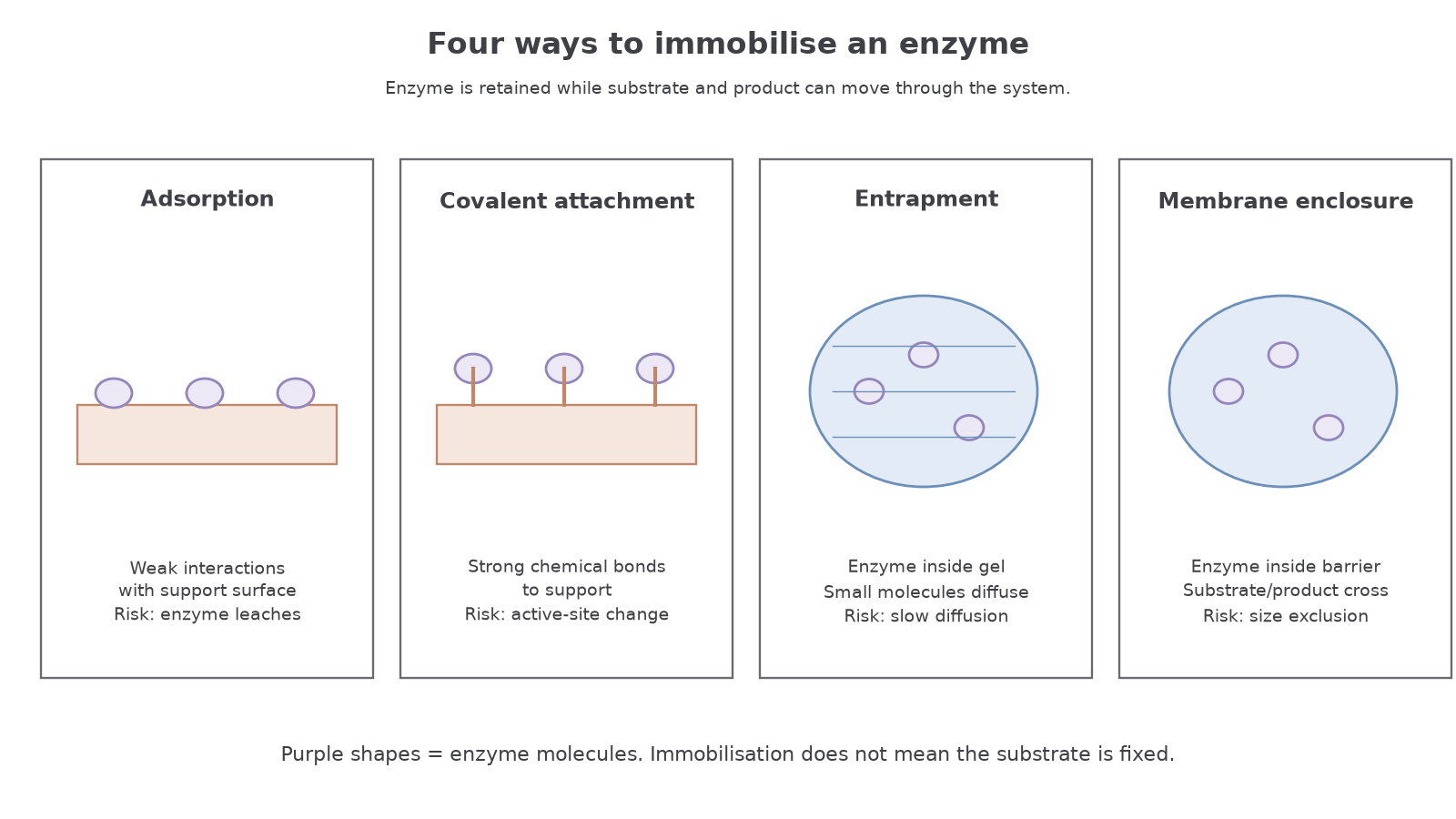
The four methods are:
| Method | What happens | Strength | Limitation |
|---|---|---|---|
| Adsorption | Enzyme molecules attach to the surface of an inert support by weak interactions | Simple and relatively low-cost | Enzyme can detach, especially if pH, ionic conditions or flow change |
| Covalent bonding or cross-linking | Enzyme is bonded to an insoluble support, or enzyme molecules are cross-linked to each other | Strong attachment; enzyme is less likely to leak away | More expensive; chemical treatment may alter enzyme shape or reduce active-site access |
| Entrapment | Enzyme is trapped inside a gel matrix, such as calcium alginate beads | Easy to model in school and useful for column processes | Substrate and product must diffuse through the gel, so rate may be reduced |
| Membrane separation or encapsulation | Enzyme is kept behind a partially permeable membrane | Enzyme is physically separated from product | Membrane damage or diffusion limits can reduce performance |
Entrapment in alginate is a useful model. Sodium alginate mixed with an enzyme can be dropped into calcium chloride solution. Calcium ions cross-link the alginate, forming gel beads with enzyme trapped inside. Small substrate molecules can diffuse in, and small product molecules can diffuse out.
Covalent bonding is usually more durable than adsorption, but "stronger" does not automatically mean "better". If bonding changes the enzyme's tertiary structure or blocks active sites, the rate may fall. A good biotechnology process chooses the method that keeps enough enzyme active while also keeping it recoverable.
Immobilisation is a trade-off: hold the enzyme firmly enough to reuse it, but still allow substrate to reach the active site and product to leave.
Column Processes And Examples
A common biotechnology design is a column packed with immobilised enzyme beads or particles. Substrate solution enters at one end, flows past the immobilised enzyme, and product is collected at the other end.
[DIAGRAM: immobilised_lactase_column: Lesson 162: Immobilised enzymes in biotechnology - diagram 02; asset_slug: 162_m06_2_1_immobilised_enzymes_in_biotechnology__diagram_02; recommended_method: drawn_biology; description: deterministic process diagram showing milk or lactose solution flowing through a column of immobilised lactase beads, product collection as glucose and galactose, and practical cautions about flow rate, bead size and product purity.]
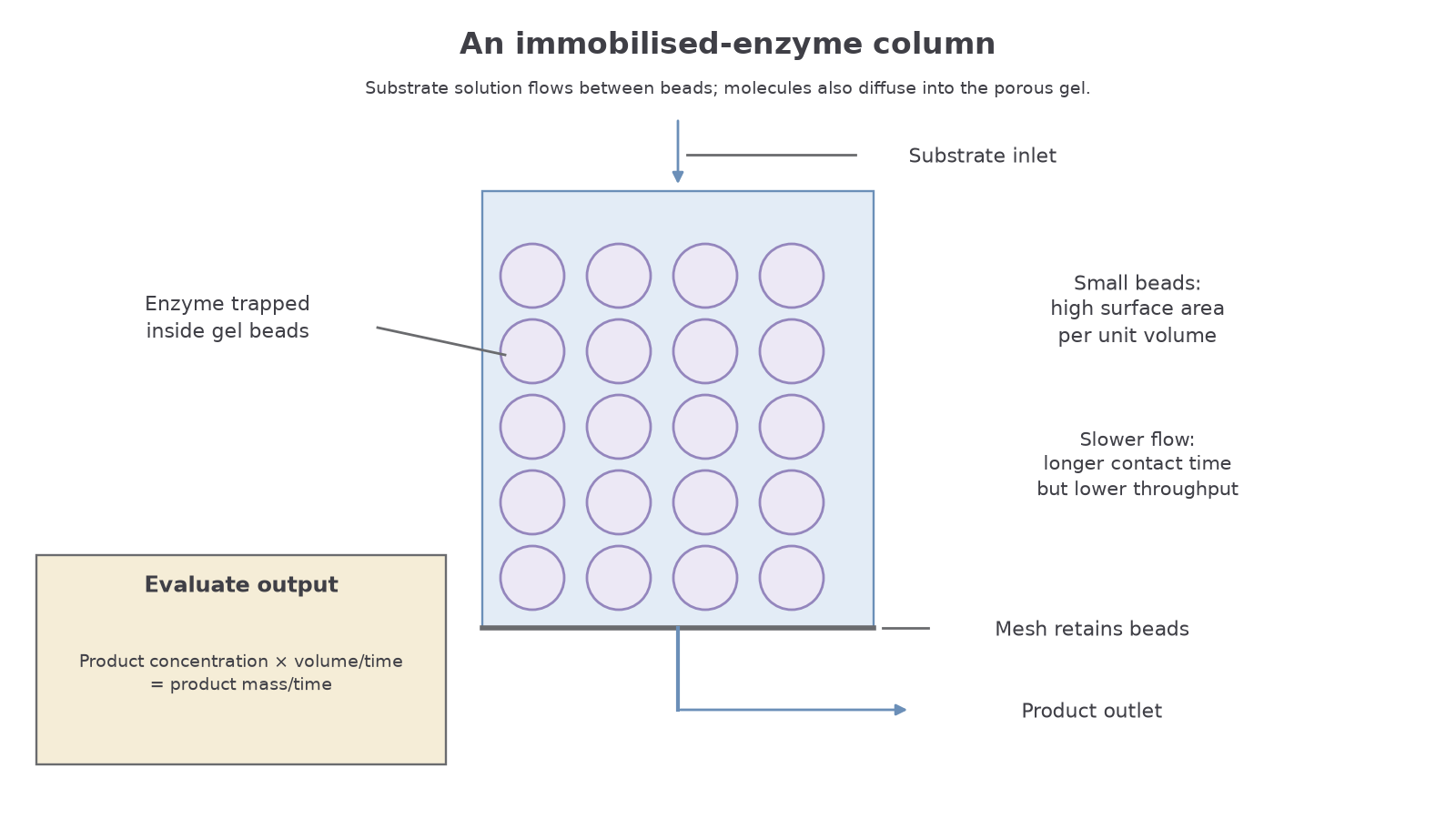
Lactase is a clear example. Lactase catalyses the hydrolysis of lactose into glucose and galactose. If lactase is immobilised in alginate beads inside a column, milk or lactose solution can flow over the beads. The product stream contains the hydrolysis products, while most of the lactase remains in the column.
Glucose isomerase is another biotechnology example. It converts glucose to fructose, which is sweeter and useful in syrup production. Industrial systems can use immobilised glucose isomerase in a fixed bed, so glucose solution passes through and fructose-containing syrup is collected.
OCR's specification lists several possible examples, including lactase, glucose isomerase, penicillin acylase, aminoacylase and glucoamylase. You are not required to recall that list. The important skill is to apply the immobilised-enzyme idea to an unfamiliar enzyme: identify the substrate, product, method, advantage and limitation.
Flow rate is a practical decision. If substrate moves too quickly through the column, there is less contact time between substrate and immobilised enzyme, so less product may form. If it moves too slowly, conversion may improve, but the process produces product more slowly.
Using product data from a lactase column
A student passes lactose solution through a column of immobilised lactase. The starting lactose concentration is 10.0 mmol dm⁻³. If all lactose were hydrolysed, the maximum glucose concentration would be 10.0 mmol dm⁻³ because each lactose molecule produces one glucose molecule.
Three treated samples have glucose concentrations of 7.8, 8.2 and 8.0 mmol dm⁻³.
Mean glucose concentration:
Continue this lesson.
You’re previewing NovaLearn without an account. Create a free account to read the rest.
Create free account