6.3.1(a) - Ecosystems, biotic and abiotic factors
An ecosystem is not just a dramatic rainforest or a huge coral reef. It can be as small as a rock pool or as local as one large tree, as long as living organisms interact with each other and with the non-living conditions around them. In this lesson, you will learn how to recognise ecosystems of different sizes, name biotic and abiotic factors, and explain why ecosystems are dynamic.
What Counts As An Ecosystem
An ecosystem is a biological system made from living organisms, the non-living environment around them, and the interactions between the two. The boundary of an ecosystem is chosen by the biologist's question. A rock pool, a playing field and a large tree can each be treated as an ecosystem if the living and non-living parts inside that boundary are being studied together.
Ecosystem
An ecosystem is a community of living organisms interacting with each other and with the abiotic environment in a particular area.
This definition has three important parts:
| Part of the definition | What it means | Example |
|---|---|---|
| community of living organisms | all the populations of different species living together | seaweeds, barnacles and limpets in a rock pool |
| abiotic environment | non-living physical and chemical conditions | temperature, salinity, oxygen concentration and pH |
| interactions | ways the living and non-living parts affect one another | shade from a tree changes light and soil moisture below it |
A habitat is not exactly the same thing as an ecosystem. A habitat is the place where an organism lives. An ecosystem includes the habitat, the organisms living there, the abiotic conditions, and the interactions among them.
[DIAGRAM: ecosystem_scale_factor_map: Lesson 163: Ecosystems, biotic and abiotic factors - diagram 01; asset_slug: 163_m06_3_1_ecosystems_biotic_and_abiotic_factors__diagram_01; recommended_method: drawn_biology; description: A clean three-panel line diagram comparing a rock pool, a playing field and a large tree as ecosystems of different sizes, with side labels grouping named biotic factors and named abiotic factors.]
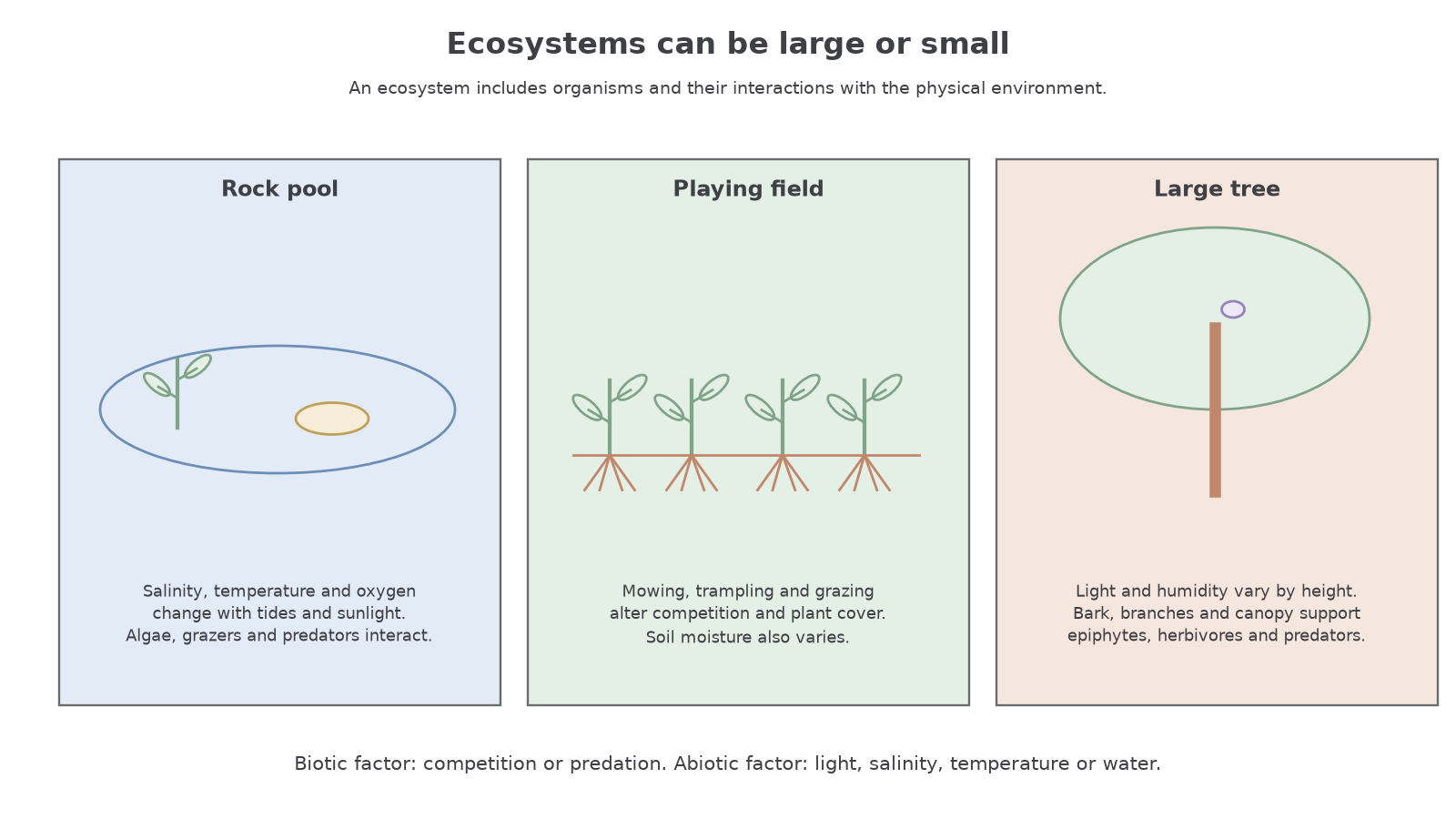
If a question asks for an ecosystem example, do not assume it must be large. OCR can reward a small named ecosystem if it includes living organisms, abiotic conditions and interactions.
Biotic Factors
Biotic factors are living components of an ecosystem, or effects caused by living organisms. They include the organisms present and the interactions between them.
Biotic Factor
A biotic factor is a living component of an ecosystem that can affect another organism, population or the ecosystem as a whole.
Named biotic factors can include predators, prey, competitors, pathogens, decomposers, food availability and plant cover. The important point is that the factor is living, or directly caused by living organisms.
| Ecosystem | Named biotic factor | How it can affect the ecosystem |
|---|---|---|
| rock pool | seaweed cover | provides food and shelter for some organisms |
| rock pool | grazing limpets | reduce the amount of algae on rock surfaces |
| playing field | grass species present | affect the food and shelter available to insects |
| playing field | fungal decomposers | break down dead material and help recycle mineral ions |
| large tree | insects feeding on leaves | reduce leaf area and affect food availability for other organisms |
| large tree | birds nesting in branches | add droppings, move seeds and interact with insects |
Biotic factors can be direct or indirect. A predator directly affects its prey. A tree indirectly affects shade-tolerant plants below it by changing how much light reaches the ground. In both cases, a living organism changes the conditions experienced by other organisms.
Be careful with classification. Fungi, bacteria and algae are living organisms, so their presence can be a biotic factor. They are not all "plants" or "animals", and OCR mark schemes often expect precise biological terms.
Biotic means living. A good answer names a living factor and then states how it affects organisms in that ecosystem.
The cause of an environmental change and the condition measured need not belong to the same category. A tree canopy is living and its shading effect is biotic, but the measured light intensity beneath it is abiotic. Decomposers are biotic; the nitrate concentration they help change is abiotic. This distinction lets an investigation test a mechanism instead of merely assigning labels.
Continue this lesson.
You’re previewing NovaLearn without an account. Create a free account to read the rest.
Create free account