5.2.1(d) - Light-dependent stage of photosynthesis
The light-dependent stage is the energy-conversion stage of photosynthesis. It does not make glucose directly; it uses light energy to make ATP and reduced NADP, which can then provide energy and reducing power for later metabolic processes. In this lesson, you will follow the electron pathway, the role of water, and the difference between cyclic and non-cyclic photophosphorylation.
Energy conversion
The light-dependent stage takes place on the thylakoid membranes of chloroplasts. The membrane matters because it holds photosystems, electron carriers and ATP synthase in positions that let energy be transferred in a controlled sequence.
A photosystem is a light-harvesting system containing photosynthetic pigments and a reaction centre. Pigments absorb light energy and pass that energy to the reaction centre. At the reaction centre, light energy excites electrons in chlorophyll to a higher energy level. Those excited electrons can then pass to electron carriers.
Photophosphorylation
Photophosphorylation is the production of ATP from ADP and inorganic phosphate using energy from light.
The word has two useful parts: photo means light, and phosphorylation means adding phosphate to ADP to form ATP. In chloroplasts, this happens because electron transfer is used to build a proton gradient, and ATP synthase uses the gradient to make ATP.
ATP is not the only important product. Non-cyclic photophosphorylation also reduces NADP. Reduced NADP is a hydrogen-carrying coenzyme; it can deliver reducing power to later reactions. You may see reduced NADP written as NADPH, but OCR often uses the wording reduced NADP.
Non-cyclic flow
Non-cyclic photophosphorylation is the main one-way electron pathway. The electron begins at water, passes through photosystem II, electron carriers and photosystem I, and finally reduces NADP. Because the electron does not return to its starting point, the pathway is non-cyclic.
[DIAGRAM: light_dependent_electron_flow: Lesson 124: Light-dependent stage of photosynthesis - diagram 01; asset_slug: 124_m05_2_1_light_dependent_stage_of_photosynthesis__diagram_01; recommended_method: drawn_biology; description: A 16:9 NovaLearn-style thylakoid membrane pathway diagram showing stroma and lumen, PSII, electron carriers, PSI, NADP reduction to reduced NADP, water photolysis supplying electrons and protons, oxygen release, proton pumping, ATP synthase, ATP formation, and a dashed cyclic photophosphorylation loop from PSI back to electron carriers.]
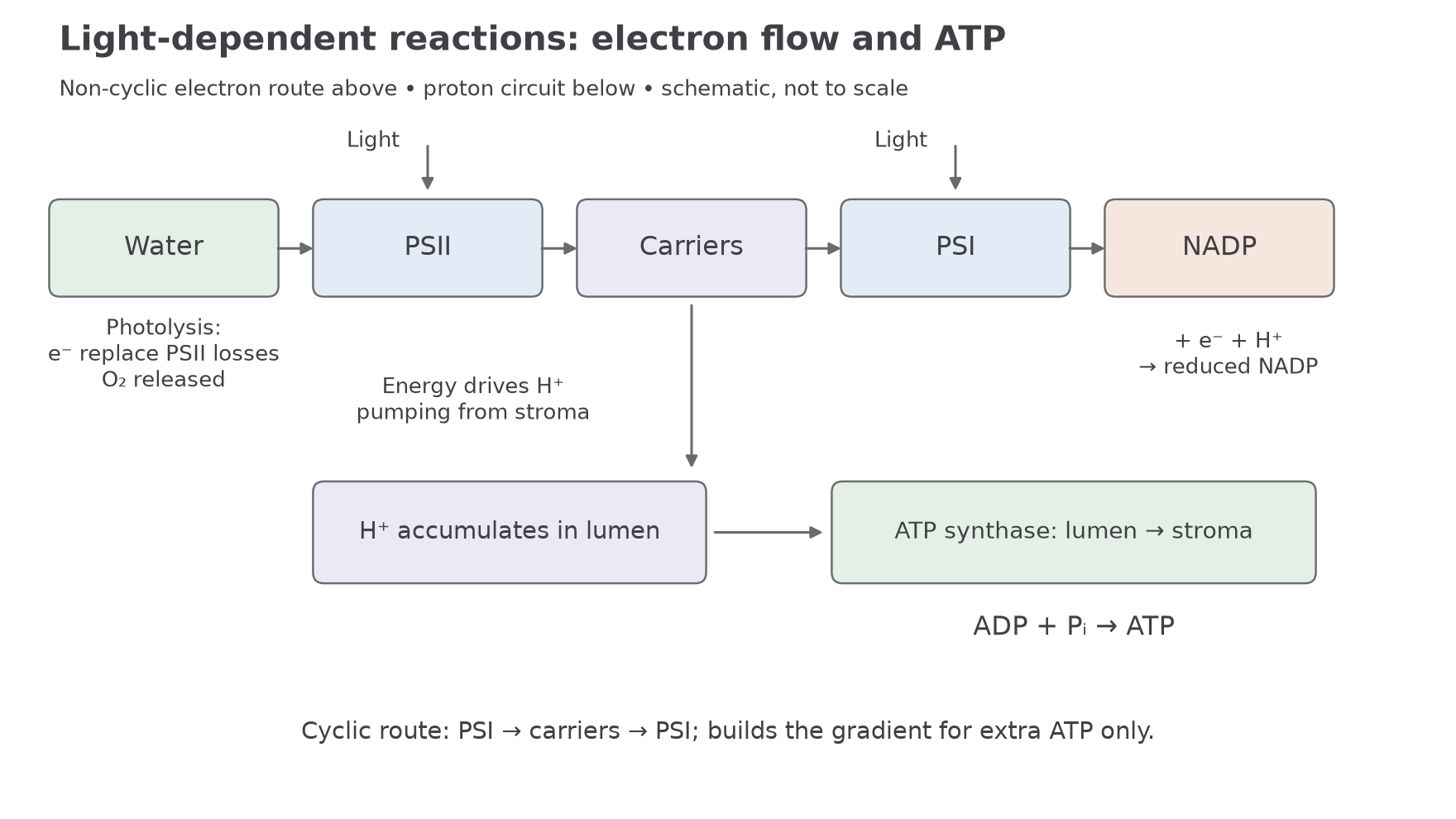
The sequence is easiest to understand as five linked moves.
| Stage | What happens | Why it matters |
|---|---|---|
| Light is absorbed at photosystem II | Electrons in chlorophyll are excited to a higher energy level | Excited electrons can leave the reaction centre and enter electron carriers. |
| Electrons pass along carriers | Electron carriers transfer the electrons in a chain | Energy released from the electrons is used to move H⁺ into the thylakoid lumen. |
| ATP is made | H⁺ diffuses back through ATP synthase | ATP synthase phosphorylates ADP to ATP. |
| Light is absorbed at photosystem I | Electrons are re-excited | The electrons regain enough energy to reduce NADP. |
| NADP is reduced | NADP accepts electrons and H⁺ | Reduced NADP is produced for later metabolic reactions. |
The proton gradient is the link between electron flow and ATP production. H⁺ becomes more concentrated inside the thylakoid lumen than in the stroma. H⁺ then diffuses down this electrochemical gradient through ATP synthase. ATP synthase uses the released energy to join ADP and inorganic phosphate.
In non-cyclic photophosphorylation, electrons flow from water to NADP, producing ATP, reduced NADP and oxygen.
Electron transfer and proton movement are different flows. Electrons move along carriers; energy from their transfer drives H⁺ movement from stroma into lumen. The membrane is poorly permeable to H⁺, so the gradient persists. Protons return from lumen to stroma through ATP synthase; electrons do not flow through ATP synthase to make ATP.
Continue this lesson.
You’re previewing NovaLearn without an account. Create a free account to read the rest.
Create free account