5.1.5(h) - Human brain structure and functions
The brain contains specialised regions that coordinate different functions. This lesson links the gross structure to the functions of five parts: the cerebrum, cerebellum, medulla oblongata, hypothalamus and pituitary gland. The key skill is to link a named part to a precise function or symptom, rather than saying vaguely that "the brain controls the body".
Gross map of the brain
Gross structure
The large-scale arrangement of the main parts of an organ, without focusing on microscopic tissue detail.
In a side view of the human brain, the cerebrum is the large folded upper region. The cerebellum is smaller and sits at the back and lower side of the brain. The medulla oblongata is the lower part of the brainstem, where the brain continues towards the spinal cord.
The hypothalamus is a small region deep in the brain, below the thalamus and above the pituitary gland. The pituitary gland hangs below the hypothalamus. The pituitary is an endocrine gland whose activity is closely controlled by the hypothalamus. Its posterior lobe contains neural tissue, so describing the gland as endocrine does not mean it contains no nervous tissue.
[DIAGRAM: human_brain_gross_structure: Lesson 116: Human brain structure and functions - diagram 01; asset_slug: 116_m05_1_5_human_brain_structure_and_functions__diagram_01; recommended_method: drawn_biology; description: simplified sagittal view of the human brain showing cerebrum, cerebellum, medulla oblongata, hypothalamus and pituitary gland in relative gross positions with label arrows.]
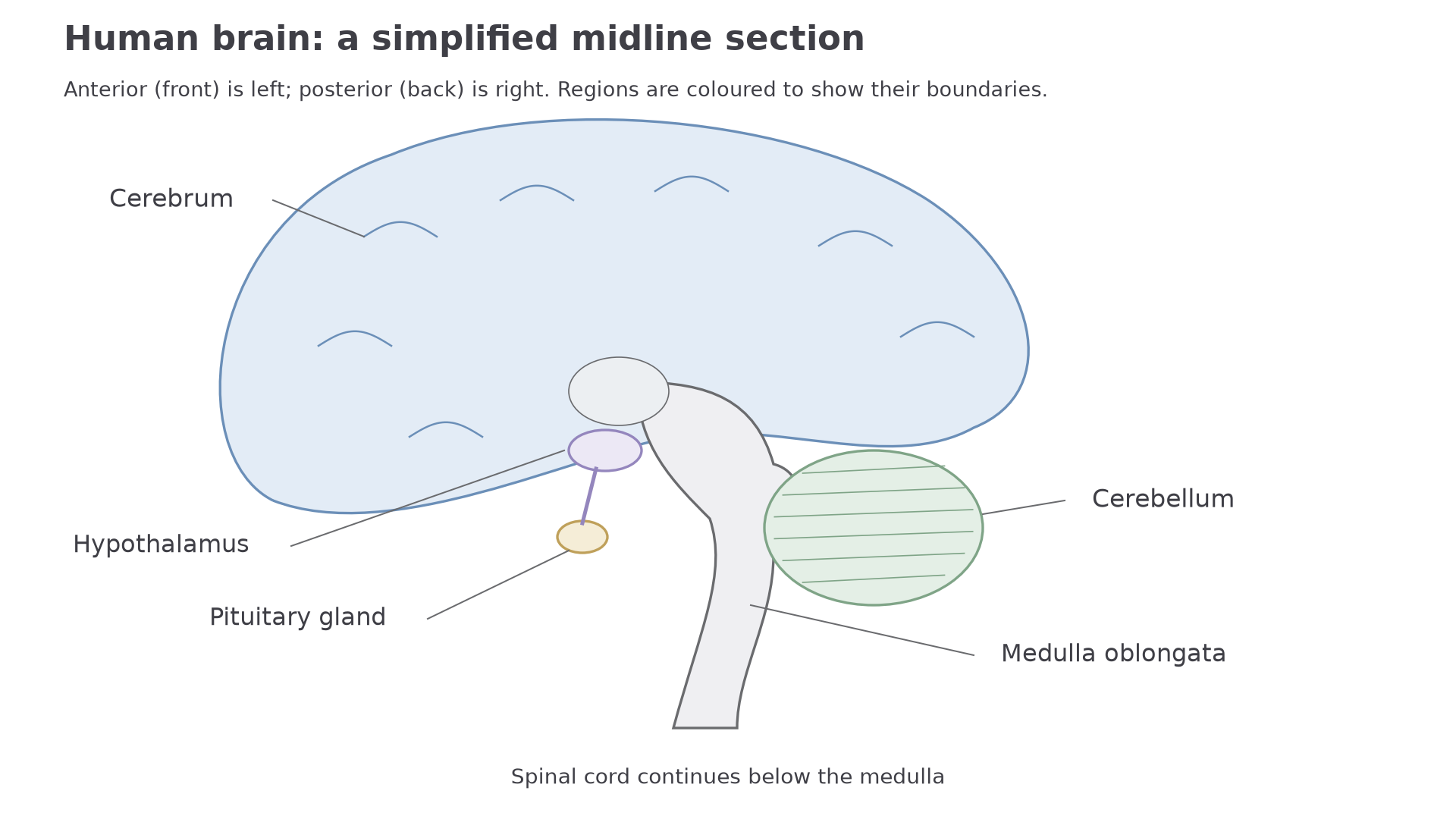
The sagittal diagram is a section through the midline, so it reveals internal regions such as the hypothalamus. An external lateral view would hide them.
Cerebrum and cerebellum
The cerebrum is the largest part of the human brain. Its folded outer layer, the cerebral cortex, gives a large surface area for neurones and synapses. For this lesson, the important point is not the detailed names of the lobes, but the type of function the cerebrum carries out.
The cerebrum is involved in conscious thought and higher mental activity. This includes memory, learning, reasoning, decision-making, speech, sensory processing and voluntary movement. If a question describes loss of speech, memory, thinking, sight, hearing or voluntary control, the cerebrum is the first required structure to consider.
The cerebellum is different. It does not initiate a conscious decision in the way the cerebrum can. Instead, it coordinates movement so that voluntary muscle contractions are smooth, balanced and accurately timed. It is also important in posture, balance and learned motor skills.
| Part | Function | Damage may cause |
|---|---|---|
| Cerebrum | Conscious thought, memory, speech, sensory processing and voluntary movement | Loss of memory, impaired speech, sensory problems or problems with voluntary actions |
| Cerebellum | Coordination of movement, posture and balance | Poor balance, uncoordinated movement or difficulty with smooth fine control |
For a structure-function question, name the part and then give the specific function. "Movement" alone is weak for the cerebellum because the cerebrum is involved in voluntary movement too; "coordination of movement and balance" is much more precise.
Apply that contrast to the damage scenario below.
Continue this lesson.
You’re previewing NovaLearn without an account. Create a free account to read the rest.
Create free account