6.1.2(b)(ii) - Phenotypic ratios, linkage and epistasis
Phenotypic ratios are the bridge between a genetic cross and an explanation of inheritance. In this lesson you will use ratios as evidence for three patterns: autosomal linkage, sex linkage and epistasis. The aim is not just to name the pattern, but to explain why the observed ratio is different from the independent-assortment ratio you would otherwise expect.
Ratio Evidence
A phenotypic ratio compares the number of offspring showing each observable phenotype. The ratio is useful because different inheritance patterns predict different proportions of offspring.
The starting point is always the expected ratio if genes assort independently and no gene masks another gene's effect.
| Cross type | Usual independent-assortment expectation | What the ratio is telling you |
|---|---|---|
| Monohybrid cross between two heterozygotes | 3:1 | One gene with a dominant and recessive allele |
| Test cross for one gene | 1:1 | One heterozygous parent crossed with a homozygous recessive parent |
| Dihybrid cross between two double heterozygotes | 9:3:3:1 | Two unlinked genes affecting two traits independently |
| Dihybrid test cross | 1:1:1:1 | A double heterozygote crossed with a double homozygous recessive organism |
If the observed ratio is clearly different from the expected ratio, there must be a biological or sampling explanation. In this lesson the main biological explanations are linkage and epistasis.
[DIAGRAM: ratio_evidence_map: Lesson 142: Phenotypic ratios, linkage and epistasis - diagram 01; asset_slug: 142_m06_1_2_phenotypic_ratios_linkage_and_epistasis__diagram_01; recommended_method: drawn_biology; description: A deterministic 16:9 decision map showing how expected independent-assortment ratios are compared with ratio clues for autosomal linkage, sex linkage and epistasis, plus a caution that significance testing belongs to the next lesson.]
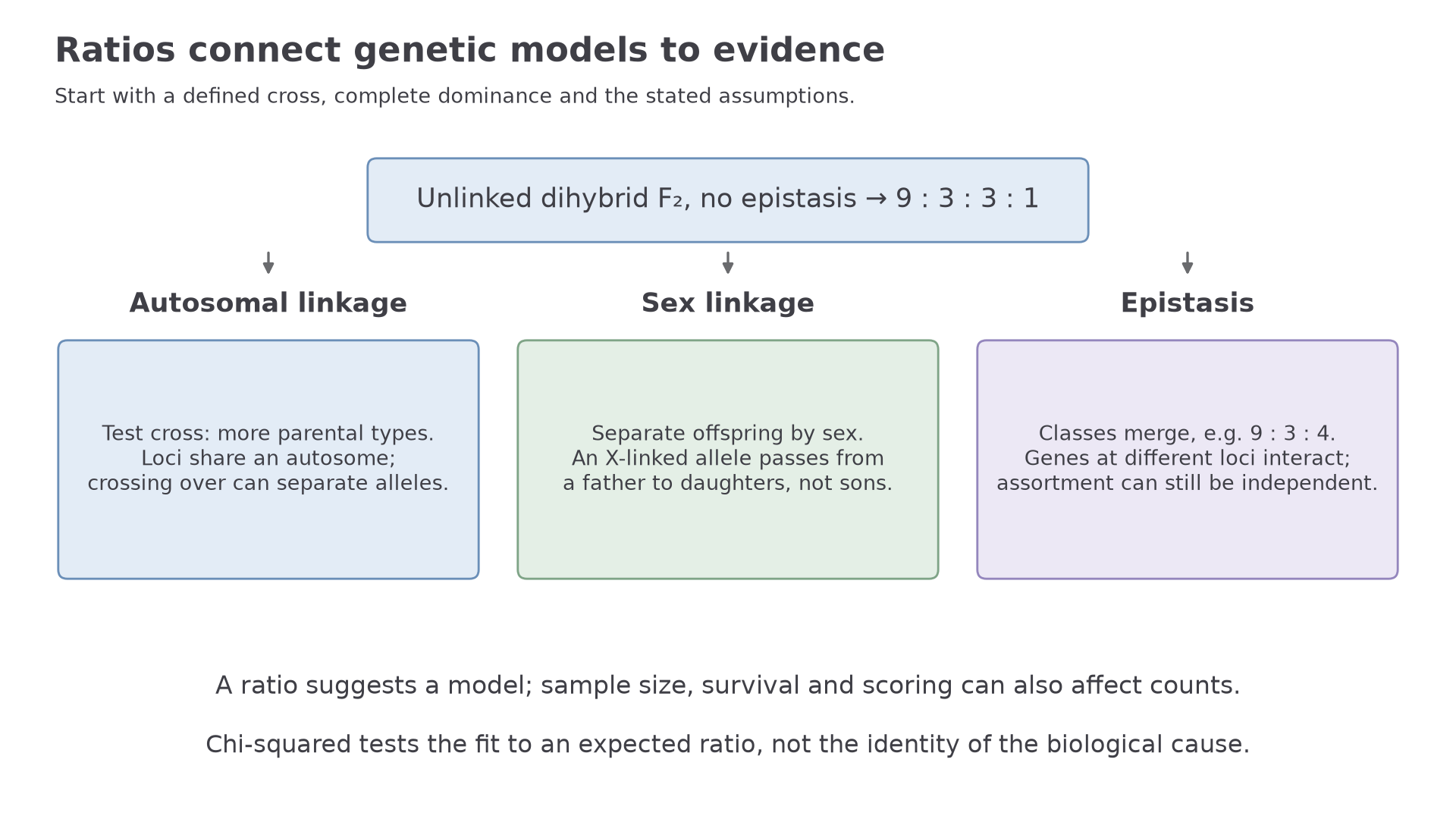
Ratio evidence needs careful language. A different ratio suggests a pattern; it does not prove it by itself. Small samples, chance, lethal genotypes, selection during development, scoring errors or experimental design can also change observed numbers. The next lesson deals with chi-squared testing, which is used to judge whether a difference from expected results is likely to be due to chance.
When you explain a ratio, give the expected ratio first, describe how the observed ratio differs, then connect that difference to a mechanism such as same-chromosome inheritance or masking between loci.
Autosomal Linkage
Autosomal linkage occurs when two gene loci are on the same autosome. An autosome is a chromosome that is not a sex chromosome. Linked genes do not assort independently because the alleles at those loci tend to stay together on the same chromosome during meiosis.
Autosomal Linkage
Autosomal linkage is the inheritance of two or more gene loci together because they are on the same non-sex chromosome.
The important ratio clue is an excess of parental phenotypes and a shortage of recombinant phenotypes. Parental phenotypes have the same combination of traits as the parents. Recombinant phenotypes have a new combination of traits because crossing over has separated linked alleles.
For a dihybrid test cross, independent assortment predicts:
1 dominant trait 1 + dominant trait 2 : 1 dominant trait 1 + recessive trait 2 : 1 recessive trait 1 + dominant trait 2 : 1 recessive trait 1 + recessive trait 2
That simplifies to 1 : 1 : 1 : 1.
If the genes are linked and there is no crossing over between the loci, a double heterozygote produces only the two parental gamete types. The offspring then show mainly the two parental phenotype combinations.
Interpreting an autosomal linkage clue
A plant heterozygous for two genes is test crossed. If the genes assort independently, four phenotype classes are expected in a 1:1:1:1 ratio. The observed offspring are:
| Phenotype class | Number |
|---|---|
| Tall, purple | 48 |
| Tall, white | 4 |
| Short, purple | 5 |
| Short, white | 43 |
The two high-number classes are the parental combinations. The two low-number classes are recombinant combinations. This suggests autosomal linkage because the gene loci for height and flower colour are on the same autosome and are usually inherited together. The few recombinant offspring can be explained by crossing over between the loci during meiosis.
Chromosome notation makes the arrangement explicit. AB/ab means A and B occur together on one homologue, with a and b on the other. Ab/aB is a different arrangement, although both organisms have genotype AaBb. With no crossing over, AB/ab produces AB and ab gametes only. Crossing two such heterozygotes gives 1 AB/AB : 2 AB/ab : 1 ab/ab, hence 3 both-dominant : 1 both-recessive phenotypes under complete dominance and no epistasis. This exact model requires no crossing over between the loci; a few recombinant offspring would give additional classes.
Do not write "the genes are linked, so crossing over cannot happen". The safer statement is: linked genes are less likely to be separated by crossing over, especially when their loci are close together. Crossing over can still produce some recombinant offspring.
Continue this lesson.
You’re previewing NovaLearn without an account. Create a free account to read the rest.
Create free account