2.1.6(g) - Stages of meiosis and homologous chromosomes
Meiosis is a two-division sequence that turns one diploid cell into haploid cells. In this lesson, the main job is not to memorise a blur of chromosome pictures, but to know what separates at each division: homologous chromosomes in meiosis 1, then sister chromatids in meiosis 2. That distinction is the thread that makes every stage name meaningful.
Chromosome language
Before the stages make sense, three pieces of chromosome language need to be kept separate.
Homologous chromosomes
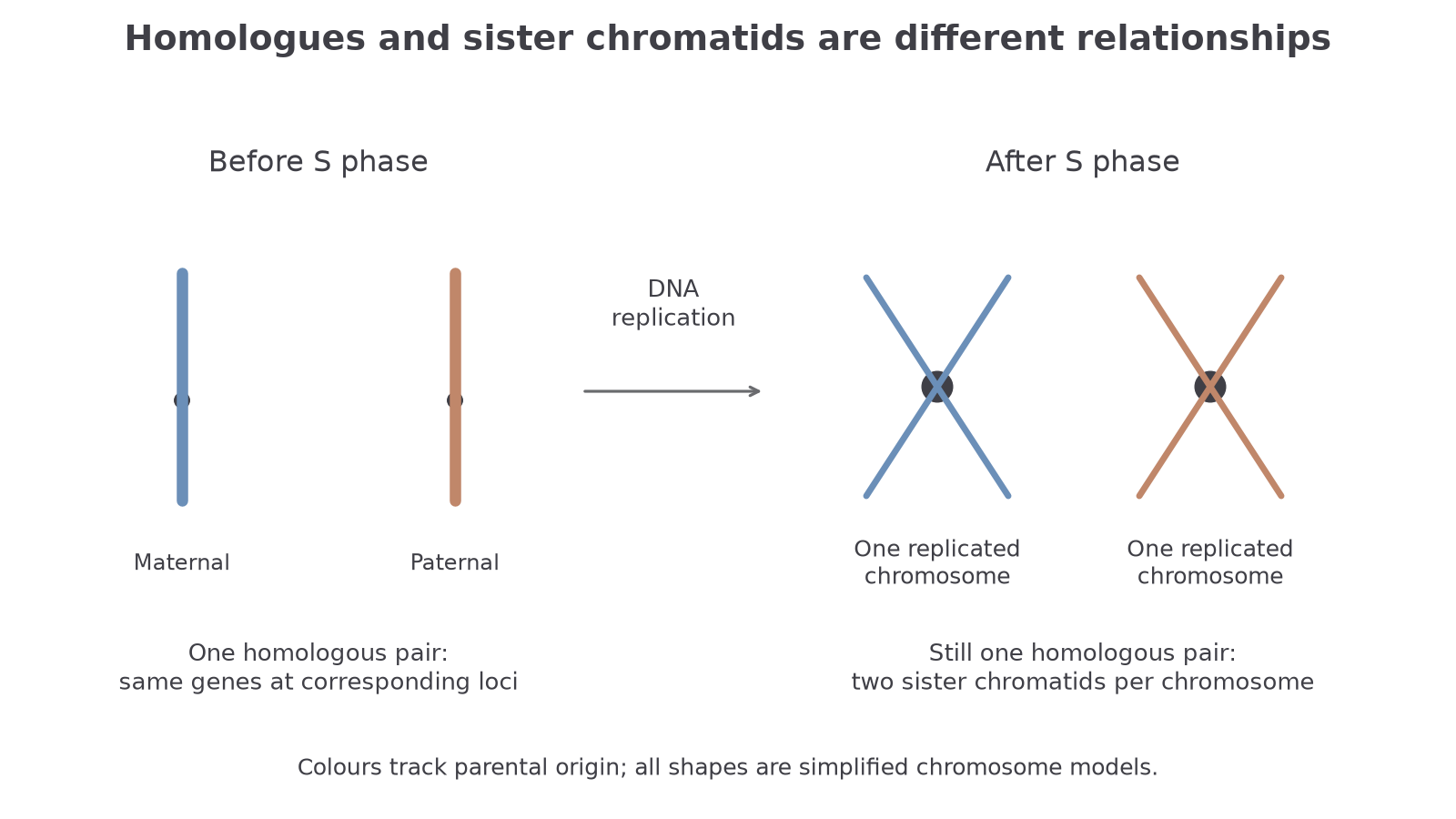
A homologous pair is a pair of chromosomes with the same genes at the same loci, one inherited from each parent; the two chromosomes may carry different alleles.
A chromosome can be unreplicated or replicated. During the S phase of interphase, DNA is copied. After that copying, each chromosome consists of two sister chromatids joined at a centromere. The important point is that DNA replication does not make a homologous pair. It makes two sister chromatids of one chromosome.
In a simple model where a diploid cell has four chromosomes, written as 2n = 4, there are two homologous pairs. After interphase, the cell still has four chromosomes because chromosome number is counted by centromeres, but it has eight chromatids because each chromosome has been copied.
When answering stage questions, use “homologous chromosomes” for the matching pair and “sister chromatids” for the two copies joined at one centromere. Mixing these terms is a common way to lose an otherwise simple mark.
[DIAGRAM: chromosome_terms: Replication produces sister chromatids, not a homologous pair; asset_slug: 048_m02_1_6_stages_of_meiosis_and_homologous_chromosomes__diagram_01; recommended_method: drawn_biology; description: Matched parental homologues carry corresponding loci before and after replication.]
Meiosis 1 separates homologous chromosomes
Interphase is included in the OCR sequence because it prepares the cell for meiosis. The cell grows, replicates its DNA during S phase, and enters meiosis with each chromosome made of two sister chromatids.
In prophase 1, chromosomes condense and homologous chromosomes pair up. Crossing over can occur between non-sister chromatids of homologous chromosomes, but the key boundary for this lesson is the stage sequence and the term homologous chromosomes. You do not need the names of the substages within prophase 1.
In metaphase 1, homologous pairs line up at the equator of the cell. The pair is still made of two replicated chromosomes: one homologue on one side of the pair, the matching homologue on the other.
In anaphase 1, homologous chromosomes separate and move to opposite poles. Sister chromatids remain joined at their centromeres, so the chromosomes moving away are still X-shaped if drawn as replicated chromosomes.
In telophase 1, the first division is completed. Two haploid cells or nuclei form, but each chromosome is still made of two sister chromatids. This is why meiosis 1 is the reduction division: the homologous pairs have been split so each new cell has one chromosome from each pair.
[DIAGRAM: main_stages_of_meiosis: Lesson 048: Stages of meiosis and homologous chromosomes - diagram 02; asset_slug: 048_m02_1_6_stages_of_meiosis_and_homologous_chromosomes__diagram_02; recommended_method: drawn_biology; description: First meiotic division showing homologous pairing, independent orientation and separation in a 2n = 4 cell. Interphase DNA is replicated before the illustrated condensed chromosomes appear.]
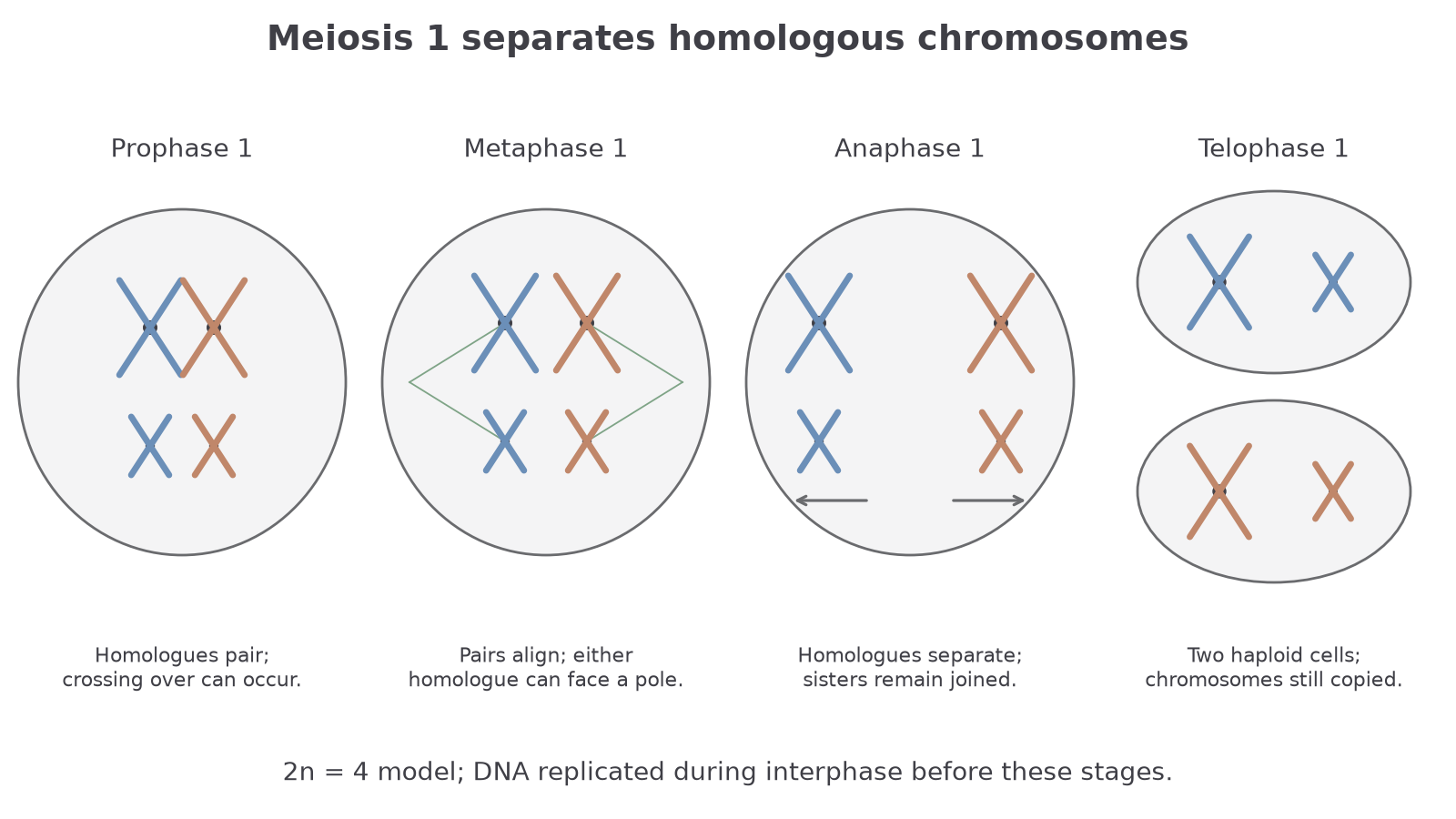
Meiosis 1 separates homologous chromosomes, not sister chromatids.
During prophase 1 the nucleolus disappears, the nuclear envelope breaks down and spindle fibres form. Pairing brings corresponding loci together. Non-sister chromatids can exchange matching DNA sections at crossing-over sites, creating new combinations of alleles on a chromosome. Sister chromatids may therefore no longer be genetically identical after crossing over.
Each bivalent can face either pole at metaphase 1, independently of the others. For two pairs, a long maternal homologue may travel with either the maternal or paternal short homologue. This independent assortment changes the combination of chromosomes received by the daughter cells. Spindle fibres attach the homologues to opposite poles and move them apart in anaphase 1 without splitting their centromeres.
At telophase 1, chromosomes reach the poles; nuclear envelopes may reform and cytokinesis normally divides the cytoplasm. The extent of chromosome decondensation varies between organisms, but there is no intervening S phase.
Continue this lesson.
You’re previewing NovaLearn without an account. Create a free account to read the rest.
Create free account