5.2.2(i)(i)-(ii) - Anaerobic respiration and yeast practicals
This lesson explains how eukaryotic cells keep making a small amount of ATP when oxygen is not available in sufficient supply. You will compare anaerobic respiration in mammalian muscle and yeast, then use yeast as a practical model for measuring respiration rate. The central idea is simple but powerful: anaerobic respiration is less efficient than aerobic respiration, but it keeps glycolysis running when oxygen is limiting.
NAD, oxygen and the need for anaerobic respiration
Glycolysis can make ATP without oxygen because it happens in the cytoplasm and uses substrate-level phosphorylation. In glycolysis, glucose is converted into pyruvate, a small amount of ATP is made, and NAD is reduced to reduced NAD.
The difficulty comes next. For glycolysis to continue, reduced NAD must be oxidised back to NAD. In aerobic respiration, reduced NAD is reoxidised through later stages of respiration that depend on oxygen as the final electron acceptor. If oxygen is absent, or if a tissue cannot receive oxygen quickly enough, that reoxidation route cannot keep up.
Anaerobic respiration solves the immediate problem by using pyruvate, or a molecule made from pyruvate, to reoxidise reduced NAD. This regenerates NAD, so glycolysis can continue producing a small amount of ATP.
[DIAGRAM: pyruvate_fates_without_oxygen: Lesson 133: Anaerobic respiration and yeast practicals - diagram 01; asset_slug: 133_m05_2_2_anaerobic_respiration_and_yeast_practicals__diagram_01; recommended_method: drawn_biology; description: A clean flow diagram showing glucose to glycolysis to pyruvate, then separate mammalian muscle and yeast anaerobic pathways, with NAD regeneration and a low ATP-yield note.]
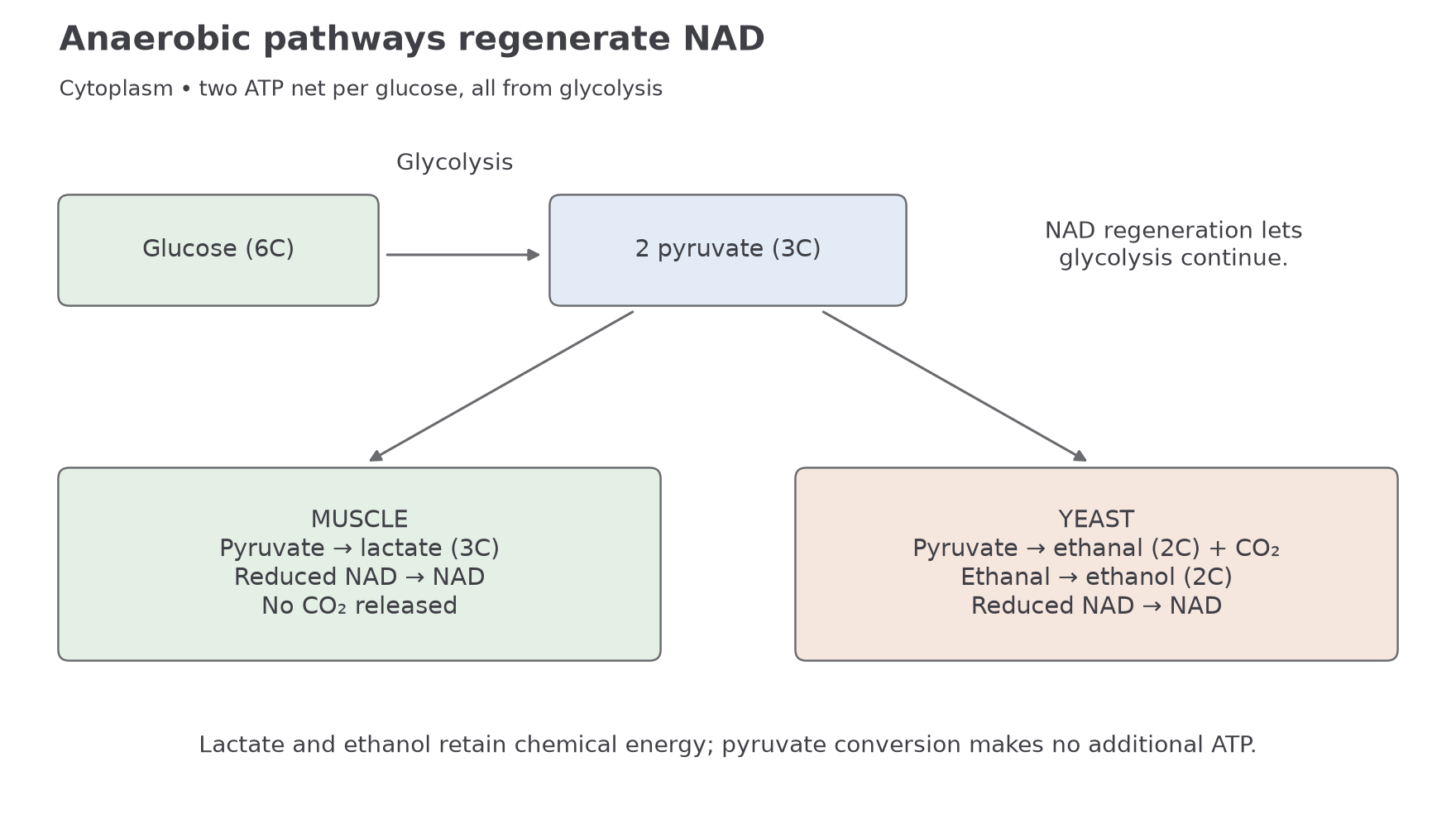
Anaerobic respiration
Respiration that releases energy from a respiratory substrate and uses it to synthesise ATP without using oxygen.
The immediate purpose of anaerobic respiration is to regenerate NAD so glycolysis can continue when oxygen is not available in sufficient supply.
Mammals and yeast use different pyruvate fates
In mammalian muscle, anaerobic respiration converts pyruvate into lactate. Reduced NAD transfers hydrogen to pyruvate, so reduced NAD is oxidised back to NAD.
The summary is:
Mammalian anaerobic respiration
This process does not release carbon dioxide. The carbon balance explains the distinction: carbon dioxide is released during anaerobic respiration in yeast, not during the conversion of pyruvate to lactate in mammalian muscle.
In yeast, pyruvate is first converted into ethanal and carbon dioxide. Ethanal is then reduced to ethanol, which oxidises reduced NAD back to NAD.
The summary is:
Yeast anaerobic respiration
This is often called alcoholic fermentation. The term is useful, but the important sequence is: pyruvate is converted to ethanol and carbon dioxide, and NAD is regenerated.
| Feature | Mammalian muscle | Yeast |
|---|---|---|
| Main anaerobic product | Lactate | Ethanol |
| Carbon dioxide released in the anaerobic pathway? | No | Yes |
| Purpose of the pathway | Regenerates NAD for glycolysis | Regenerates NAD for glycolysis |
Pyruvate and lactate each contain three carbon atoms: reduction transfers hydrogen without removing carbon. Yeast removes one carbon as CO₂, leaving two-carbon ethanal and then two-carbon ethanol. Neither conversion of pyruvate makes extra ATP; both regenerate the oxidised NAD needed by glycolysis.
Why the ATP yield is much lower
Anaerobic respiration is useful, but it is not efficient. It allows glycolysis to continue, so the cell gets the net ATP made in glycolysis. That is only a small yield from each glucose molecule.
Aerobic respiration has a much higher ATP yield because glucose is oxidised more completely. The link reaction, Krebs cycle and oxidative phosphorylation allow many reduced coenzymes to feed electrons into electron transport, building the proton gradients used to make ATP. Without oxygen, oxidative phosphorylation cannot continue normally, so those high-yield stages cannot keep producing ATP.
Another way to see the same idea is to look at the products. Lactate and ethanol still contain a lot of chemical energy. Anaerobic respiration has not fully oxidised the respiratory substrate to carbon dioxide and water.
The benefit is still important. Mammalian muscle can keep contracting for a short time when oxygen delivery cannot meet ATP demand. Yeast can survive and continue growing in oxygen-poor conditions, and the carbon dioxide and ethanol produced by yeast are useful in baking and fermentation industries.
To explain the low ATP yield, link the idea to oxygen, reduced NAD, oxidative phosphorylation and incomplete oxidation. Do not just state "anaerobic respiration makes less ATP".
The net yield is two ATP per glucose, all from glycolysis. If a supplied aerobic yield is 30 ATP per glucose, producing the same ATP anaerobically requires 30 ÷ 2 = 15 times as much glucose. Treat the supplied aerobic yield as an assumption: actual yields vary. Rapid substrate depletion limits how long the low-yield pathway can meet a high demand.
Designing yeast respiration investigations
Yeast is useful for respiration-rate practicals because it is easy to grow, uses sugars as respiratory substrates, and produces measurable changes. In anaerobic conditions, yeast releases carbon dioxide during ethanol formation, so carbon dioxide volume can be used as a practical measure of rate.
Continue this lesson.
You’re previewing NovaLearn without an account. Create a free account to read the rest.
Create free account