6.2.1(a)(i)-(ii) - Natural plant clones and cuttings
Plant cloning is not always a laboratory technique. Many plants naturally make genetically identical new plants by vegetative propagation, and growers can use the same idea to produce reliable crops and garden plants. In this lesson you will learn how natural plant clones form, why they are useful in horticulture, and how a stem cutting can be taken as a simple cloning technique.
What A Plant Clone Is
A clone is an organism, cell or group of cells that is genetically identical to another organism, cell or group of cells. In this lesson the clone is a whole plant produced from part of a parent plant.
Plant Clone
A plant clone is a plant that is genetically identical to the parent plant from which it was produced, except for any mutation that may occur.
The key process is asexual reproduction. The new plant is produced from one parent without gametes or fertilisation. Cells in the parent plant divide by mitosis, so the daughter cells receive the same genetic information as the parent cells.
That is why a plant produced from a runner, tuber, bulb or cutting can have the same genotype as the parent plant. It is not made from a seed produced by meiosis and fertilisation.
A clone does not have to look absolutely identical in every condition. The clone has the same genetic information, but its phenotype can still be affected by environmental conditions such as light, mineral ions, water availability, pathogens or pruning.
Natural Vegetative Propagation
Vegetative propagation is asexual reproduction using vegetative plant organs, such as stems, roots, leaves or buds, rather than seeds. In natural vegetative propagation, the plant already has structures that can produce new individuals.
Vegetative Propagation
Vegetative propagation is asexual reproduction in plants from vegetative structures such as stems, roots, leaves or buds.
Different vegetative structures provide different ways to form new plants. The examples below are all forms of vegetative propagation.
| Structure | What it is | How it produces a clone | Example |
|---|---|---|---|
| Runner or stolon | A horizontal stem growing from the parent plant | Nodes touch soil, form roots and shoots, then become plantlets | Strawberry |
| Rhizome | A horizontal underground stem | Buds on the rhizome grow into shoots; sections can separate | Ginger, iris, couch grass |
| Tuber | A swollen storage organ, often an underground stem | Buds, sometimes called "eyes", grow into new shoots | Potato |
| Bulb | A short stem with fleshy storage leaves and buds | Buds grow into new shoots; offsets may form beside the parent | Onion, daffodil |
[DIAGRAM: vegetative_propagation_forms: Lesson 156: Natural plant clones and cuttings - diagram 01; asset_slug: 156_m06_2_1_natural_plant_clones_and_cuttings__diagram_01; recommended_method: drawn_biology; description: A deterministic 16:9 comparison diagram showing runners, rhizomes, tubers and bulbs as natural vegetative propagation structures that can produce genetically identical plantlets.]
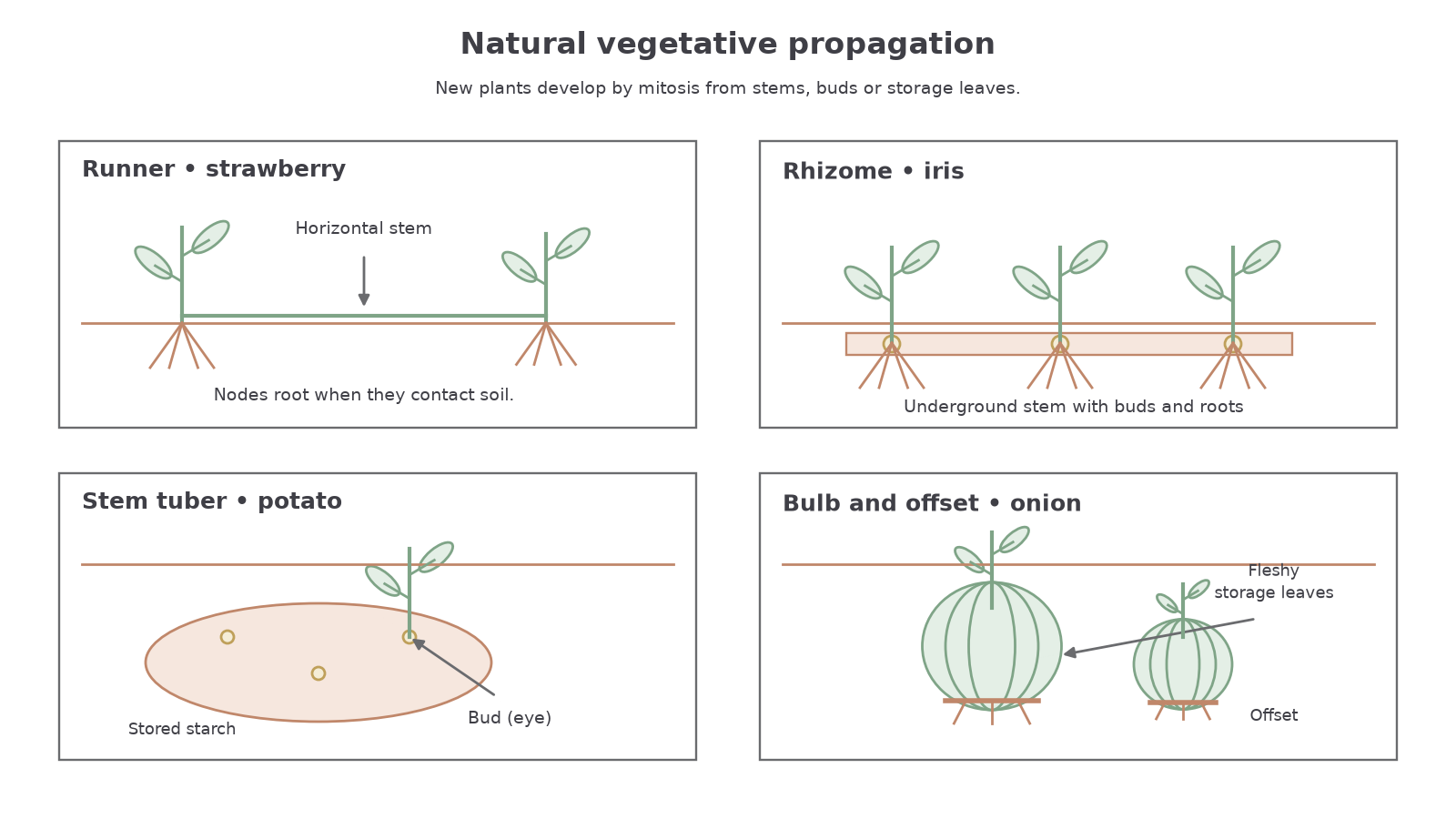
The diagram groups the structures by the same biological idea: a part of the plant contains living cells with the parent genotype, and those cells can divide by mitosis to form roots, shoots and leaves. If the connection to the parent plant dies or is cut, the new plant can become independent.
A grower can separate rooted runner plantlets, divide a rhizome into pieces containing buds, plant tuber pieces containing eyes, or separate bulb offsets. In a bulb, fleshy leaves store food around a short stem; in a potato tuber, the swollen stem stores starch. A storage organ alone is not enough: the propagated piece needs living tissue capable of producing a shoot. Dividing suitable bulb tissue or separating offsets increases plant number; simply replanting one intact bulb does not immediately multiply it.
Using Natural Clones In Horticulture
Horticulture is the cultivation of plants, especially crops, fruit, vegetables, ornamental plants and garden plants. Growers use natural plant cloning because it can preserve a useful genotype.
If a parent plant has desirable features, vegetative propagation can produce many plants with the same genotype. Desirable features might include flower colour, fruit quality, disease resistance, growth habit, crop yield, flavour or tolerance of local conditions.
The main benefit is uniformity. If a grower has one plant with a valuable combination of alleles, cloning can produce more plants with that same combination. This is especially useful when seed production would be slow, unreliable, absent, or would produce genetically varied offspring.
Examples include:
- strawberry plants produced from runners
- potato crops produced from tubers
- daffodils or onions multiplied from bulbs and offsets
- ornamental plants propagated from cuttings to keep the same flower colour or growth form
There is a trade-off. A crop of clones can be predictable and uniform, but the plants have low genetic variation. If all the plants share susceptibility to a pathogen or environmental stress, a disease outbreak or poor growing condition may affect many of them in the same way.
For OCR-style answers, avoid saying only "cloning is quicker". Say what is being preserved: a desirable genotype or desirable characteristics. Then link that to uniform plants, reliable crop quality, or plants that are difficult to grow from seed.
Continue this lesson.
You’re previewing NovaLearn without an account. Create a free account to read the rest.
Create free account