2.1.2(p) - Inorganic ions in biological processes
Inorganic ions are small charged particles, but they are involved in many of the biological processes you meet across the course. This lesson keeps the boundary tight: you need to recognise the required ion symbols, know whether each ion is positive or negative, and connect each one with a sensible biological role cue. The aim is precision, not a long tour of every later mechanism.
Ions And Symbols
An ion is an atom or group of atoms with an overall charge. The charge matters because it affects how the particle dissolves in water, interacts with proteins, moves through channels or carriers, and contributes to electrical or pH gradients.
Inorganic ion
A charged atom or group of atoms of the kinds studied here, such as sodium, nitrate or hydrogencarbonate. Inorganic ions differ from organic molecular ions such as charged amino acids.
There are two useful groups.
| Type of ion | Charge | OCR examples in this lesson |
|---|---|---|
| Cation | Positive | , , , , |
| Anion | Negative | , , , , |
The number and sign in the symbol are not decoration. means a calcium ion with a 2+ charge. means a calcium atom. would be the wrong ion for this specification point.
The symbols with several atoms need special care. is ammonium, is nitrate, is hydrogencarbonate, is phosphate, and is hydroxide. Hydrogencarbonate is often called bicarbonate in physiology sources, but OCR uses hydrogencarbonate.
| Error | Why it loses precision | Better answer |
|---|---|---|
| Writing for calcium ion | This is the element symbol, not the ion. | |
| Writing for phosphate | The charge is wrong for the required OCR symbol. | |
| Mixing nitrate and ammonium | Both contain nitrogen, but they are different ions with different symbols and charges. | and |
| Calling carbonic acid | Carbonic acid is a molecule, not the hydrogencarbonate ion. | |
| Treating as the same as | They have opposite charges and opposite pH effects. | is hydroxide; is hydrogen ion. |
Positive ions in cells and tissues
Ion movement can change a cell’s behaviour because charged particles affect electrical potential and water potential. Sodium and potassium gradients across neurone membranes allow electrical signalling; potassium uptake into guard cells lowers their water potential so water enters and the cells become turgid. Calcium ions can act as intracellular signals, including triggering contraction and neurotransmitter release. Calcium salts also mineralise bone: a structural role is distinct from the signalling role of dissolved Ca²⁺.
A higher hydrogen-ion concentration means a lower pH. Changes in pH can change protein charge and enzyme activity. Ammonium provides nitrogen that plants can incorporate into amino acids; it is not itself a protein.
Cations are positive ions. In biological systems they are usually dissolved in water, distributed unevenly between compartments, or bound briefly to proteins and other molecules. You do not need every later mechanism here, but you should have a role cue for each required cation.
| Cation | Name | Useful biological role cue |
|---|---|---|
| calcium ion | Mineralised tissues such as bones and teeth; signalling in muscle contraction, synapses and blood clotting. | |
| sodium ion | Major extracellular ion; membrane potentials and cotransport contexts. | |
| potassium ion | Major intracellular ion; membrane potentials and stomatal opening contexts. | |
| hydrogen ion | pH, acid-base changes and proton gradients used in ATP synthesis. | |
| ammonium ion | A form of fixed nitrogen in plant and nitrogen-cycle contexts. |
For exam precision, separate the ion from the element. Sodium as an element has the symbol ; a sodium ion is . Potassium as an element has the symbol ; a potassium ion is . Calcium has a 2+ charge in the required symbol, so write , not .
If a question asks for an ion, include the charge. A symbol without the charge may describe the element rather than the ion.
For example, an answer about nerve impulses might mention and because these ions form electrochemical gradients across membranes. This lesson does not require a full action-potential sequence; it only requires you to recognise the ions and their role cue.
Movement of hydrogen ions down an electrochemical gradient can drive ATP synthesis. This is a role cue; the full mechanism is studied later.
Negative ions in transport and synthesis
Plants take up nitrate and use its nitrogen to synthesise nitrogen-containing compounds after reduction. Phosphate supplies the phosphorus in nucleotides, ATP and phospholipids. Much carbon dioxide is carried in blood as hydrogencarbonate; the reversible acid–base system also helps resist changes in pH. Chloride movement helps balance charge during this transport. Hydroxide ions react with hydrogen ions to form water, reducing hydrogen-ion concentration and increasing pH. These examples link each ion to a mechanism, not simply to an organ.
Anions are negative ions. Some are single atoms, such as chloride. Others are groups of atoms, such as nitrate, hydrogencarbonate, phosphate and hydroxide. The group stays together as one charged ion in the symbol.
| Anion | Name | Useful biological role cue |
|---|---|---|
| nitrate ion | Fixed nitrogen source used by plants to make amino acids, proteins and nucleic acids. | |
| hydrogencarbonate ion | Carbon dioxide transport and blood buffering contexts. | |
| chloride ion | Charge balance, chloride shift and acid-base contexts. | |
| phosphate ion | ATP, nucleotides, phospholipids and mineralised tissues. | |
| hydroxide ion | Alkaline ion that can combine with and change pH. |
Phosphate is a good example of why role cues are more useful than isolated memorisation. Phosphate ions can be used to form the covalently bound phosphate groups in ATP, nucleotides and phospholipids. The free ion is not the same thing as an entire ATP molecule. ATP links energy release to cellular work. Phosphate is also part of nucleotides, so it appears in DNA and RNA, and it is present in phospholipids. The required recognition symbol in this specification point is .
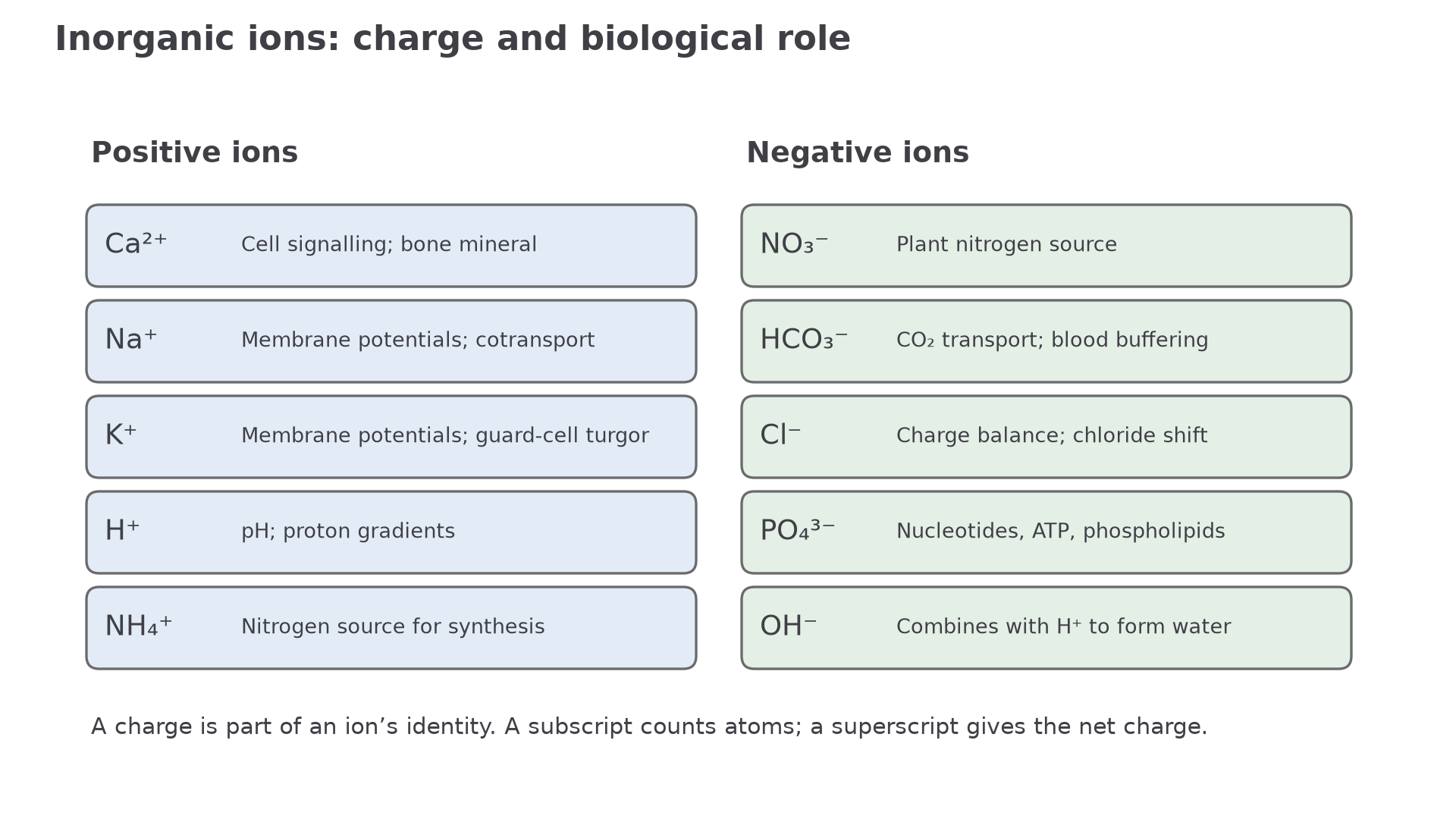
The diagram gathers the required cations and anions with short role cues. Use it as a checking map, not as a separate mechanism to memorise.
[DIAGRAM: inorganic_ion_roles_map: Lesson 26: Inorganic ion symbols and biological roles - diagram 01; asset_slug: 026_m02_1_2_inorganic_ions_in_biological_processes__diagram_01; recommended_method: drawn_biology; description: A clean 16:9 role-map diagram with two columns, grouping OCR-required cations and anions by symbol, charge group, ion name and concise biological role cue.]
Quick Recap
Use both the ion name and its correct charged symbol. Match ions to their biological contexts without confusing a free ion with a phosphate group already bound into a molecule.