5.1.5(e) - Plant hormone growth practicals
Plant hormones can be investigated by applying known concentrations to growing plant material and measuring a growth response. In this lesson, you will learn how to design a valid plant-hormone growth practical, prepare a dilution series, process root or shoot data, and decide what the results can and cannot show. The focus is the practical investigation and data handling, not memorising one named historical experiment.
Practical Question And Variables
A plant-hormone growth practical asks a cause-and-effect question: does changing the concentration of a plant hormone change a measurable growth response? A suitable concrete example is applying different concentrations of IAA, an auxin, to germinating seedlings and measuring root length, shoot length, or percentage change in length after a fixed time.
The independent variable is the factor deliberately changed. Here it is plant hormone concentration. The dependent variable is the response measured, such as mean root length or mean shoot length. Control variables are kept the same so that a difference in growth is more likely to be due to the hormone concentration rather than another factor.
Important control variables include:
| Variable to control | Why it matters |
|---|---|
| plant species and seed age | different species or older seeds may grow at different rates |
| number of seeds per dish | affects crowding/competition and the reliability of the mean |
| volume of solution | affects water availability and hormone dose reaching the tissue |
| temperature and incubation time | growth rate depends strongly on both |
| light conditions | light can trigger phototropism and alter shoot growth direction |
For the aqueous-stock assay described here, a water-only treatment is a control treatment. It provides the baseline growth without added hormone, so the hormone treatments can be compared with it.
[DIAGRAM: plant_hormone_growth_assay_setup: Lesson 113: Plant hormone growth practicals - diagram 01; asset_slug: 113_m05_1_5_plant_hormone_growth_practicals__diagram_01; recommended_method: drawn_biology; description: A 16:9 NovaLearn-style line diagram showing a plant hormone growth assay with water control, increasing IAA concentrations, seedlings on filter paper, vertical dark incubation, controlled variables, and a measurement grid for root and shoot length.]
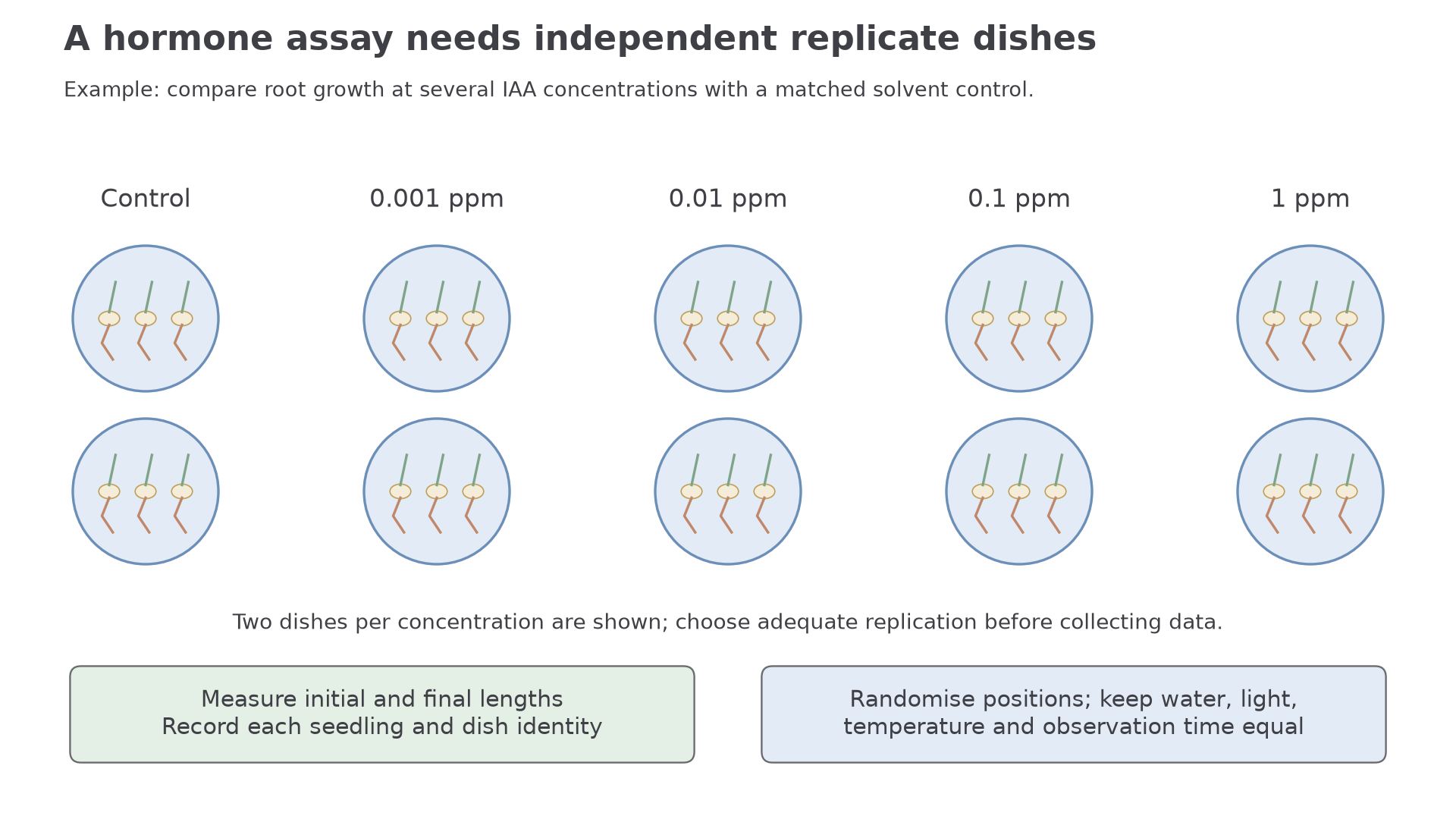
Placing dishes vertically can make root and shoot direction easier to compare because roots tend to grow downwards and shoots upwards. Incubating in darkness removes directional light as a stimulus, so phototropism does not become a hidden variable.
Designing A Growth Assay
A good method makes the biological response measurable and keeps the comparison fair. One simple design is to place equal numbers of germinating seeds on damp filter paper in Petri dishes, with each dish containing a different hormone concentration. After a fixed time, measure the root and shoot lengths of each seedling.
The living material must be treated safely and ethically. Plants are usually lower-risk than animals, but the investigation still needs care: avoid unnecessary waste, use only the organisms needed for reliable data, handle plant growth regulators according to the risk assessment, and dispose of solutions as instructed.
Replication is essential because individual seedlings vary. A dish with one seed is weak evidence; a dish with several seedlings gives a mean and allows anomalous seedlings to be noticed. If possible, repeat the whole treatment set, because one dish can dry unevenly or be affected by a small positioning error.
When asked to improve a plant growth practical, do not just say "repeat it". Say what is repeated, why it helps, and how the data will be processed, such as calculating a mean and identifying anomalous results.
The practical should separate method, result and conclusion. For example: "the mean root length decreased as IAA concentration increased" is a description. "High IAA inhibited root growth compared with the water control" is a conclusion. "IAA definitely caused the change" is too strong if the method lacked controls, repeats, or accurate dilution.
If the hormone stock contains a carrier solvent, use an otherwise identical solvent-only control; a water-only control is sufficient only for an aqueous stock. Use separate replicate dishes as well as several seedlings, because seedlings sharing one dish are not independent treatment replicates.
Serial Dilution
Serial dilution is a stepwise method for making a range of lower concentrations from a stock solution. It is useful in hormone-growth practicals because the response may change across several orders of magnitude: a concentration that stimulates one organ may have little effect or inhibit growth in another.
Serial dilution
A serial dilution is a sequence of dilutions where each new solution is made by diluting a measured volume of the previous solution by a fixed factor.
A common one-in-ten dilution uses 1 cm³ of the previous solution plus 9 cm³ of distilled water. If the stock solution is 100 ppm, then:
| Tube | How it is prepared | Concentration |
|---|---|---|
| stock | undiluted hormone solution | 100 ppm |
| 1 | 1 cm³ stock + 9 cm³ water | 10 ppm |
| 2 | 1 cm³ of 10 ppm + 9 cm³ water | 1 ppm |
| 3 | 1 cm³ of 1 ppm + 9 cm³ water | 0.1 ppm |
[DIAGRAM: one_in_ten_serial_dilution_chain: Lesson 113: Plant hormone growth practicals - diagram 02; asset_slug: 113_m05_1_5_plant_hormone_growth_practicals__diagram_02; recommended_method: drawn_biology; description: A deterministic 16:9 dilution-chain diagram showing 100 ppm stock, 10 ppm, 1 ppm, 0.1 ppm, 0.01 ppm and 0.001 ppm tubes, with each transfer labelled 1 cm3 plus 9 cm3 water and notes on keeping stock, factor-of-10 spacing and clean apparatus.]
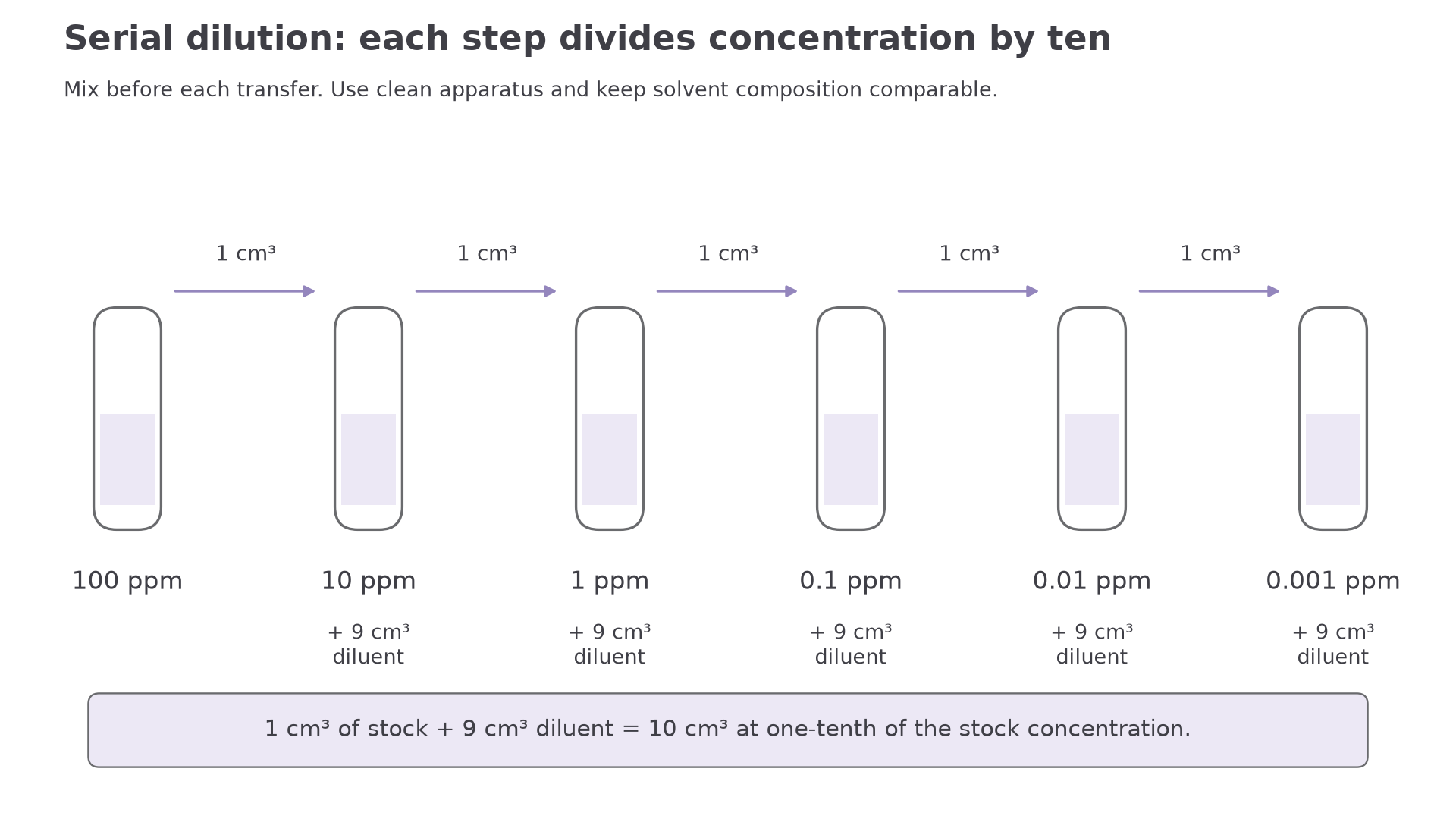
The accuracy of the dilution series depends on technique. Use clean measuring apparatus for each transfer, or a correctly rinsed apparatus if the method allows it. Mix each tube thoroughly before taking the next 1 cm³ sample. If the 10 ppm tube is not mixed, the next tube will not really be 1 ppm.
Preparing 0.1 ppm from 100 ppm stock
Start with 100 ppm stock.
Step 1: transfer 1 cm³ of 100 ppm stock into 9 cm³ water.
Step 2: transfer 1 cm³ of 10 ppm solution into 9 cm³ water.
Step 3: transfer 1 cm³ of 1 ppm solution into 9 cm³ water.
Each interval is a factor of 10, so the concentration range is logarithmic.
The highest concentration is often the original stock solution. Do not accidentally make every tube a dilution and then forget to include the stock treatment.
Processing Growth Data
Raw length data are usually processed before a conclusion is drawn. First calculate a mean for each concentration. Then compare each treatment with the water control. Percentage change is useful because it expresses stimulation or inhibition relative to baseline growth.
Continue this lesson.
You’re previewing NovaLearn without an account. Create a free account to read the rest.
Create free account