6.2.1(b)(i)-(ii) - Micropropagation and artificial plant cloning
Artificial plant cloning uses laboratory tissue culture to make many plants with the same genotype as a selected parent plant. In this lesson you will learn how micropropagation works, why sterile conditions and plant growth substances matter, and how to evaluate its use in horticulture and agriculture. The key skill is not just describing the stages, but deciding when producing many identical plants is useful and when it creates risk.
Artificial Plant Clones
A clone is an organism or cell that is genetically identical to another organism or cell. Plants can form clones naturally, and cuttings can be used as a simple cloning technique, but this lesson focuses on artificial plant cloning in a laboratory.
Micropropagation
Micropropagation is the production of many genetically identical plantlets from small pieces of plant tissue grown by tissue culture.
Tissue culture
Tissue culture is the growth of plant cells, tissues or organs in vitro on a sterile nutrient medium.
The starting material is an explant, which is a small piece of plant tissue. Explants are often taken from actively dividing regions such as shoot tips, root tips or buds. These tissues are useful because many plant cells are totipotent: with suitable conditions, they can divide and develop into a whole plant.
The purpose is controlled multiplication. Instead of waiting for a plant to produce seeds or enough cuttings, a grower can take tissue from one selected plant and produce large numbers of plantlets with the same desirable genotype.
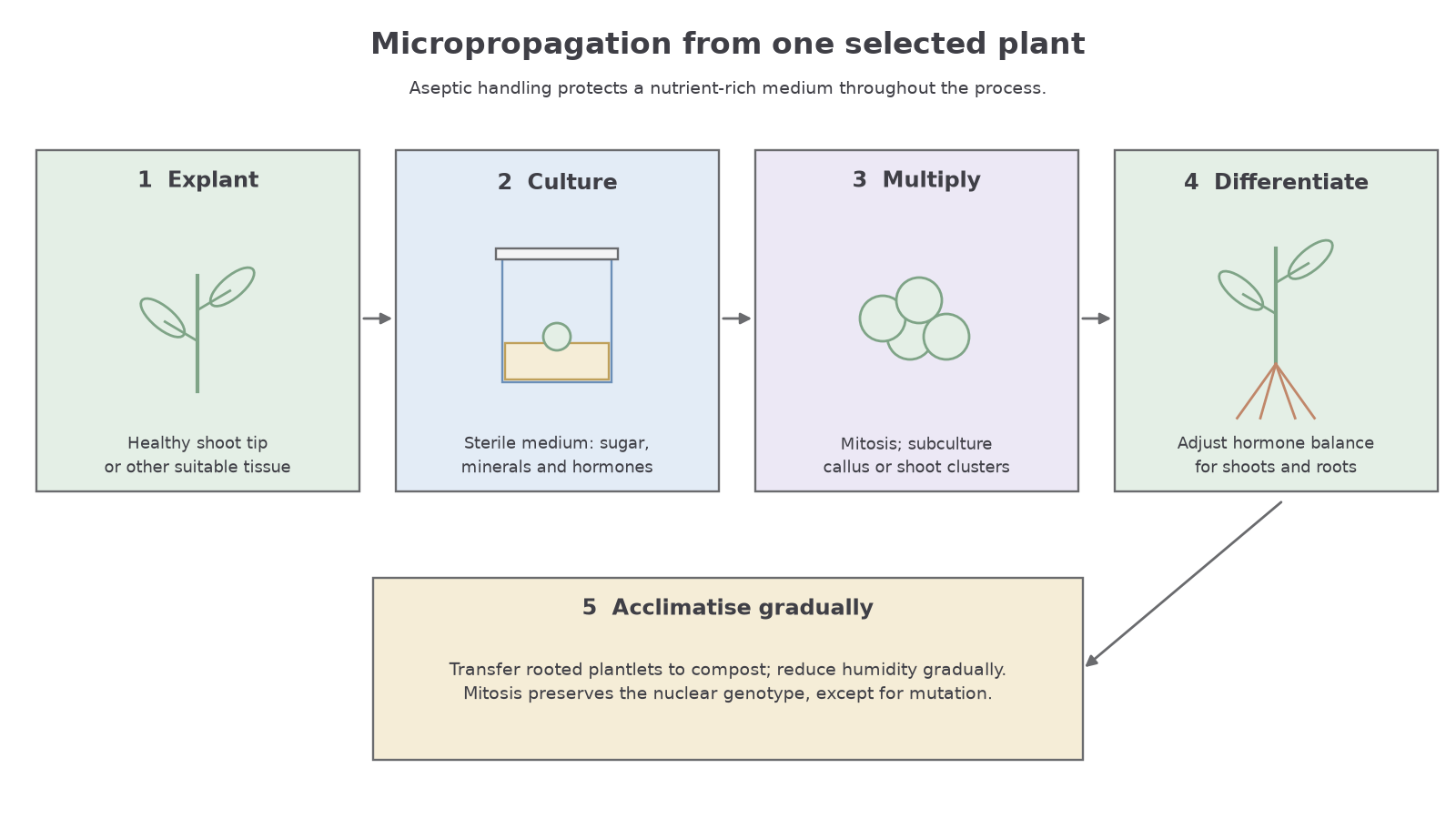
[DIAGRAM: micropropagation_sequence: Lesson 157: Micropropagation and artificial plant cloning - diagram 01; asset_slug: 157_m06_2_1_micropropagation_and_artificial_plant_cloning__diagram_01; recommended_method: drawn_biology; description: A deterministic 16:9 flow diagram showing micropropagation from selected parent plant to sterile explant, nutrient medium, callus or shoot multiplication, rooting plantlets and acclimatisation to soil, with asepsis and hormone control highlighted.]
Starting The Culture
Micropropagation starts with a carefully chosen parent plant. The parent is selected because it has desirable characteristics, such as high yield, attractive flowers, disease resistance, uniform fruit quality or rapid growth. If the parent is unhealthy or infected, the clones may inherit the same problem or the culture may fail.
The explant must be placed into culture using aseptic technique. Aseptic means preventing contamination by microorganisms. This matters because the culture medium contains water, mineral ions, sugars and other nutrients. These conditions support plant cell division, but they also support rapid growth of bacteria and fungi if the culture is contaminated.
Why asepsis is needed
A student places a leaf explant onto a nutrient agar medium without sterilising the tissue or apparatus. After a few days, a visible fungal growth covers the medium.
The problem is not only that the fungus is present. The fungus can compete with the plant tissue for nutrients and space, release waste products, and overgrow the explant. The plant culture may then die or fail to divide.
The medium supplies the resources that the tiny explant cannot obtain for itself. It may contain sugars for respiration, mineral ions for growth, amino acids or other nutrients, and plant growth substances. The balance of growth substances affects whether cells keep dividing, form a callus, or differentiate into shoots and roots.
Callus
A callus is a mass of undifferentiated plant cells formed when cells divide but have not yet developed into specialised tissues.
The nutrients have different functions. Sucrose supplies a respiratory substrate, providing ATP for cell division; nitrate or amino acids supply nitrogen for proteins; phosphate is needed for nucleotides, phospholipids and ATP. Supplying a named nutrient without its function does not explain why the medium supports growth.
Surface sterilisation removes microorganisms on the outside of an explant. It does not guarantee removal of an internal virus. Shoot-meristem culture can help obtain virus-free stock because the rapidly dividing tip may contain little or no virus, but the resulting stock must be checked before large-scale multiplication.
Multiplying Plantlets
Once the explant is established, cells divide by mitosis. The culture may form a callus, or shoots may develop directly from the explant depending on the tissue and hormone balance. The important biological idea is that the cells divide and are then encouraged to differentiate into plant tissues.
The growing tissue is often divided into smaller pieces and transferred to fresh sterile medium. This is called subculturing. Each small piece can divide again, so one original explant can produce many separate plantlets.
Plant growth substances are used to control development. A higher cytokinin to auxin balance often encourages shoot formation, while auxin is commonly used to encourage root formation. You do not need to memorise named chemicals for this lesson; the important idea is that hormones or plant growth substances direct differentiation into shoots and roots.
Turning one explant into many plantlets
- Take a small explant from a selected parent plant.
- Surface-sterilise the explant and place it on sterile nutrient medium.
- Allow cells to divide by mitosis, forming a callus or multiple shoots.
- Divide the callus or shoot clusters into smaller pieces and transfer them to fresh medium.
- Use suitable plant growth substances to encourage shoot and root development.
- Transfer plantlets to compost or soil and acclimatise them to lower humidity and less protected conditions.
Continue this lesson.
You’re previewing NovaLearn without an account. Create a free account to read the rest.
Create free account