3.1.3(a)-(b)(iii) - Plant transport systems and vascular tissue
Large multicellular plants cannot rely on diffusion alone to connect roots, stems and leaves. In this lesson you will use size, metabolic demand and surface-area-to-volume ratio to explain why transport systems are needed, then link xylem and phloem structure to function in herbaceous dicotyledonous plants. You will also learn how stained sections and stem dissections provide practical evidence for the position and structure of vascular tissue.
Why Plants Need Transport
A small unicellular organism can exchange enough substances across its surface because every part of the cell is close to the outside. A large multicellular plant has a different problem: many living cells are deep inside roots, stems or leaves, and different organs do different jobs. Roots absorb water and mineral ions; leaves make assimilates such as sucrose by photosynthesis; growing tissues need a supply of raw materials and products of photosynthesis.
Diffusion is effective only over short distances. As a plant becomes larger, its total surface area increases, but its volume increases faster. That means each unit volume of living tissue has less external surface available for direct exchange. The plant therefore needs a transport system to move substances between organs.
Surface-Area-To-Volume Ratio
Surface-area-to-volume ratio is the amount of surface area available for exchange compared with the volume of tissue that needs supplying.
Comparing Two Cubes
For a cube:
surface area =
volume =
A cube with side length 1 mm has:
surface area = mm²
volume = mm³
SA:V = 6:1
A cube with side length 10 mm has:
surface area = mm²
volume = mm³
SA:V = 600:1000 = 0.6:1
The larger cube has much less surface area for each unit of volume, so diffusion across the outside would be too slow to supply all the cells.
Plants also have a metabolic demand. Living plant cells respire, actively transport mineral ions, make proteins, build cell walls and maintain concentration gradients. A higher metabolic rate means faster use of substances and faster production of waste, so the transport problem is not only about size; it is also about the activity of the cells being supplied.
When explaining the need for plant transport, link three ideas: large size increases diffusion distance, low surface-area-to-volume ratio reduces exchange surface per unit volume, and metabolic activity creates demand for substances.
Vascular Tissue Structure
The vascular system in plants is made mainly from xylem and phloem. They are both transport tissues, but they are not the same kind of tube.
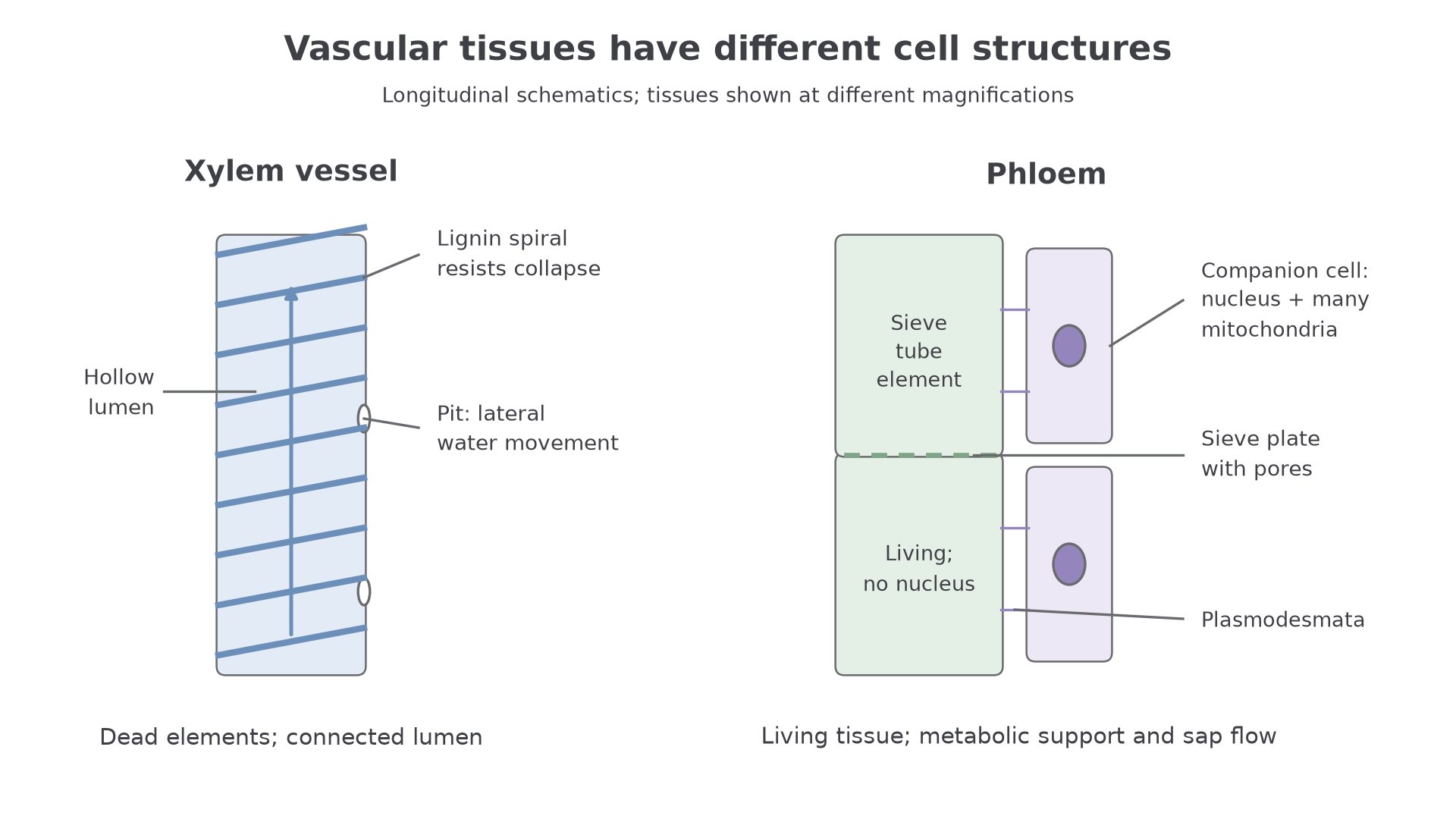
Xylem vessels transport water and mineral ions, mainly from roots towards leaves. A xylem vessel is formed from vessel elements joined end to end. Mature vessel elements are dead and hollow, so there is no living cytoplasm blocking the lumen. The end walls are lost or perforated during differentiation, producing a connected water-conducting lumen. Their walls are strengthened with lignin, which supports the plant and helps prevent the vessel collapsing under tension. Lignin may be laid down in rings, spirals or other thickenings. Pits in the wall allow water to move sideways between xylem vessels and nearby tissues.
Phloem transports assimilates, especially sucrose, between parts of the plant, such as from photosynthesising leaves to growing or storage tissues. The full mechanism of translocation is taught later; here, the important point is that phloem is a living transport tissue.
Phloem contains sieve tube elements and companion cells. Sieve tube elements are living cells arranged end to end. Their end walls form sieve plates with pores, so sap can pass from one sieve tube element to the next. Sieve tube elements have little cytoplasm and no nucleus at maturity, so companion cells carry out many metabolic functions for them. Companion cells contain a nucleus and many mitochondria, which provide ATP for metabolic support and active loading. They connect to sieve tube elements by numerous plasmodesmata.
[DIAGRAM: vascular_tissue_cell_structure: Lesson 066: Plant transport systems and vascular tissue practicals - diagram 01; asset_slug: 066_m03_1_3_plant_transport_systems_and_vascular_tissue_practicals__diagram_01; recommended_method: drawn_biology; description: A clean 16:9 line drawing comparing xylem vessel structure with phloem sieve tube elements and companion cells, including lignified thickening, pits, hollow lumen, sieve plates and metabolic support.]
| Tissue | Main transported material | Cell status at maturity | Structure-function link |
|---|---|---|---|
| Xylem vessel | Water and mineral ions | Dead, hollow vessel elements | Lignified walls provide support and reduce collapse; hollow lumen gives low resistance |
| Sieve tube element | Assimilates such as sucrose in phloem sap | Living but reduced, with sieve plates | End-to-end arrangement and sieve plates allow sap movement |
| Companion cell | Does not form the transport tube itself | Living, metabolically active | Supports sieve tube elements, including processes that require energy |
Do not call all plant transport tissue "vessels". Xylem has vessels. Phloem has sieve tube elements and companion cells.
Distribution In Dicot Organs
Herbaceous plants have non-woody stems. This lesson examines the characteristic vascular arrangement of herbaceous dicotyledonous plants. Dicotyledonous plants are flowering plants with a characteristic arrangement of vascular tissue in roots and stems. Monocot stems can have scattered vascular bundles, but that is not the required arrangement here.
Continue this lesson.
You’re previewing NovaLearn without an account. Create a free account to read the rest.
Create free account