5.2.2(h) - Chemiosmotic theory
ATP production in respiration and photosynthesis depends on a surprisingly similar idea: a membrane can store energy as a proton gradient. In this lesson you will learn how an electron transport chain, a proton gradient and ATP synthase work together in oxidative phosphorylation and photophosphorylation. The core challenge is keeping the direction of electrons and protons precise.
The Shared Chemiosmotic Model
The chemiosmotic theory explains how energy from electron transport can be used to make ATP. Chemiosmosis couples proton movement down an electrochemical gradient to ATP synthesis; it is not ordinary osmosis of water.
Chemiosmosis
Chemiosmosis is the movement of protons down an electrochemical gradient through ATP synthase, using the stored energy in the gradient to make ATP from ADP and inorganic phosphate.
The theory uses three core components in a clear sequence:
- An electron transport chain is embedded in a membrane.
- Energy released as electrons pass along the chain is used to move protons, or H⁺ ions, across the membrane.
- This builds a proton gradient, with a higher proton concentration on one side of the membrane than the other.
- Protons diffuse back down the gradient through ATP synthase.
- ATP synthase uses this flow of protons to catalyse the formation of ATP from ADP and inorganic phosphate.
[DIAGRAM: chemiosmotic_shared_model: Lesson 132: Chemiosmotic theory - diagram 01; asset_slug: 132_m05_2_2_chemiosmotic_theory__diagram_01; recommended_method: drawn_biology; description: A deterministic 16:9 mechanism diagram showing a membrane with an electron transport chain pumping protons to a high-H+ side, a proton gradient, ATP synthase allowing protons to diffuse back to the low-H+ side, and ADP plus Pi forming ATP.]
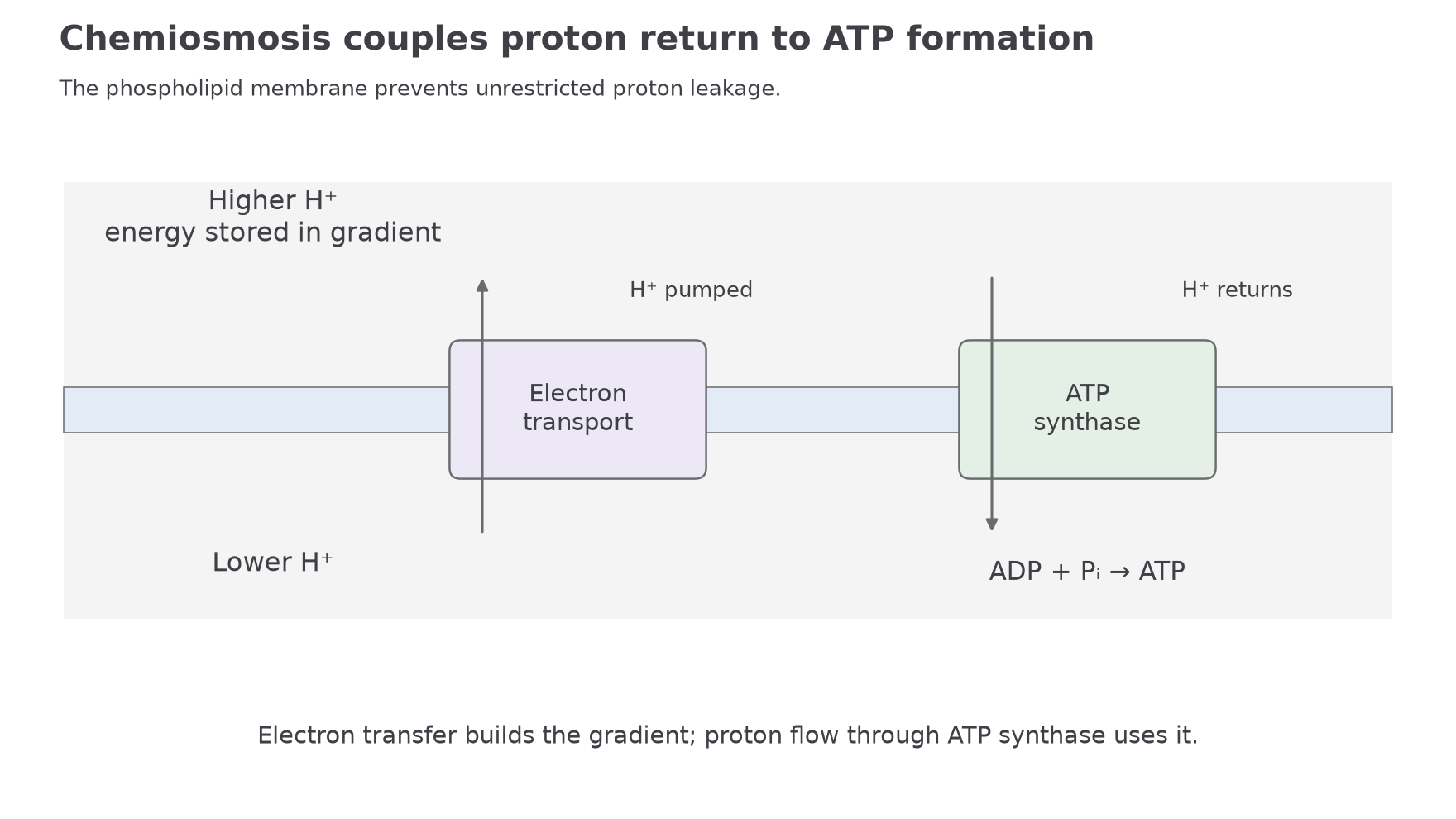
The membrane matters because it keeps the two sides separate. If protons could cross the membrane freely anywhere, the gradient would collapse and ATP synthase could not use it.
Electrons pass along the electron transport chain; protons move across the membrane and then back through ATP synthase.
Oxidative Phosphorylation
In oxidative phosphorylation, the chemiosmotic theory applies to the inner mitochondrial membrane, especially the cristae. This links naturally to the previous respiration lesson: reduced NAD and reduced FAD carry hydrogen atoms from earlier stages of respiration to the electron transport chain.
The sequence is:
- Reduced NAD and reduced FAD are oxidised, releasing electrons and protons.
- Electrons pass along electron carriers in the inner mitochondrial membrane.
- Energy released from electron transfer is used to pump protons from the mitochondrial matrix into the intermembrane space.
- A proton gradient forms across the inner mitochondrial membrane.
- Protons diffuse from the intermembrane space back into the matrix through ATP synthase.
- ATP synthase catalyses phosphorylation of ADP using inorganic phosphate, forming ATP.
Oxidative Phosphorylation
Oxidative phosphorylation is ATP production associated with electron transport in aerobic respiration, using chemiosmosis across the inner mitochondrial membrane.
Oxygen belongs in the wider oxidative phosphorylation picture because it acts as the final electron acceptor. For this lesson, the key chemiosmotic role is that electron transport releases the energy used to pump protons and maintain the gradient.
Use "protons" or "H⁺ ions" when describing the gradient. OCR may not accept vague "hydrogen" if the answer needs proton movement.
Use that particle distinction throughout the sequence in the next check.
What ATP Synthase Does
ATP synthase is not just a hole in the membrane. It is an enzyme complex that allows protons to move down their electrochemical gradient and couples that movement to ATP synthesis.
ATP Formation
The energy is not stored in the protons as if they were carrying ATP. The energy is stored in the gradient: a difference in proton concentration and charge across the membrane. When protons move down that gradient through ATP synthase, the enzyme can catalyse phosphorylation of ADP.
This gives a useful contrast:
| Process | Direction | Protein involved | Energy use |
|---|---|---|---|
| Proton pumping | Protons move against their gradient | Electron transport chain proteins/carriers | Uses energy released by electron transfer |
| Proton diffusion | Protons move down their gradient | ATP synthase | Drives ATP synthesis |
Continue this lesson.
You’re previewing NovaLearn without an account. Create a free account to read the rest.
Create free account