6.2.1(e)-(f) - Microorganisms in biotechnology and food
Microorganisms can be grown as tiny biological factories. In this lesson, you will learn why bacteria and fungi are useful in biotechnology, then use bacterial and fungal food examples to weigh benefits and risks. The product may be the microbial cells themselves or a substance they make.
Microbial Biotechnology
Biotechnology means using living organisms, or parts of living organisms, to make useful products or carry out useful processes. In this lesson the living organisms are microorganisms, especially bacteria and fungi. Yeasts are single-celled fungi, and moulds are filamentous fungi.
Microorganism
A microorganism is an organism that is too small to be seen clearly without a microscope, such as a bacterium, yeast or mould.
Microorganisms are useful in biotechnology because they can turn simple raw materials into useful biomass or products. For example, bacteria can convert lactose in milk into lactic acid during yoghurt production, and fungi can be grown to produce mycoprotein for meat-free foods. Other biotechnology processes can use microorganisms to make medicines, enzymes or useful chemicals, but this lesson's food examples stay with bacterial and fungal sources.
Each microbial feature affects the economics of production:
| Feature of microorganisms | Why it helps biotechnology |
|---|---|
| Short life cycle | The population can increase rapidly, so product yield can be increased quickly. |
| Simple growth requirements | Many species can grow using relatively simple sources of carbon, nitrogen, minerals and water. |
| Small size | Large numbers can be grown in a small space compared with crops or animals. |
| Controlled conditions | Production can occur throughout the year, with less dependence on climate or season. |
| Genetic variation and genetic modification | Useful strains can be selected or engineered to improve yield or product quality. |
"Cheap" and "quick" are not enough on their own. Say why: production can be low cost because microorganisms may need simple nutrients, little space and moderate temperatures; production can be rapid because microorganisms reproduce quickly.
From Growth To Products
Microbial biotechnology depends on matching the organism's growth requirements to the product wanted. A growing microorganism needs raw materials to build new cells and run metabolism. A carbon source, such as glucose or lactose, supplies carbon and energy. A nitrogen source, such as ammonia or amino acids, can be used to make amino acids, proteins and nucleic acids. Minerals, water, suitable pH and a suitable temperature help enzymes work effectively.
A strain selected to produce an enzyme is not necessarily the best strain for producing edible biomass. The objective determines which growth conditions and downstream separation steps matter.
[DIAGRAM: microbial_food_decision_map: Lesson 159: Microorganisms in biotechnology and food production - diagram 01; asset_slug: 159_m06_2_1_microorganisms_in_biotechnology_and_food_production__diagram_01; recommended_method: drawn_biology; description: Deterministic 16:9 grey line decision map linking why microorganisms are useful in biotechnology to bacterial and fungal food-source examples, then weighing advantages and disadvantages for HSW evaluation.]
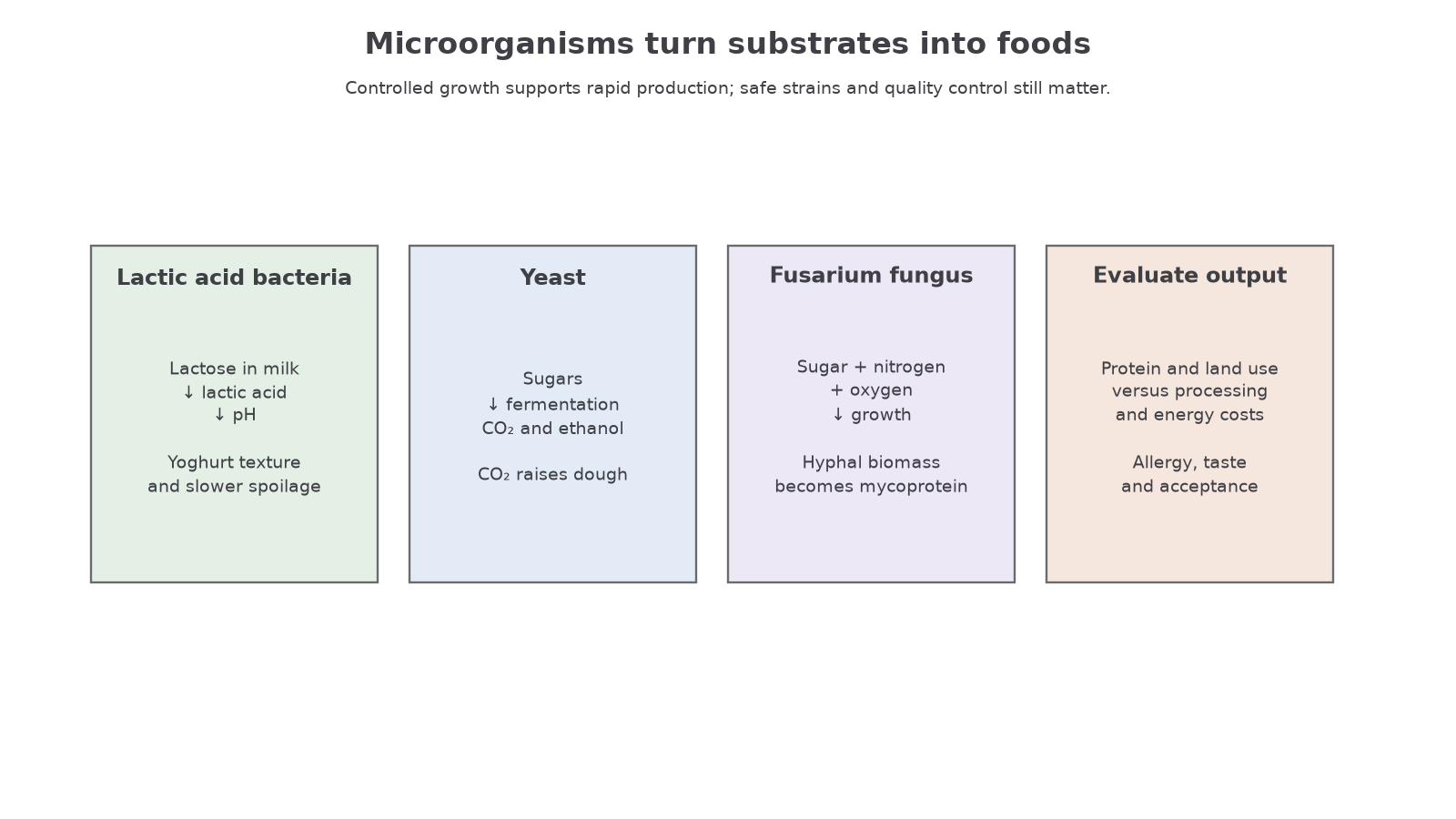
The diagram distinguishes harvesting the organism itself from using a product of its metabolism.
When a question asks for advantages of microorganisms in food production, qualify the point. "Rapid growth" is stronger than "fast", and "low cost because little space and moderate temperatures are needed" is stronger than "cheap".
Bacterial Food Sources
A bacterial food source is a food produced using bacteria or containing bacterial biomass. A useful example is yoghurt, which is made using lactic acid bacteria such as Lactobacillus delbrueckii and Streptococcus thermophilus.
In yoghurt production, the bacteria use lactose from milk as a substrate and convert it into lactic acid. The lactic acid lowers the pH. This matters for three linked reasons:
- Acidic conditions contribute to yoghurt flavour.
- The lower pH changes milk proteins, helping form the thicker texture.
- The lower pH can inhibit many spoilage or pathogenic microorganisms, helping extend shelf life.
Lactic Acid Fermentation
Lactic acid fermentation is the conversion of sugars, such as lactose, into lactic acid by microorganisms under conditions where lactic acid is the main useful product.
Do not write that lactic acid "kills all bacteria". The better explanation is that a lower pH can reduce the growth of many unwanted microorganisms because their enzymes work less effectively away from their optimum pH, or may denature at more extreme pH values.
OCR can also connect food production to earlier protein chemistry. If bacteria break down casein, the protein in milk, the products are amino acids or shorter peptides. The reaction is hydrolysis because water is used to break peptide bonds. That is not a new biotechnology process to memorise; it is an application of biological molecules in a food-production context.
Continue this lesson.
You’re previewing NovaLearn without an account. Create a free account to read the rest.
Create free account