5.1.5(j) - Fight or flight and adrenaline signalling
A sudden threat needs a whole-body response, not one isolated organ changing on its own. In this lesson you will learn how the nervous and endocrine systems coordinate the mammalian fight-or-flight response, then zoom into the outline cell-signalling pathway for adrenaline. The key distinction is simple but easy to blur: adrenaline is the first messenger outside the target cell, while cyclic AMP is a second messenger inside the target cell.
A Coordinated Alarm Response
The fight-or-flight response is a coordinated set of physiological changes that prepares a mammal for rapid action when it detects danger or another stressful environmental stimulus. The response is not just "feeling scared"; it changes the activity of several organs so that muscles can receive more oxygen and respiratory substrate.
Coordination needs both nervous and endocrine communication.
| Communication route | Main role in fight-or-flight | Why it is useful |
|---|---|---|
| Nervous system | Detects the stimulus, processes information in the central nervous system, and sends rapid impulses through the autonomic nervous system | Very fast, directed signalling |
| Endocrine system | Adrenal medulla secretes adrenaline into the blood | Widespread hormone signal that reaches many target tissues |
The usual sequence is:
- A threatening environmental stimulus is detected by receptors.
- Sensory information is passed to the central nervous system.
- The sympathetic branch of the autonomic nervous system helps start the response.
- Nervous impulses stimulate the adrenal medulla.
- The adrenal medulla secretes adrenaline into the blood.
- Adrenaline is transported to target tissues that have suitable receptors.
Adrenaline
Adrenaline is a hormone secreted by the adrenal medulla that helps prepare the body for rapid activity during a fight-or-flight response.
Do not make the response purely hormonal or purely nervous. Coordination means that nervous signalling starts and directs the response, while endocrine signalling helps coordinate widespread target tissues.
Target Organ Effects
Adrenaline is carried around the body in the blood, but only target cells respond. A target cell has receptors and signalling machinery that allow it to detect the hormone and change its activity.
[DIAGRAM: fight_or_flight_coordination: Lesson 118: Fight or flight and adrenaline second messenger signalling - diagram 01; asset_slug: 118_m05_1_5_fight_or_flight_and_adrenaline_second_messenger_signalling__diagram_01; recommended_method: drawn_biology; description: A deterministic 16:9 flow diagram showing threat detection, CNS coordination, sympathetic impulses to the adrenal medulla, adrenaline in blood, and coordinated target-organ effects in heart, lungs, liver or muscle, and blood flow.]
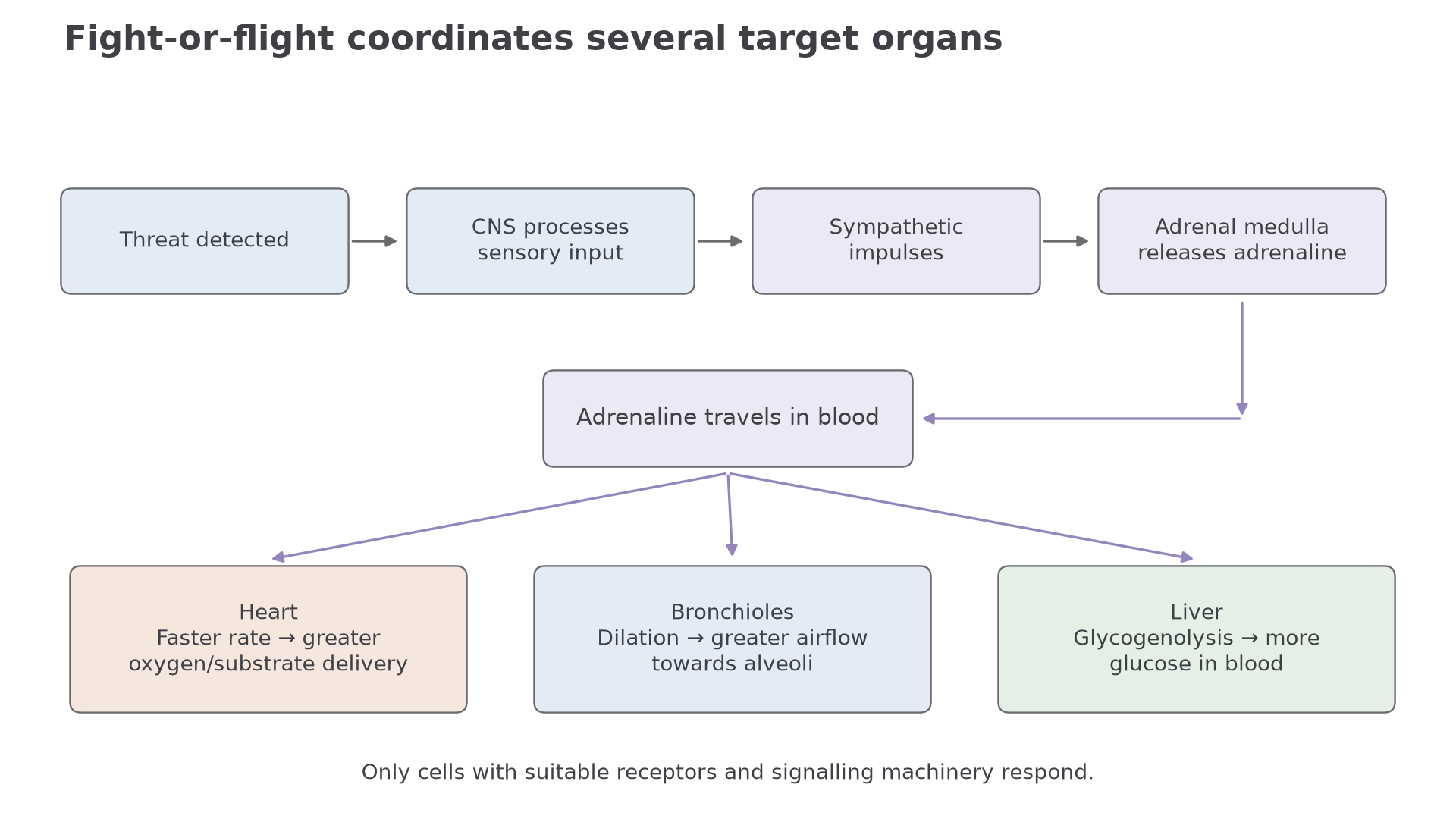
Useful fight-or-flight effects include:
| Target tissue or organ | Response | How this supports fight-or-flight |
|---|---|---|
| Heart or sino-atrial node | Heart rate increases | Blood circulates faster, delivering oxygen and glucose more quickly |
| Bronchioles | Bronchioles dilate and breathing rate may increase | More air reaches the alveoli, supporting oxygen uptake |
| Liver cells | Glycogenolysis increases | More glucose becomes available for respiration |
| Skeletal muscles | More blood flow and more respiratory substrate available | Muscles can contract powerfully for rapid movement |
| Gut | Blood flow decreases | Blood is redirected away from digestion towards muscles |
| Iris muscles | Pupils dilate | More light enters the eye, supporting visual detection of danger |
The important reasoning pattern is target -> response -> survival value. For example, it is stronger to say "adrenaline increases glycogenolysis in liver cells, making more glucose available for respiration" than simply to say "adrenaline affects the liver".
Linking a response to its role
Suppose adrenaline acts on smooth muscle in bronchioles.
The smooth muscle relaxes, so the bronchioles dilate. Wider bronchioles allow more air to move towards the alveoli. This helps maintain a steep diffusion gradient for oxygen uptake into the blood, supporting aerobic respiration in active muscles.
Use the same response-to-benefit link for two effects.
Continue this lesson.
You’re previewing NovaLearn without an account. Create a free account to read the rest.
Create free account