5.2.1(a) - Photosynthesis and respiration interrelationship
Photosynthesis builds organic molecules using light energy, while respiration transfers energy from organic molecules to ATP. Their reactants and products link the processes. Comparing their rates explains why a leaf can take up or release carbon dioxide as light changes.
Linked Processes
Photosynthesis and aerobic respiration are connected, but they are not simply the same reaction running backwards. They happen in different cell structures, involve different enzyme-controlled pathways, and transfer energy in different directions.
Photosynthesis
Photosynthesis is the process in which light energy is used to make organic molecules from carbon dioxide and water in photosynthetic organisms.
Aerobic respiration
Aerobic respiration is the process in which organic molecules are broken down using oxygen, releasing energy that can be used to make ATP.
The relationship in this lesson is the overview relationship between raw materials and products:
- photosynthesis uses carbon dioxide and water, and produces glucose and oxygen
- aerobic respiration uses glucose and oxygen, and produces carbon dioxide and water
Plants, algae and some bacteria can photosynthesise. Living plant, animal and microbial cells transfer chemical energy to ATP through respiration or related energy-releasing pathways. A green plant is therefore not a "photosynthesis-only" organism: its cells respire as well.
[DIAGRAM: photosynthesis_respiration_interrelationship: Lesson 121: Photosynthesis and respiration interrelationship - diagram 01; asset_slug: 121_m05_2_1_photosynthesis_and_respiration_interrelationship__diagram_01; recommended_method: drawn_biology; description: Deterministic drawn flow diagram linking photosynthesis and aerobic respiration through glucose, oxygen, carbon dioxide and water, with separate arrows for light energy input and ATP-linked energy release.]
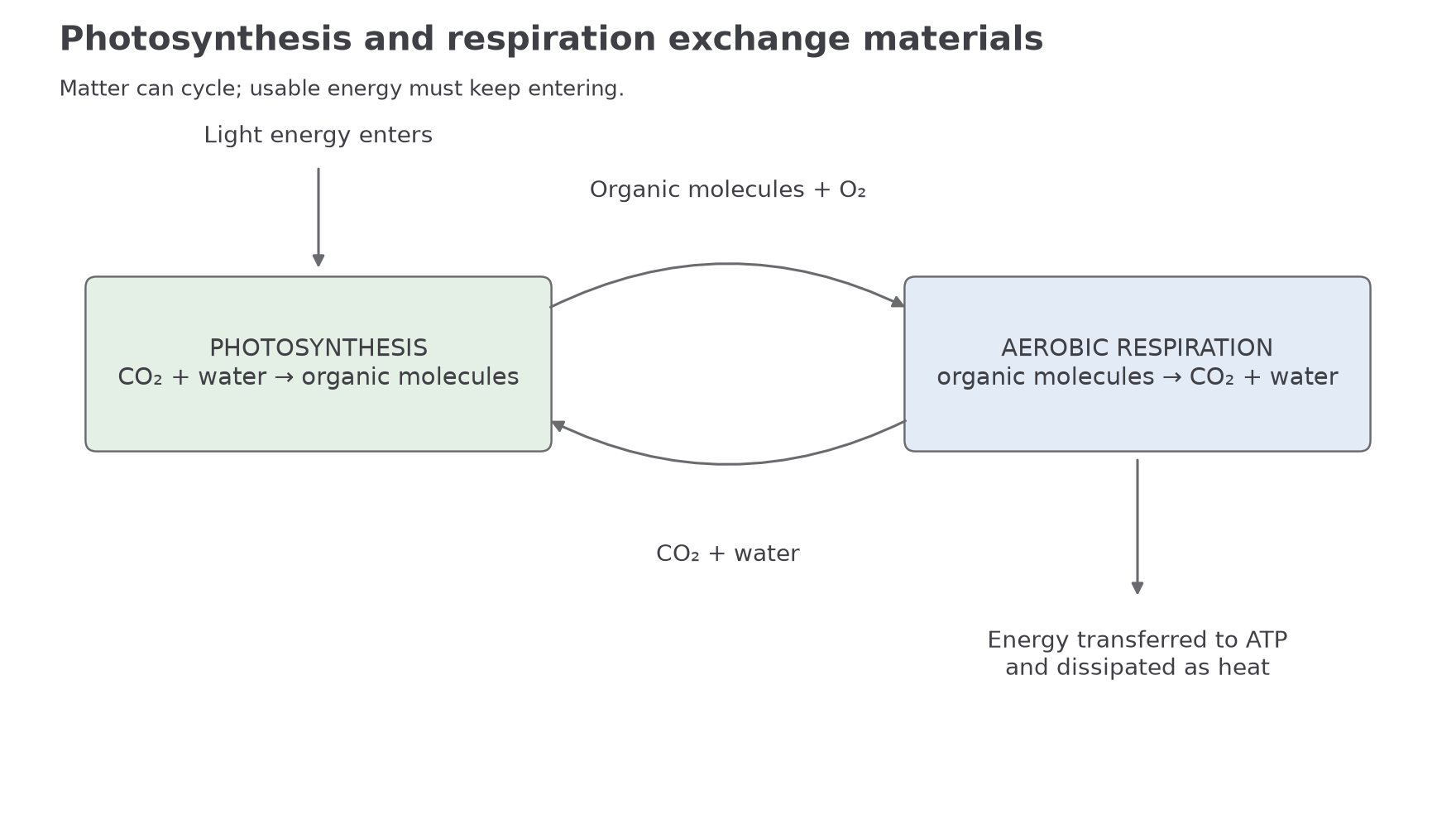
Raw Materials And Products
A raw material is a substance used up as a reactant in a process. A product is a substance made by that process. The key OCR idea is that a product of one of these processes can be a raw material for the other.
| Process | Raw materials | Main products | Energy transfer |
|---|---|---|---|
| Photosynthesis | Carbon dioxide and water | Glucose and oxygen | Light energy is transferred into chemical energy stored in organic molecules |
| Aerobic respiration | Glucose and oxygen | Carbon dioxide and water | Chemical energy in organic molecules is released for ATP production |
The simplified equation for photosynthesis is:
Photosynthesis Summary
The simplified equation for aerobic respiration is:
Aerobic Respiration Summary
These equations are useful for ratios. In the simplified photosynthesis equation, 6 molecules of carbon dioxide are linked with 1 molecule of glucose and 6 molecules of oxygen. That means the carbon dioxide:glucose ratio is 6:1, and the carbon dioxide:oxygen ratio is 1:1.
Using The Equation As A Sense Check
A student predicts that making 2 molecules of glucose by photosynthesis would use 8 molecules of carbon dioxide.
From the simplified equation, 1 glucose needs 6 carbon dioxide. So 2 glucose would need:
The prediction of 8 is too low. Doubling glucose production doubles the carbon dioxide requirement: 2 × 6 gives 12, so 8 does not satisfy the 6:1 ratio.
Glucose in the equation is a simplified summary product. In real plant cells, photosynthetic products may be converted into sucrose, starch, cellulose, lipids, amino acids or other organic molecules. For this specification point, the important point is still the same: photosynthesis builds organic molecules using carbon dioxide and water, while respiration can break organic molecules down.
The equations also conserve atoms: one glucose contains the six carbon atoms supplied by six carbon dioxide molecules. A mole is a counting unit, so the same ratios apply to molecules, moles and millimoles. For example, glucose corresponds to carbon dioxide, or . Never compare a value in mol with one in mmol without converting it.
Estimate before calculating: fixing 0.98 mmol glucose needs a little under 6 mmol CO₂ because the ratio is 6:1. The exact result, 5.88 mmol, fits that estimate; 0.163 mmol would indicate an inverted ratio.
Continue this lesson.
You’re previewing NovaLearn without an account. Create a free account to read the rest.
Create free account