6.3.1(d) - Primary and deflected succession
Ecosystems are not fixed snapshots. Over time, the species in a community can change because organisms alter the abiotic conditions around them, and those new conditions favour different species. In this lesson, you will learn the process of primary succession from pioneer species to a climax community, then see how human activity can deflect that sequence and maintain a plagioclimax community.
What Succession Describes
Succession is the directional change in the community of organisms in an ecosystem over time. It is not just that individual organisms grow older. The species present, their abundance, and the abiotic conditions of the habitat all change together.
Primary succession
Primary succession is the development of a community on newly formed or newly exposed land where there is no developed soil and no existing community.
Primary succession can begin on bare rock, cooled lava, newly exposed glacial material, or bare sand. The exact example matters less than the starting problem: there is little or no soil, little organic matter, few mineral ions available to plants, and poor water retention. Most larger plants cannot immediately survive there.
This is different from secondary succession, where a disturbance removes much of a community but leaves soil behind. Secondary succession is useful as a contrast, but this lesson focuses on primary succession: the development of an ecosystem from a bare, hostile starting point.
The process is gradual because early organisms change the habitat. Their growth, death and decomposition alter the abiotic conditions, so later species can establish. Those later species may then alter the conditions again and outcompete the earlier species.
Pioneer Species
The first species to colonise the bare substrate are called pioneer species. They form the pioneer community. Examples often used in primary succession include lichens, mosses and small hardy plants, but the key idea is not the name of one organism. The key idea is that pioneers can tolerate conditions that most later species cannot.
Pioneer species
Pioneer species are the first species to colonise a newly formed or newly exposed habitat during succession.
Pioneer species may arrive as spores, seeds or fragments from nearby habitats. They are successful early on because they can survive with little soil, few mineral ions, strong exposure, low water retention or large temperature changes. Some early plants can also form associations with nitrogen-fixing microorganisms, which can increase the availability of nitrate ions over time.
Pioneer species do not "try" to prepare the habitat for later species. Their ordinary life processes have that effect. As they grow, trap particles, weather rock surfaces, die and decompose, organic matter builds up. This improves the early soil. More humus can hold more water, and decomposition releases mineral ions. The habitat becomes less hostile for other plants.
[DIAGRAM: primary_succession_sequence: Lesson 167: Primary and deflected succession - diagram 01; asset_slug: 167_m06_3_1_primary_and_deflected_succession__diagram_01; recommended_method: drawn_biology; description: 16:9 NovaLearn-style sequence from bare rock/no soil through pioneer species, soil development, herb/grass/shrub seral stages and climax community, with side captions showing organic matter, soil depth, water retention and nitrate availability increasing.]
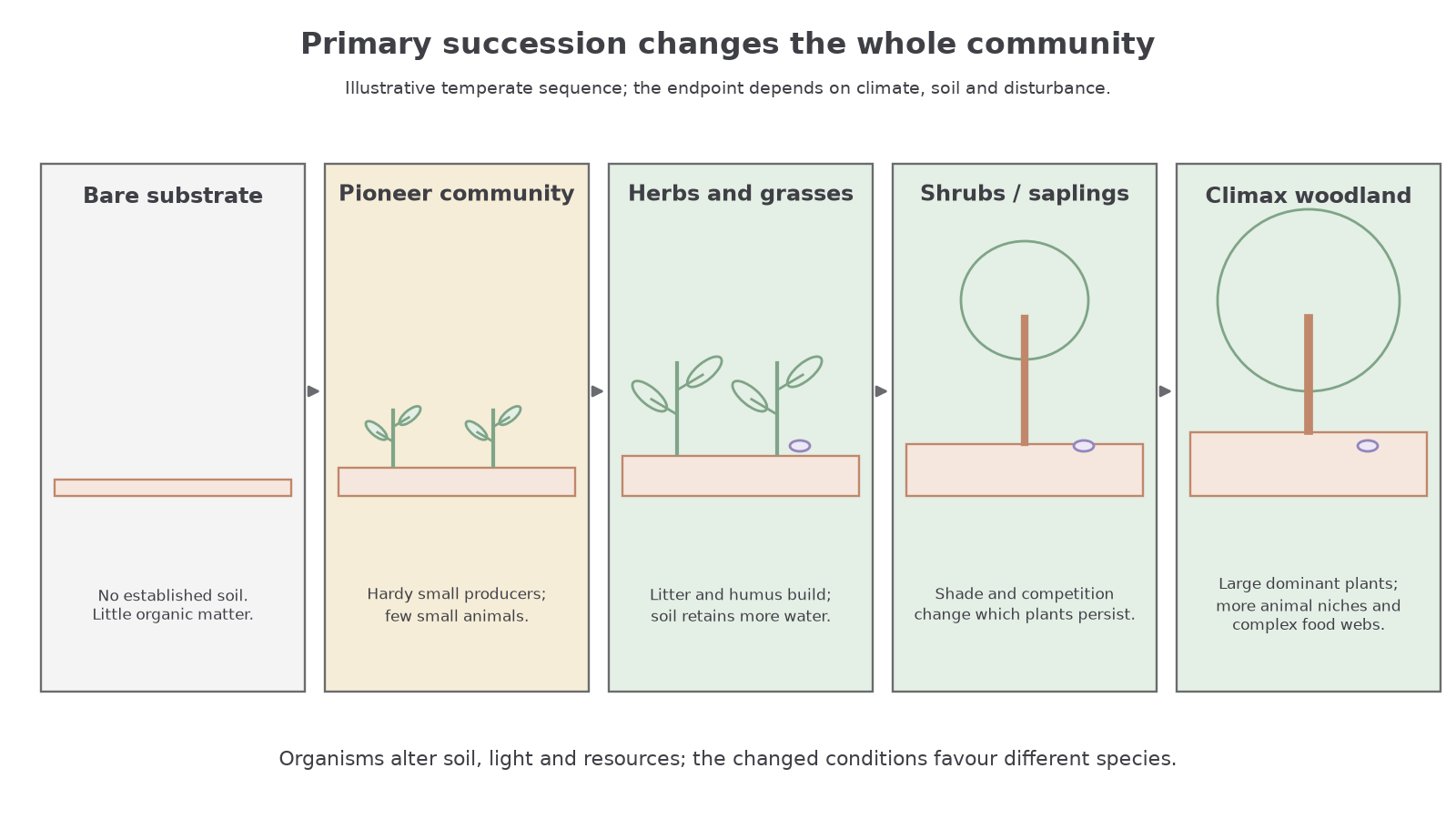
Read the diagram from left to right. The important pattern is that the community changes because the abiotic environment changes. Soil depth, organic matter, mineral ion availability and water retention usually increase as succession proceeds. These changes allow less hardy, larger or more competitive species to become established.
Avoid teleological wording. A precise answer says pioneer species alter abiotic conditions through growth, weathering, death and decomposition; it does not say they improve the habitat "so that" later species can arrive.
Lichens are a symbiotic association involving a fungus and a photosynthetic partner, not flowering plants. They can be pioneers on exposed rock, while mosses and grasses illustrate pioneer plants in suitable habitats. The first successful colonists depend on the substrate and local conditions.
Seral Stages To Climax
The full sequence of communities in succession is called a sere. Each intermediate community is a seral stage. A simple primary succession sequence might be:
- bare substrate with no developed soil;
- pioneer community, such as lichens, mosses or hardy plants;
- herb and grass community as soil improves;
- shrubs and young trees as soil deepens and water retention improves;
- climax community under the prevailing conditions.
Continue this lesson.
You’re previewing NovaLearn without an account. Create a free account to read the rest.
Create free account