5.1.1(d) - Temperature control in ectotherms and endotherms
Temperature control matters because enzyme-controlled reactions are sensitive to temperature. If body temperature moves too far from a suitable range, metabolic reactions become too slow or proteins may lose their functional shape. In this lesson you will compare two strategies: endotherms use internally generated heat and physiological feedback, while ectotherms rely much more on behavioural use of their surroundings.
Temperature control problem
Thermoregulation is the control of body temperature. It is part of homeostasis because the body is keeping an internal condition within limits even when the external environment changes.
Thermoregulation
Thermoregulation is the control of body temperature within a suitable range for enzyme-controlled reactions and cell function.
Biologists use the terms endotherm and ectotherm because they are more precise than "warm-blooded" and "cold-blooded". An endotherm uses heat generated within the body, mainly from metabolic reactions, to help maintain body temperature. Mammals and birds are endotherms. An ectotherm depends mainly on external heat sources, such as sunlight, warm surfaces, water or air. Reptiles, amphibians, fish and many invertebrates are ectotherms.
Endotherm
An endotherm uses heat produced internally by metabolic reactions to help maintain body temperature.
The paired term describes a different main heat source.
Ectotherm
An ectotherm depends mainly on external heat sources, so its body temperature is more affected by the environment.
The difference is not that ectotherms are always cold or that endotherms never use behaviour. The important contrast is the main source of heat and the main type of control. Endotherms usually control body temperature more precisely using physiological responses. Ectotherms control it less precisely, mostly by moving between warmer and cooler places.
Avoid the shortcut "cold-blooded". A lizard basking on a hot rock may have a high body temperature; it is still an ectotherm because the heat source is mainly external.
Endotherm feedback pathway
Endotherm temperature control is a negative-feedback system. A change in body temperature is detected, information is coordinated, effectors respond, and the response reduces the original change.
Peripheral temperature receptors are sensory receptors in places such as the skin. They detect temperature changes outside the body or near the body surface. The hypothalamus in the brain acts as the main coordinating centre. It receives information from peripheral receptors; its own thermoreceptors also detect the temperature of blood passing through it. It compares this information with the set point and coordinates responses by effectors.
Effector
An effector is a muscle or gland that brings about a response after receiving a signal from a coordinating centre.
For this specification point, the important effectors are in the skin and muscles:
| Effector | Type of effector | Why it matters in temperature control |
|---|---|---|
| Arterioles in the skin | Smooth muscle in blood vessel walls | Change blood flow near the body surface. |
| Sweat glands | Glands in the skin | Produce sweat, which can cool the skin by evaporation. |
| Hair erector muscles | Small muscles attached to hairs | Change hair position, which affects insulation in furry mammals. |
| Skeletal muscles | Muscles used for movement | Can contract rapidly during shivering to generate heat. |
[DIAGRAM: endotherm_temperature_control: Lesson 095: Temperature control - diagram 01; asset_slug: 095_m05_1_1_temperature_control_in_ectotherms_and_endotherms__diagram_01; recommended_method: drawn_biology; description: Warm and cold responses coordinated by the hypothalamus, with skin and blood temperature detection shown separately.]
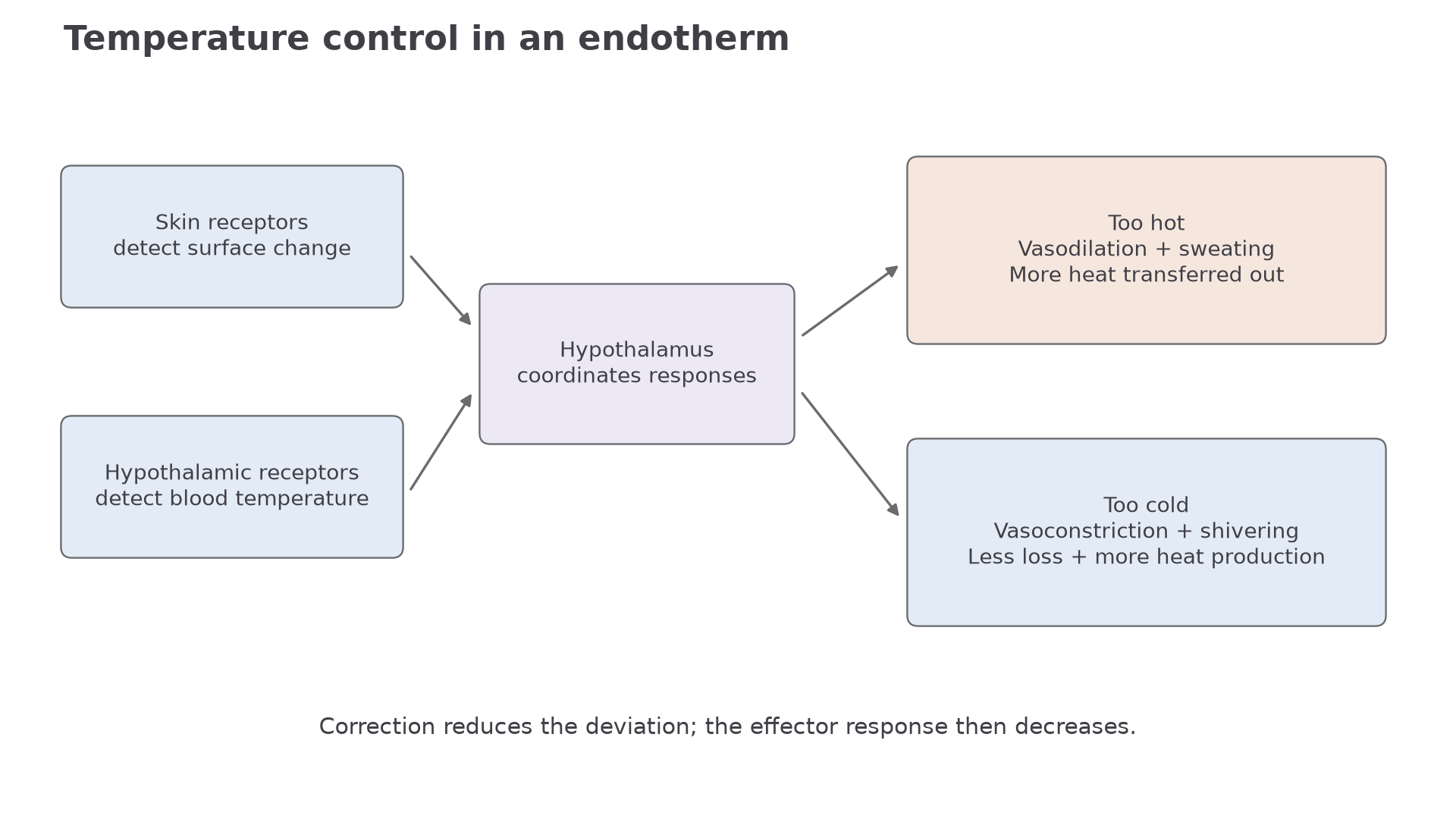
The hypothalamus does not cool or warm the body by itself. It coordinates effectors that change heat loss or heat production.
Too hot and too cold
When an endotherm is too hot, the response should increase heat loss. When it is too cold, the response should reduce heat loss or increase heat production. Follow the effect on heat transfer: arterioles change blood flow; evaporation transfers energy from skin to the surroundings.
| Temperature change | Physiological response | How the response helps |
|---|---|---|
| Too hot | Vasodilation of arterioles near the skin surface | More warm blood flows near the surface, so more heat is lost. |
| Too hot | More sweating | Evaporation of water from sweat removes heat from the skin. |
| Too hot | Hair erector muscles relax, so hairs lie flat | Less insulating air is trapped close to the skin. This is most useful in furry mammals. |
| Too cold | Vasoconstriction of arterioles near the skin surface | Less warm blood flows near the surface, so less heat is lost. |
| Too cold | Less sweating | Less heat is lost by evaporation. |
| Too cold | Hair erector muscles contract, so hairs stand up | More insulating air can be trapped in fur. In humans this has little warming effect. |
| Too cold | Shivering | Rapid skeletal muscle contractions increase respiration and generate heat. |
Vasodilation
Vasodilation is the widening of arterioles, increasing blood flow through a tissue such as the skin.
The opposite vessel response is used when heat needs to be conserved.
Vasoconstriction
Vasoconstriction is the narrowing of arterioles, reducing blood flow through a tissue such as the skin.
Behaviour can support these physiological responses. A human may move into shade, remove clothing or reduce activity when too hot. When too cold, a human may add clothing, move indoors or huddle with others. These behaviours do not make humans ectotherms; they are extra ways an endotherm changes heat exchange with the environment.
Ectotherm behavioural control
Ectotherms do control body temperature, but mainly by behaviour. Their body temperature usually varies more with the environment than an endotherm's body temperature does.
Continue this lesson.
You’re previewing NovaLearn without an account. Create a free account to read the rest.
Create free account