4.1.1(f)-(g) - Lymphocytes, clonal selection and immune memory
The specific immune response is the part of defence that recognises a particular antigen and builds a response against it. That specificity depends on B and T lymphocytes, which carry receptors that only fit certain antigens. In this lesson you will learn how the matching lymphocytes are selected, copied, differentiated and remembered, so that a second exposure to the same antigen produces a faster response.
Specific recognition
A lymphocyte is a type of white blood cell. B lymphocytes and T lymphocytes both have a large nucleus and a small amount of cytoplasm, but for the specific immune response the most important structural feature is on the cell surface: each lymphocyte has receptors with a particular shape.
Antigen
A molecule or part of a molecule recognised by specific immune receptors; foreign antigens can trigger a specific immune response.
The receptors on a lymphocyte are specific. This means they are complementary to one antigen shape, or a small part of an antigen. A pathogen carries many antigens, but any one lymphocyte clone responds only when its own receptor matches the antigen involved.
B and T lymphocytes use this specificity differently:
| Lymphocyte type | Key structural feature | Main biological role |
|---|---|---|
| B lymphocyte | Specific cell-surface receptors that can bind antigen | Can develop into plasma cells that secrete antibodies, and into B memory cells |
| T helper lymphocyte | Specific T-cell receptors; responds to antigen presented by another cell | Releases interleukins that coordinate and stimulate other immune cells |
| T killer lymphocyte | Specific T-cell receptors; responds to antigen on infected body cells | Destroys infected host cells |
T lymphocytes usually respond to antigen displayed on another cell, such as an antigen-presenting cell from the phagocytosis lesson or an infected body cell. You do not need the CD4, CD8 or MHC labels for this lesson unless a question supplies them. The important idea is that T cells also act specifically: the T-cell receptor must match the presented antigen.
When asked about lymphocyte structure in this topic, do not stop at "white blood cell". Link structure to function: specific receptors on the cell surface recognise a complementary antigen.
Selection, expansion and differentiation
The specific immune response works because the body already contains many different lymphocyte clones. A clone is a group of lymphocytes with the same receptor specificity. Before infection, the clone that matches a new antigen may be very rare. The pathogen does not make a new receptor appear; instead, it selects the rare lymphocytes that already have complementary receptors.
Clonal selection
Activation of the lymphocyte clone whose cell-surface receptor is complementary to a specific antigen.
After selection, the selected lymphocyte divides repeatedly by mitosis. This makes many genetically identical cells with the same receptor specificity. That copying stage is clonal expansion.
Clonal expansion
Repeated mitotic division of an activated lymphocyte to produce many cells of the same antigen specificity.
Expansion matters because one selected lymphocyte is not enough to clear an infection. The immune system needs many effector cells, which act immediately, and memory cells, which remain after the first response.
[DIAGRAM: specific_immune_response_pathway: Lesson 074: Lymphocytes, clonal selection and immune memory - diagram 01; asset_slug: 074_m04_1_1_lymphocytes_clonal_selection_and_immune_memory__diagram_01; recommended_method: drawn_biology; description: 16:9 NovaLearn-style pathway diagram showing pathogen antigen selecting matching B and T lymphocytes, clonal expansion by mitosis, differentiation into plasma cells, B memory cells, T helper cells, T killer cells and T memory cells, with interleukin signalling and faster secondary response.]
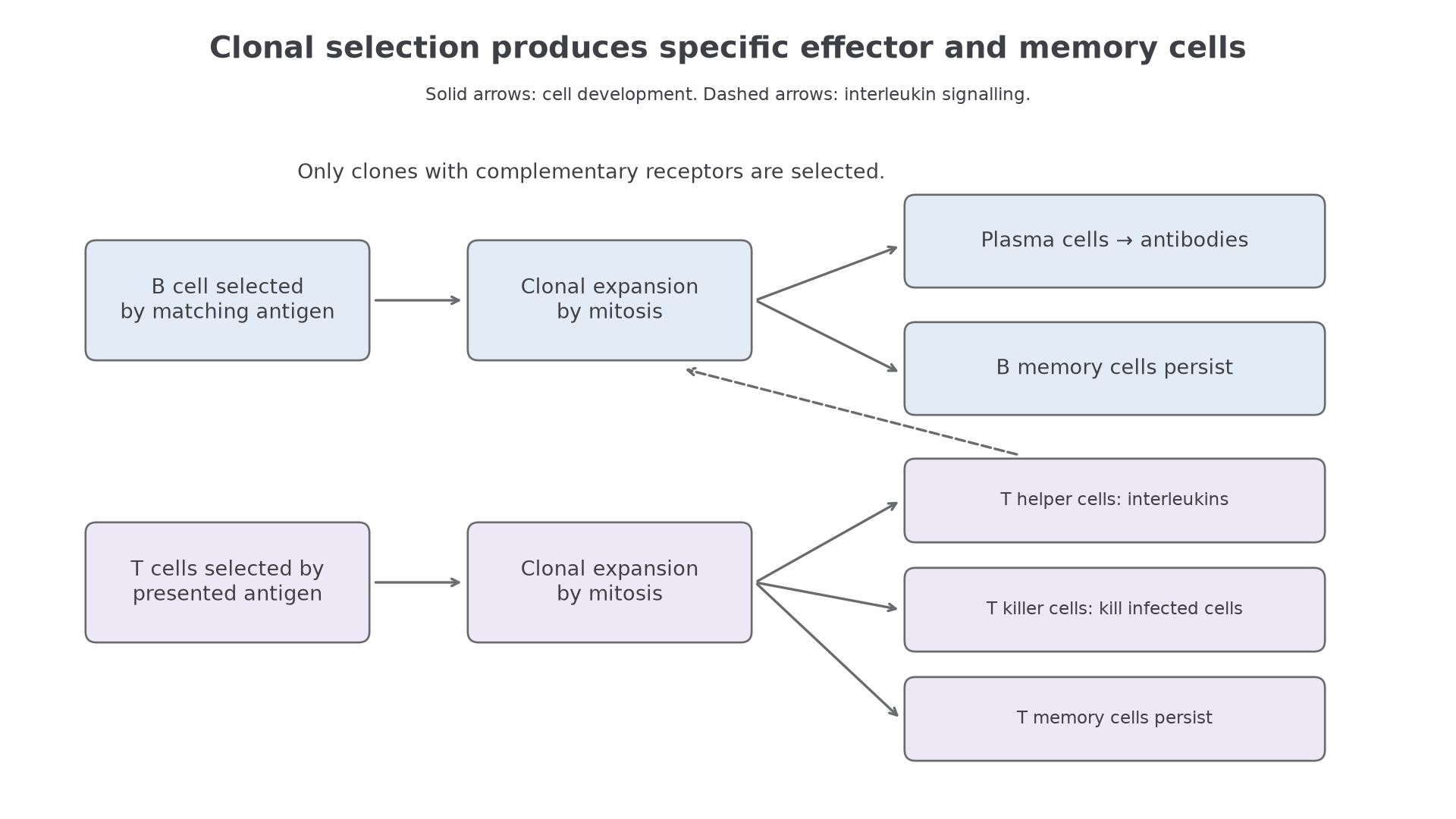
The connector labelled interleukins represents signals from T helper cells to the B-cell response; it does not represent B cells becoming T cells.
The sequence is:
- An antigen is encountered.
- A B or T lymphocyte with a complementary receptor is activated.
- The selected lymphocyte undergoes clonal expansion by mitosis.
- The clone differentiates into specialised cells.
- Some specialised cells act in the current response; others become memory cells.
Do not blur selection and expansion. Selection is choosing the matching clone. Expansion is making many copies of that clone. Differentiation is when those copied cells become specialised, such as plasma cells or memory cells.
B lymphocyte response
B lymphocytes are central to the antibody-producing part of the specific immune response. A B lymphocyte has receptors on its surface that are complementary to a particular antigen. When that B lymphocyte is selected and receives the correct signals, it expands and differentiates.
Two B-cell outcomes are plasma cells and B memory cells.
Plasma cell
A differentiated B lymphocyte that secretes antibodies specific to the antigen that selected the original B cell.
Plasma cells are antibody-secreting effector cells. Some are short-lived and others persist; their role is to secrete large quantities of antibody. The detailed protein structure of antibody molecules and the actions of opsonins, agglutinins and antitoxins belong to the next lesson. Here, the essential link is simply:
“selected B lymphocyte -> clonal expansion -> plasma cells -> specific antibodies”
Some cells from the same expanded clone become B memory cells. B memory cells do not secrete large quantities of antibody during the first response. They remain in the body and can respond rapidly if the same antigen is encountered again. They can then divide and differentiate into plasma cells much more quickly than naive B cells did during the primary response.
T helper cells support the B-cell response. They release interleukins, which are chemical signals that stimulate B cells to divide and differentiate.
Continue this lesson.
You’re previewing NovaLearn without an account. Create a free account to read the rest.
Create free account