5.1.2(e) - Kidney failure, dialysis and transplants
Kidneys help keep the internal environment stable by filtering blood, removing nitrogenous waste, regulating water content and controlling the concentrations of mineral ions. In this lesson you will learn what happens when kidney function fails, why glomerular filtration rate and electrolyte balance matter, and how haemodialysis and kidney transplants can treat kidney failure. The focus is the treatment decision, so earlier nephron and ADH mechanisms are used only as short reminders.
What Fails In Kidney Failure
Kidney failure means that the kidneys can no longer carry out enough of their normal excretory and homeostatic functions. The immediate problem is not just "less urine"; it is that the blood is no longer filtered and adjusted effectively.
Glomerular filtration rate
Glomerular filtration rate, or GFR, is the volume of filtrate formed by the glomeruli in a given time.
In a healthy nephron, high pressure in the glomerulus forces small molecules and water into Bowman's capsule. If kidney tissue is damaged, fewer functional nephrons are available or the filtering surface is less effective, so GFR falls. A lower GFR means less filtrate is formed per minute, so less urea, excess water and excess mineral ions can be removed from the blood.
This is why GFR is treated as a useful measure of kidney function: if filtration falls, the kidney has less opportunity to correct the composition of the blood. Do not confuse GFR with selective reabsorption. Filtration is the entry of small molecules and water into the nephron; selective reabsorption is the later recovery of useful substances. Kidney failure can disrupt both overall performance and downstream regulation, but this lesson is focused on the consequences and treatments.
Interpreting A Change In GFR
A patient's GFR falls from 96 cm³ min⁻¹ to 24 cm³ min⁻¹.
Percentage of original GFR:
The patient's kidneys are forming only one quarter of the original volume of filtrate per minute. This does not by itself diagnose a cause, but it shows a major reduction in filtering capacity.
That interpretation matters because a smaller volume of filtrate means fewer small waste molecules can enter the nephron for excretion.
For a percentage decrease, subtract the final GFR from the original GFR before dividing by the original: . The remaining percentage is 25%; the decrease is 75%. GFR is a volume of filtrate per unit time, not the volume of urine: most filtered water is normally reabsorbed.
Effects On Blood Composition
The effects of kidney failure follow directly from the kidney's normal jobs. If excretion and regulation are reduced, substances that should be removed or balanced remain in the blood.
[DIAGRAM: consequence_map: Lesson 100: Kidney failure, dialysis and transplants - diagram 01; asset_slug: 100_m05_1_2_kidney_failure_dialysis_and_transplants__diagram_01; recommended_method: drawn_biology; description: Flowchart linking kidney failure to reduced GFR, waste build-up, fluid retention and electrolyte imbalance.]
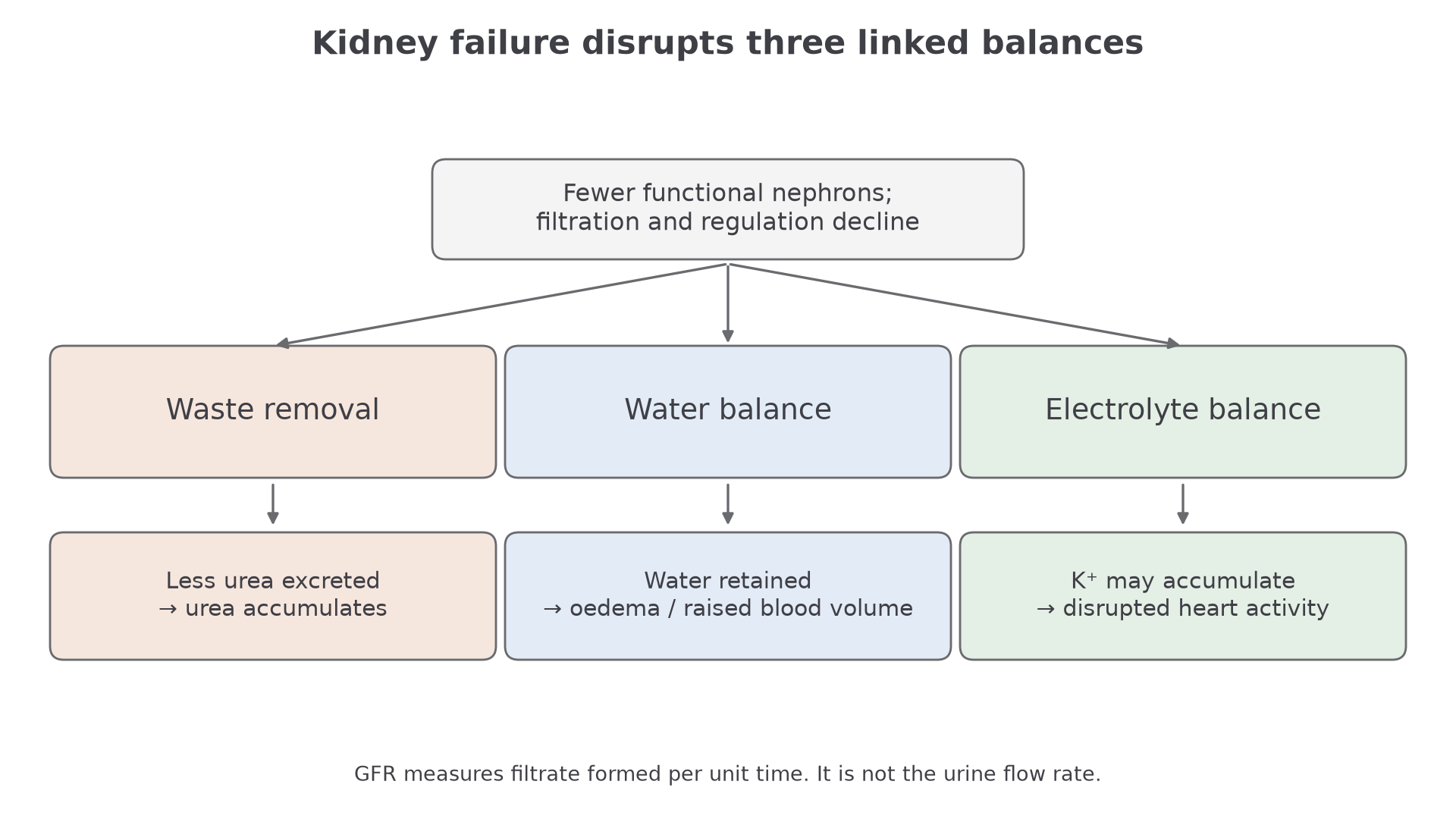
Urea is a small nitrogenous waste product from amino acid breakdown. If urea is not removed efficiently, it accumulates in the blood and can contribute to symptoms such as nausea, tiredness and general illness. Excess water may also remain in the blood and tissue fluid, causing swelling, increased blood volume and increased blood pressure.
Electrolyte
An electrolyte is a dissolved ion that helps control processes such as water balance, nerve and muscle function, and heart rhythm.
In this lesson, the key electrolyte idea is balance. The body needs mineral ions such as sodium and potassium within narrow ranges. If kidney failure reduces ion removal or adjustment, electrolyte concentrations can become too high or too low. For example, excess potassium ions can interfere with electrical activity in muscles, including cardiac muscle. Phosphate and calcium balance can also be disturbed, affecting bones and other body systems.
The common mistake is to say that kidney failure simply means "toxins in the blood". That is too vague for a strong answer. Link the failed function to a named consequence: lower GFR, less removal of urea, retention of water, or disturbed electrolyte balance.
Haemodialysis As A Partial Replacement
Haemodialysis is the dialysis treatment required for this specification point. Other forms of dialysis exist in medicine, but you do not need to learn their methods here.
In haemodialysis, blood is taken from the patient and passed through a dialyser, sometimes called an artificial kidney. The patient's blood and the dialysis fluid are separated by a partially permeable membrane. Small molecules and water can cross the membrane; blood cells and large plasma proteins remain in the blood.
The dialysis fluid is carefully controlled:
| Feature of dialysis fluid | Why it matters |
|---|---|
| No urea | Maintains a concentration gradient so urea diffuses out of the blood. |
| Appropriate glucose concentration | Prevents useful glucose being lost from the blood by diffusion. |
| Appropriate mineral ion concentration | Allows excess ions to diffuse out while avoiding loss of ions below normal blood concentration. |
| Controlled water removal | Removes excess water without making the blood too concentrated. |
Excess water is removed mainly by ultrafiltration driven by a pressure difference across the membrane, rather than by calling water removal diffusion.
Continue this lesson.
You’re previewing NovaLearn without an account. Create a free account to read the rest.
Create free account