6.1.3(b)(i)-(iii) - Uses of gene sequencing and synthetic biology
Sequencing a gene or genome gives scientists the order of bases in DNA. The power of sequencing comes from what can be done with those data: comparing genomes, predicting polypeptides, tracking disease, searching for evolutionary relationships and designing new biological systems. The useful step is connecting each dataset to a biological question and a justified inference.
From Sequence To Meaning
A DNA sequence is a long string of bases. On its own, that string is useful but not enough. To turn sequence data into biological meaning, scientists usually combine three ideas.
| Idea | What it contributes | Example use |
|---|---|---|
| Gene sequencing | Determines the order of bases in DNA | "Sequencing gives the base sequence of a gene or genome." |
| Bioinformatics | Stores, organises, searches and compares large biological datasets | "Bioinformatics allows rapid retrieval and comparison of sequence, protein and pathway data." |
| Computational biology | Uses algorithms, statistics and models to analyse data and make predictions | "Computational biology can model relationships, predict amino-acid sequences, and predict protein structure or function." |
[DIAGRAM: sequencing_data_to_applications: Lesson 150: Gene sequencing applications and synthetic biology - diagram 01; asset_slug: 150_m06_1_3_gene_sequencing_applications_and_synthetic_biology__diagram_01; recommended_method: drawn_biology; description: A deterministic 16:9 flow diagram showing gene sequencing producing DNA base-order data, bioinformatics storing and comparing large sequence/protein/pathway datasets, computational biology modelling and predicting from those data, and the OCR-required outputs: genotype-phenotype research, epidemiology, evolutionary relationships, amino-acid prediction and synthetic biology.]
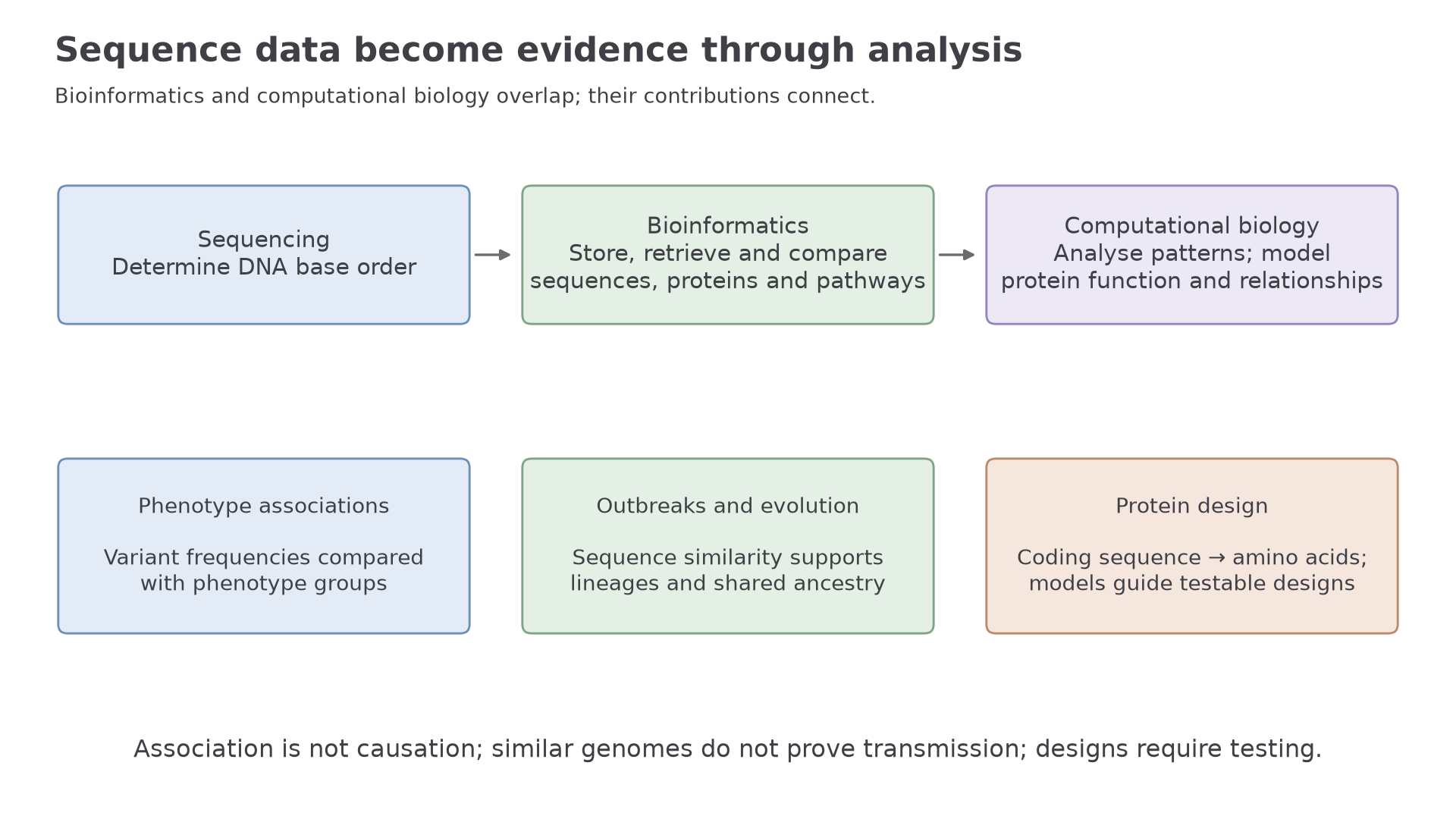
These fields overlap in practice; this useful distinction describes their main contributions rather than mutually exclusive activities. A complete account identifies the data stored, the comparisons made and the predictions tested.
For example, a database may hold DNA sequences, amino-acid sequences, protein structures and metabolic pathway information. Bioinformatics helps scientists search and compare those records. Computational biology then uses algorithms or models to identify patterns, test associations, predict a polypeptide sequence, or model a possible protein's structure and function.
Keep bases and amino acids separate. A DNA sequence is an order of bases; a polypeptide sequence is an order of amino acids. The link between them is the genetic code.
Genome-Wide Comparisons
A genome-wide comparison looks across a large amount of the genome rather than at one isolated gene. Gene sequencing made this possible because many individuals or species can have large parts of their genomes sequenced and compared using software.
Comparisons between individuals can help research into genotype-phenotype relationships. A genotype is the genetic information an organism has; a phenotype is the observable outcome, influenced by genotype and environment. If a particular sequence variant is found more often in individuals with a particular phenotype, that may suggest an association.
This is powerful, but the wording must stay careful. A sequence difference may be associated with a phenotype without directly causing it. Further evidence is needed to test whether the variant affects gene expression, protein structure, enzyme activity, development or another biological process.
Comparisons between species can help search for evolutionary relationships. Closely related species are expected to have more similar DNA sequences because they share a more recent common ancestor. Conserved sequences may also suggest important functions, because harmful changes in those regions are less likely to persist.
| Comparison | What sequencing data can show | Careful conclusion |
|---|---|---|
| Individuals of the same species | Shared and different variants across the genome | Possible links between genotype and phenotype |
| Different species | Similarity, difference and conserved regions | Evidence for evolutionary relationships or shared ancestry |
| Pathogen samples | Sequence similarities and new mutations | Possible epidemiological links, lineages or variants |
In epidemiology, the same comparison idea is used with pathogen genomes. If two bacterial or viral samples have very similar genome sequences, they may belong to the same outbreak or lineage. Sequence data can also show when a new variant has appeared. However, the data must be combined with time, place, sampling and case information before strong conclusions are made about transmission.
Predicting Polypeptides
Gene sequencing can also allow the amino-acid sequence of a polypeptide to be predicted. The key link is the genetic code: triplets of bases in DNA correspond, through mRNA codons, to amino acids or stop signals.
Use this chain:
DNA coding sequence -> mRNA codons -> amino-acid sequence -> primary structure of a polypeptide
Here is a small worked example using a coding DNA sequence. In a coding DNA strand, replace T with U to get the matching mRNA codons.
Predicting a short amino-acid sequence
Coding DNA sequence:
ATG GAA TTT TAA
mRNA codons:
AUG GAA UUU UAA
Using the genetic code:
AUGcodes for methionine.GAAcodes for glutamic acid.UUUcodes for phenylalanine.UAAis a stop codon.
Predicted amino-acid sequence:
methionine – glutamic acid – phenylalanine
Continue this lesson.
You’re previewing NovaLearn without an account. Create a free account to read the rest.
Create free account