5.1.4(a)-(b) - Endocrine communication and adrenal glands
Hormones let one part of the body alter the activity of cells somewhere else. In this lesson you will learn the core route of endocrine communication: secretion into blood, transport in blood, and detection by target cells or tissues. You will then use the adrenal glands as the OCR example of endocrine glands, linking the cortex and medulla to the hormones they secrete and the functions of those hormones.
Blood-Borne Signals
A hormone is a chemical messenger. It is produced by a gland or endocrine tissue, released into the blood, carried around the body in the blood plasma, and detected by particular target cells or target tissues.
Endocrine Gland
An endocrine gland is a gland that secretes hormones directly into the blood.
The word directly matters. Endocrine glands are often described as ductless because their hormones enter the blood rather than travelling along a duct. This contrasts with an exocrine gland, which releases a product into a duct; digestive enzymes from the pancreas are a common example of exocrine secretion, but the pancreas also has endocrine tissue in a later lesson.
For this lesson, the core route is:
- an endocrine gland secretes a hormone;
- the hormone enters the blood;
- the blood transports the hormone around the body;
- target cells or tissues detect the hormone;
- the target cells alter their activity.
Use "secretes hormones directly into the blood" for an endocrine gland. Avoid "excretes hormones" because excretion means removal of metabolic waste, not hormone release.
Use that exact distinction in the definition check.
Target Cell Detection
A hormone may be carried all around the body, but it does not cause every cell to respond. A cell responds only if it can detect that hormone. This requires a specific receptor with a binding site complementary to the hormone and suitable intracellular signalling machinery.
Target Cell
A target cell is a cell that can respond to a particular hormone because it has the appropriate receptor.
[DIAGRAM: endocrine_signal_route: Lesson 106: Endocrine communication and adrenal glands - diagram 01; asset_slug: 106_m05_1_4_endocrine_communication_and_adrenal_glands__diagram_01; recommended_method: drawn_biology; description: A clean drawn biology flow diagram showing an endocrine gland secreting hormone molecules into a blood vessel, blood transporting the hormone, a target tissue with matching receptors responding, and a non-target tissue lacking matching receptors not responding.]
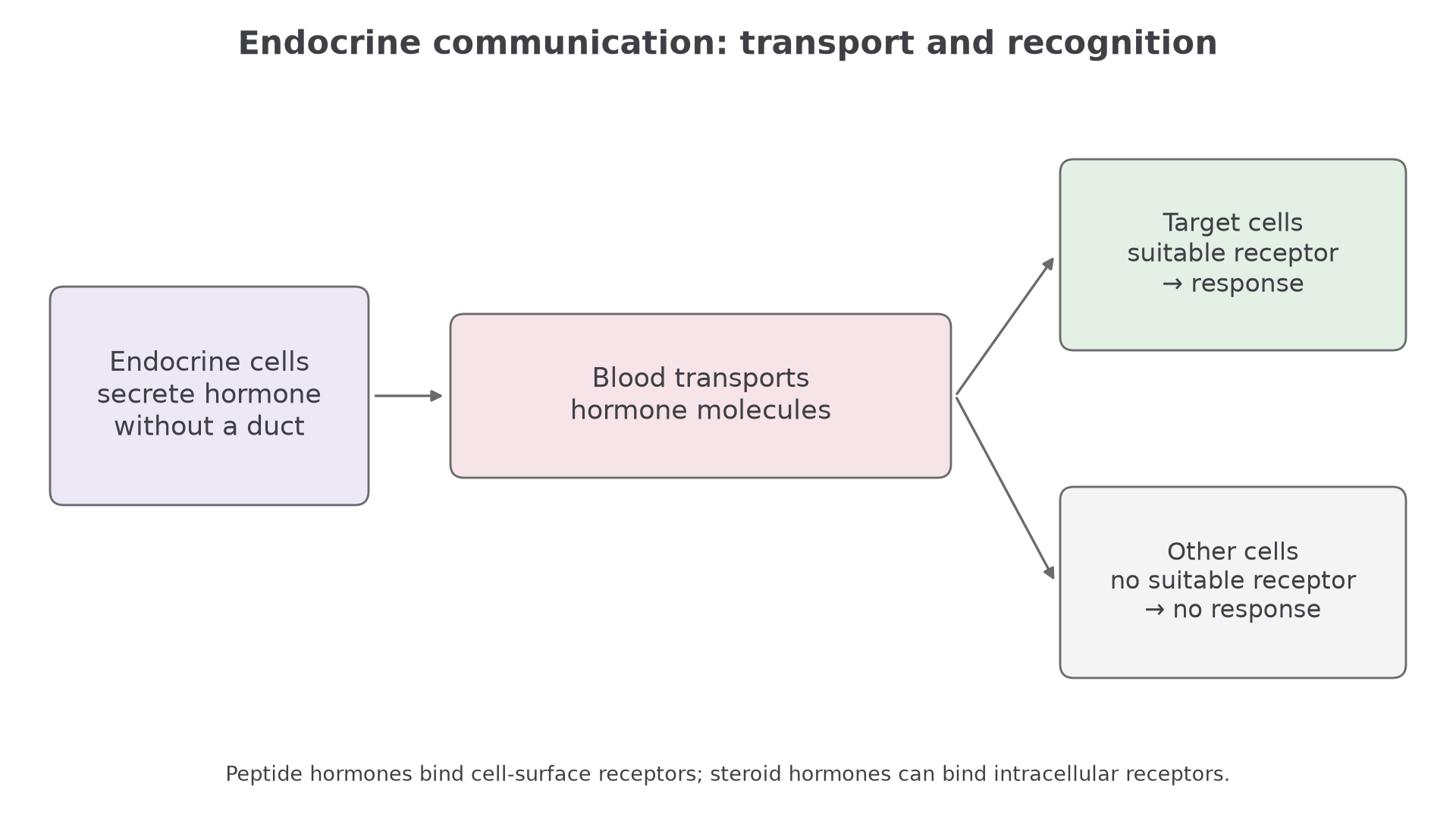
The diagram shows why blood transport and target-cell detection are separate ideas. The blood is the distribution route. Receptors explain specificity.
Reasoning from transport to response
A hormone is released into the blood. It reaches liver cells and muscle cells. Only the liver cells change their activity.
The best explanation is not "the hormone only travelled to the liver". The hormone was carried in the blood and may have reached many tissues. The liver cells changed activity because they were target cells for that hormone, with suitable receptors.
This is also why hormones can coordinate whole-body responses. One hormone can travel widely, but different tissues respond only if they are target tissues and if their receptors/signalling machinery lead to a response.
Peptide hormones cannot readily cross the phospholipid bilayer, so they bind cell-surface receptors and activate signalling inside the cell. Lipid-soluble steroid hormones can enter cells and bind intracellular receptors, often altering gene expression. Receptor location depends on hormone chemistry; all hormones do not share one receptor location.
Adrenal Gland Structure
The adrenal glands are a pair of endocrine glands. One adrenal gland is positioned above each kidney. Each gland has two main regions:
- the adrenal cortex, the outer region;
- the adrenal medulla, the inner region.
Both regions are endocrine tissue because they secrete hormones directly into the blood. They are not just two labels on the same tissue: the cortex and medulla secrete different hormones and have different functions.
| Region | Position in gland | Main hormone outputs | Broad function |
|---|---|---|---|
| Adrenal cortex | Outer region | Steroid hormones, including glucocorticoids such as cortisol and mineralocorticoids such as aldosterone | Longer-lasting regulation of metabolism, ions, water balance and blood pressure |
| Adrenal medulla | Inner region | Adrenaline and noradrenaline | Rapid support for stress responses such as fight-or-flight |
The terms cortex and medulla appear in other organs too, so do not rely on memory tricks alone. In the adrenal gland, the cortex is outside and the medulla is inside.
Continue this lesson.
You’re previewing NovaLearn without an account. Create a free account to read the rest.
Create free account