5.1.5(f) - Commercial uses of plant hormones
Plant hormones can be used commercially because they change plant growth, development or ripening in predictable ways when the dose, timing and conditions are controlled. In this lesson you will learn the three uses named in this specification point: controlling fruit ripening, using rooting powders, and using hormonal weed killers. The evaluation skill is just as important as the biology: a useful commercial response can still have limits, costs and risks.
Commercial Control
A plant hormone is a chemical signal produced in a plant that affects growth, development or response in target tissues. Commercial growers often use natural hormones, synthetic compounds that mimic hormones, or compounds that alter hormone action. These are often called plant growth regulators in horticulture.
The commercial idea is simple: if a hormone helps control a plant response, people can sometimes use that response deliberately. The difficult part is control. The same hormone can have different effects depending on the species, tissue, concentration, stage of development and environment.
Commercial use of plant hormones
Commercial use of plant hormones means applying, releasing or controlling hormone-like signals to produce a useful outcome in agriculture, horticulture, food storage or weed management.
Three applications show how the response can be controlled:
| Use | Main hormone idea | Commercial purpose |
|---|---|---|
| Ripening control | Ethene affects fruit ripening | Time ripening for transport, storage and sale |
| Rooting powders | Auxin-like compounds stimulate root formation | Increase success when propagating plants from cuttings |
| Hormonal weed killers | Synthetic auxins disrupt growth in susceptible plants | Control weeds, especially broad-leaved weeds in grass or cereal contexts |
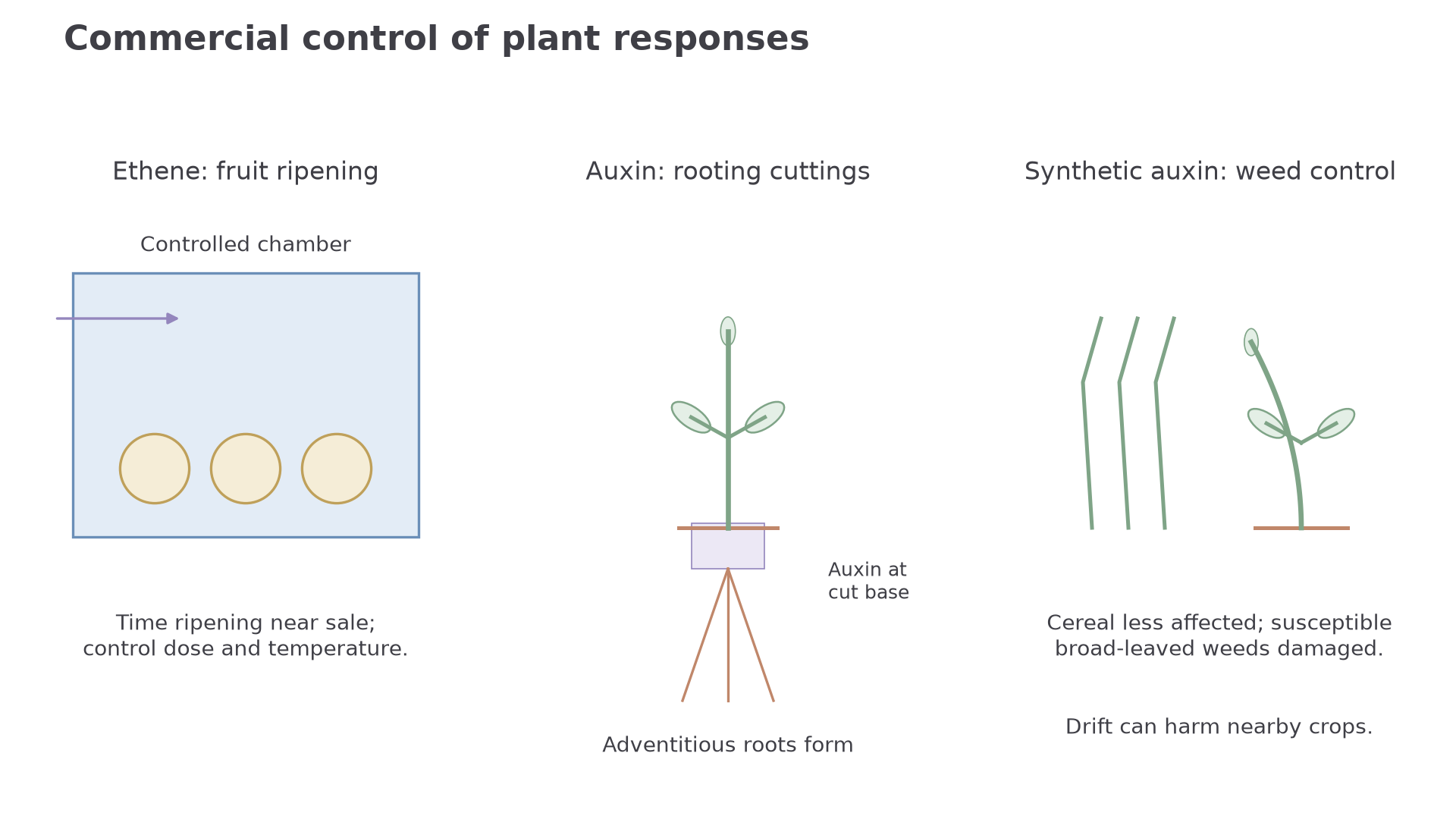
[DIAGRAM: commercial_plant_hormone_uses: Lesson 114: Commercial uses of plant hormones - diagram 01; asset_slug: 114_m05_1_5_commercial_uses_of_plant_hormones__diagram_01; recommended_method: drawn_biology; description: Three-panel drawn biology diagram comparing ethene ripening control, auxin rooting powder applied to a cutting, and synthetic auxin weedkiller selectivity, with concise benefits and control variables.]
Ripening Control
Ethene is a gaseous plant hormone. Many horticultural sources call it ethylene, but ethene is the name to use in this course. Ripening fruit releases ethene, which diffuses to nearby fruit and promotes further ripening. Ethene is especially useful for fruits that continue to ripen after harvest.
Ripening is not just a fruit "getting older". It includes changes that make fruit more suitable to eat: starch may be converted to sugars, acids may decrease, the fruit may soften, pigments may change and aroma compounds may be produced. These changes affect taste, texture, colour and shelf life.
Commercially, ethene can be used to make ripening more predictable. For example, fruit can be harvested firm enough for transport, then exposed to ethene in controlled conditions so that batches ripen more uniformly near the point of sale. The key word is controlled: ethene is a gas, so an open-air spray would be unreliable because the gas can diffuse away.
If asked to explain ethene use, go beyond "it ripens fruit". Strong answers mention controlled conditions such as concentration, temperature, exposure time, fruit stage and preventing ethene escaping or affecting other produce.
There is also a reverse commercial problem: sometimes growers, stores or transporters want to delay ripening. They may reduce ethene exposure, remove ethene from storage air, use cold storage, or use compounds that reduce ethene production or perception. You do not need to memorise named chemicals for this specification point, but you should understand the decision: control of ethene action can either promote or slow ripening.
A good evaluation answer avoids overclaiming. Too much ethene, the wrong timing, or treating fruit at the wrong developmental stage can reduce quality. Ethene can also promote fruit drop in some situations, so the benefit of uniform ripening must be weighed against waste and damage.
Rooting Powders
Rooting powders are used when plants are propagated from cuttings. A cutting is a piece of plant tissue, usually part of a shoot, that is placed in suitable conditions so it can form roots and grow into a new plant.
The powder usually contains an auxin-like compound. Auxin is linked with growth and can stimulate cells near the cut base of a stem to form adventitious roots, meaning roots that develop from tissue that was not originally a root.
Continue this lesson.
You’re previewing NovaLearn without an account. Create a free account to read the rest.
Create free account