2.1.6(h) - Specialised cells in multicellular organisms
Multicellular organisms are not built from one general-purpose cell repeated millions of times. They work because cells become specialised: their visible shape, internal contents and surface structures suit a particular job. In this lesson you will learn the named animal and plant cell examples required here, and how to turn each structure into a clear function explanation.
Shape-Function Principle
A specialised cell has features that make it better at one main role than an unspecialised cell would be. The key habit is to ask two linked questions: what feature does this cell have, and how does that feature help the cell carry out its function?
Specialised cell
A cell with structural, biochemical or surface features adapted for a particular function in a multicellular organism.
Specialisation is not simply "having more organelles". Sometimes a cell becomes specialised by losing structures that would get in the way. A mature mammalian erythrocyte, for example, lacks a nucleus, whereas a palisade cell is packed with chloroplasts. Both are specialised, but in different directions.
A list of named cells is an organiser, not a replacement for reasoning. In a written answer, name the feature and connect it to the job. "Has a large surface area" is unfinished; "has a large surface area so oxygen diffuses into the cell more rapidly" is a biological explanation.
Blood Cells
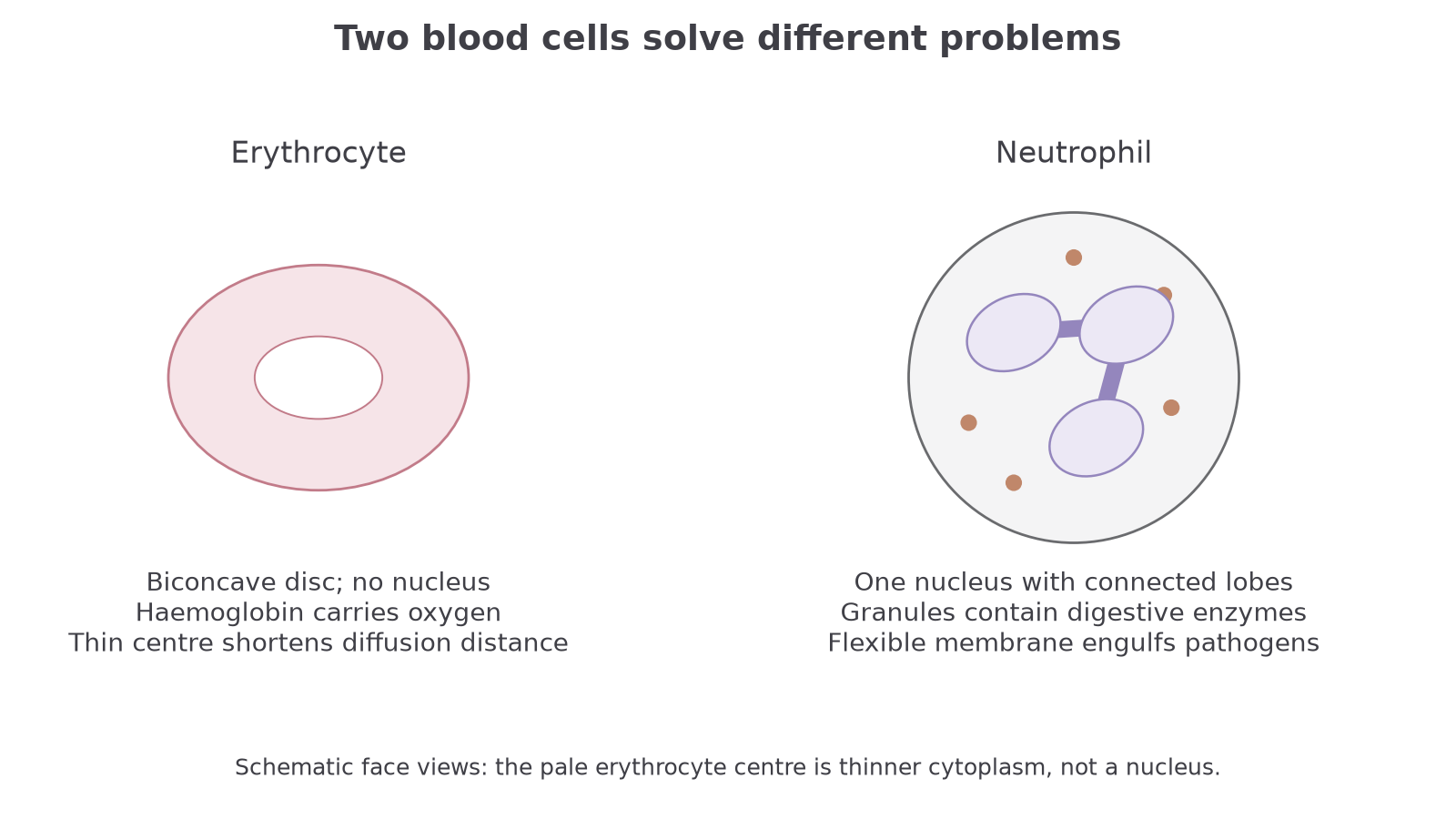
Erythrocytes are red blood cells. Their main role is to transport oxygen in the blood. They contain haemoglobin, the protein that binds oxygen. Their biconcave disc shape gives a large surface area compared with their volume, so oxygen can diffuse into and out of the cell efficiently. Mature mammalian erythrocytes also lack a nucleus, leaving more internal space for haemoglobin, and their flexible shape helps them pass through narrow capillaries.
Neutrophils are white blood cells that act as phagocytes. They help defend the body by engulfing and digesting pathogens. Their multi-lobed nucleus makes the cell easier to deform as it moves through small gaps between cells, and their cytoplasm contains enzyme-filled granules that help digest material after it has been engulfed.
These two blood cells are a useful contrast. An erythrocyte is specialised for transport, so it is small, flexible and packed with haemoglobin. A neutrophil is specialised for defence, so it needs movement, recognition and digestion rather than oxygen loading.
| Cell | Main function | Useful structure-function link |
|---|---|---|
| Erythrocyte | Transport oxygen | Biconcave shape increases surface area for diffusion; no nucleus leaves more space for haemoglobin. |
| Neutrophil | Engulf and digest pathogens | Lobed nucleus helps flexibility; enzyme-containing granules help break down engulfed material. |
The biconcave erythrocyte is thin in its centre, shortening the diffusion pathway as well as increasing surface area relative to volume. It also lacks mitochondria, so it does not use the oxygen it transports for aerobic respiration. A neutrophil has one nucleus with connected lobes, not several separate nuclei. Its membrane can extend around a pathogen to form an internal vesicle, which fuses with enzyme-containing lysosomes for digestion.
[DIAGRAM: blood_cell_adaptations: Erythrocyte and neutrophil features; asset_slug: 049_m02_1_6_specialised_cells_in_multicellular_organisms__diagram_01; recommended_method: drawn_biology; description: Biconcave profile and connected nuclear lobes distinguish oxygen transport from phagocytosis.]
Surface And Movement Cells
Squamous epithelial cells are thin, flat cells. When arranged as a lining, their thin shape can make a short diffusion pathway. This is why squamous epithelial cells are useful where substances need to cross a surface quickly. Their flat, tile-like shape also helps form a smooth protective lining.
Ciliated epithelial cells are different. They are lining cells with many cilia projecting from their free surface. Cilia are tiny motile extensions that beat in a coordinated way, moving material over the epithelial surface. In airways, for example, ciliated epithelial cells help move mucus and trapped particles away from delicate gas-exchange surfaces.
Sperm cells solve a different movement problem: the whole cell must move towards an egg. A sperm cell has a flagellum, often called a tail, that propels it. The midpiece contains many mitochondria, which supply ATP for movement, and the head contains a haploid nucleus. The acrosome at the front contains enzymes that help the sperm penetrate the egg's outer layers during fertilisation.
A common error is to use "cilia" and "flagellum" as if they mean the same thing. In this lesson, ciliated epithelial cells have many cilia that move material across a surface. A sperm cell has a flagellum that moves the whole cell.
A squamous cell is viewed from the side when judging its thickness: its broad face can look large while the diffusion distance through it is short. Ciliated airway cells have mitochondria to supply ATP for ciliary beating; mucus is produced by neighbouring goblet cells rather than by the cilia. The sperm head delivers one haploid chromosome set so fertilisation can restore the diploid number.
Continue this lesson.
You’re previewing NovaLearn without an account. Create a free account to read the rest.
Create free account