6.1.1(a) - Gene mutations and protein effects
A gene mutation is a change in the sequence of nucleotides within a gene. That small molecular change can matter because a gene's nucleotide sequence is used to produce a polypeptide, and the amino-acid sequence affects the protein's shape and function. Substitution, insertion and deletion can each have beneficial, neutral or harmful effects, depending on the sequence affected and the environment.
From Gene To Protein
A gene is a length of DNA that codes for a polypeptide or functional RNA. In this lesson the focus is on protein production, so the useful chain is:
DNA nucleotide sequence → mRNA codons → amino-acid sequence → protein folding → protein function
The DNA sequence is read in triplets during protein synthesis. A triplet in DNA is transcribed into a codon in mRNA, and each codon helps specify an amino acid or a stop signal during translation. The order of amino acids is the primary structure of a protein. Primary structure affects how the protein folds into its final three-dimensional shape, including its tertiary structure.
Gene Mutation
A gene mutation is a change in the sequence of nucleotides within a gene.
This is why a mutation can affect protein function. If the mutation changes the mRNA codons, it may change the amino-acid sequence. If the amino-acid sequence changes, the protein may fold differently. If the folding changes a functional region, such as an enzyme active site or binding region, the protein may work less well, stop working, or occasionally work in a way that gives an advantage.
Not every mutation changes the protein. Some changes leave the same amino acid specified, or change an amino acid in a part of the protein where function is not affected. A sequence change must therefore be traced through to its molecular and organism-level consequences; harm cannot be inferred from the word mutation alone.
Substitution, insertion and deletion
Three important types of gene mutation are substitution, insertion and deletion of one or more nucleotides.
| Mutation type | What changes in the DNA sequence | Immediate reading-frame idea |
|---|---|---|
| Substitution | One nucleotide is replaced by a different nucleotide | The number of nucleotides is unchanged, so the triplet grouping usually stays aligned |
| Insertion | One or more nucleotides are added | The reading frame may shift if the number inserted is not a multiple of three |
| Deletion | One or more nucleotides are removed | The reading frame may shift if the number deleted is not a multiple of three |
[DIAGRAM: mutation_types_reading_frame: Lesson 136: Gene mutations and protein effects - diagram 01; asset_slug: 136_m06_1_1_gene_mutations_and_protein_effects__diagram_01; recommended_method: drawn_biology; description: A deterministic 16:9 line diagram comparing an original coding sequence with substitution, insertion and deletion examples, showing reading-frame effects and the chain from nucleotide sequence to protein function.]
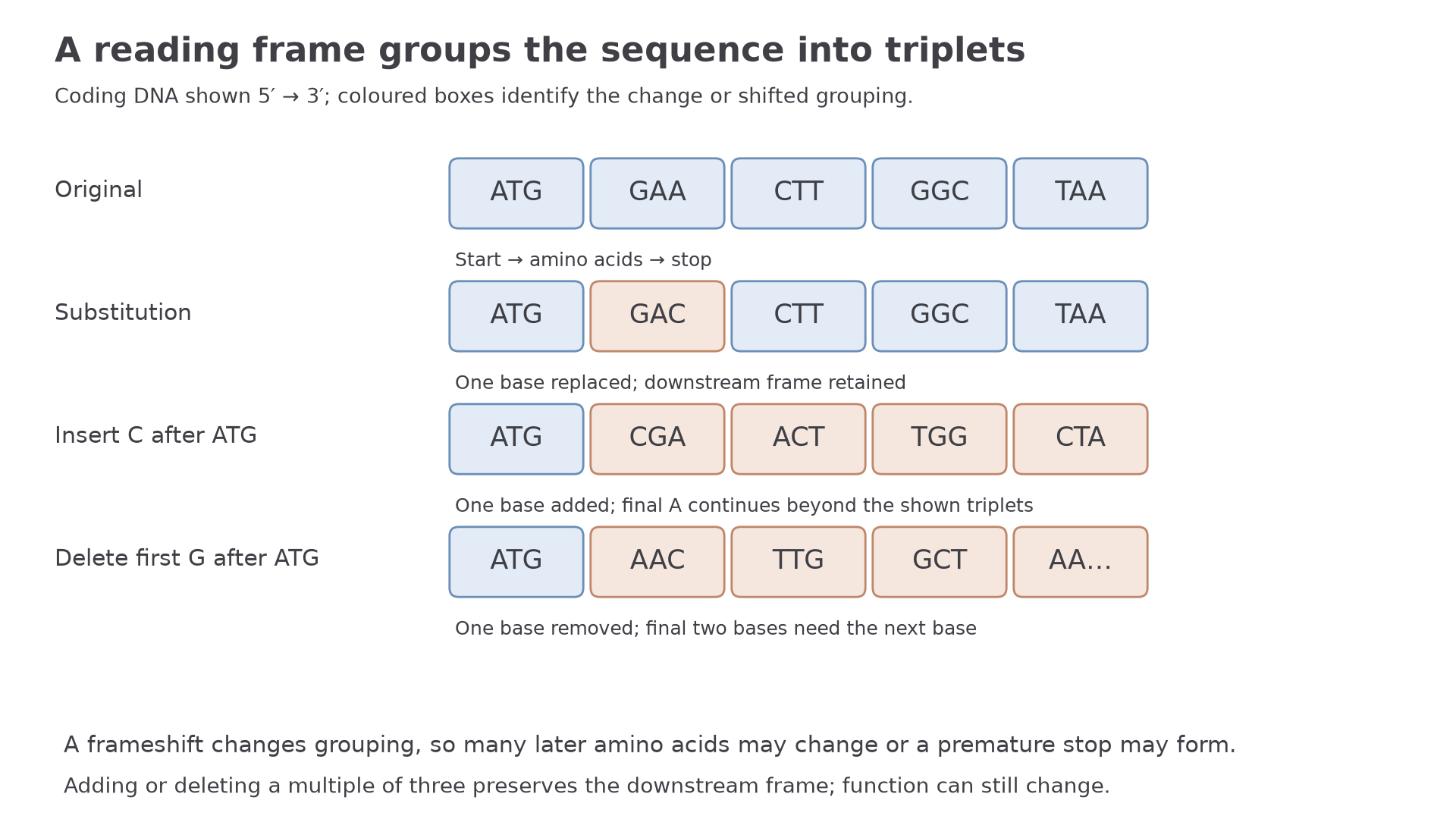
The phrase reading frame means the way a nucleotide sequence is grouped into consecutive triplets. In a coding region, insertion or deletion of one or two nucleotides changes the grouping from the mutation onwards. That is called a frameshift. A frameshift can change many amino acids after the mutation and may introduce an early stop signal, so it often has a large effect on the protein.
However, do not overstate it. If three nucleotides, or a multiple of three, are inserted or deleted in a coding region, the mutation may add or remove one or more whole codons without shifting every later triplet. The protein can still be affected, but the downstream reading frame is not necessarily shifted.
Substitutions And Neutral Effects
A substitution replaces one nucleotide with another. Because the number of nucleotides stays the same, a substitution usually affects one triplet/codon rather than shifting every codon after it.
There are several possible outcomes:
| Possible outcome | Why it can happen | Likely protein effect |
|---|---|---|
| Same amino acid | The genetic code is degenerate, meaning more than one codon can code for the same amino acid | Primary structure unchanged, so protein function may be unchanged |
| Different amino acid with similar properties | The new amino acid may interact with the rest of the protein in a similar way | Protein function may be little changed |
| Different amino acid with different properties | Bonding, charge, shape or interactions may change | Folding/tertiary structure may change, affecting function |
| Stop signal produced earlier | The new codon may act as a stop codon | A shortened polypeptide may be produced, often with reduced or no function |
Continue this lesson.
You’re previewing NovaLearn without an account. Create a free account to read the rest.
Create free account