6.1.1(b) - Regulation of gene expression
In this lesson you learn how cells control whether a gene is used, how an RNA transcript is processed, and whether a protein becomes active after it has been made. The same DNA can lead to very different cell activity because gene expression is regulated at several points. The examples are the lac operon, general eukaryotic transcription factors, primary mRNA processing, and activation of proteins by cyclic AMP.
Control Points In Gene Expression
Gene expression means using the information in a gene to make a functional product, usually a protein. Control of gene expression means regulating this process so that a cell does not make every protein all the time.
For this lesson, think of gene expression as a route with three main control points:
- Transcriptional control: regulation of whether, or how often, a gene is transcribed into RNA.
- Post-transcriptional control: regulation after the primary RNA transcript has been made, but before mature mRNA is translated.
- Post-translational control: regulation after a polypeptide has been made, often by activating or modifying the protein.
Gene Expression
Gene expression is the use of information in a gene to produce a functional product, such as a polypeptide or protein.
Cells regulate this route so that a gene product is made or activated only when and where it is needed.
Regulation Of Gene Expression
Regulation of gene expression is the control of whether, when, or how much a gene product is made or becomes active.
[DIAGRAM: three_levels_gene_expression_control: Lesson 137: Regulation of gene expression - diagram 02; asset_slug: 137_m06_1_1_regulation_of_gene_expression__diagram_02; recommended_method: drawn_biology; description: A clean 16:9 flow diagram showing DNA transcription to primary mRNA, processing to mature mRNA, translation to inactive protein and cyclic AMP-linked activation to active protein, with labels for transcriptional, post-transcriptional and post-translational control.]
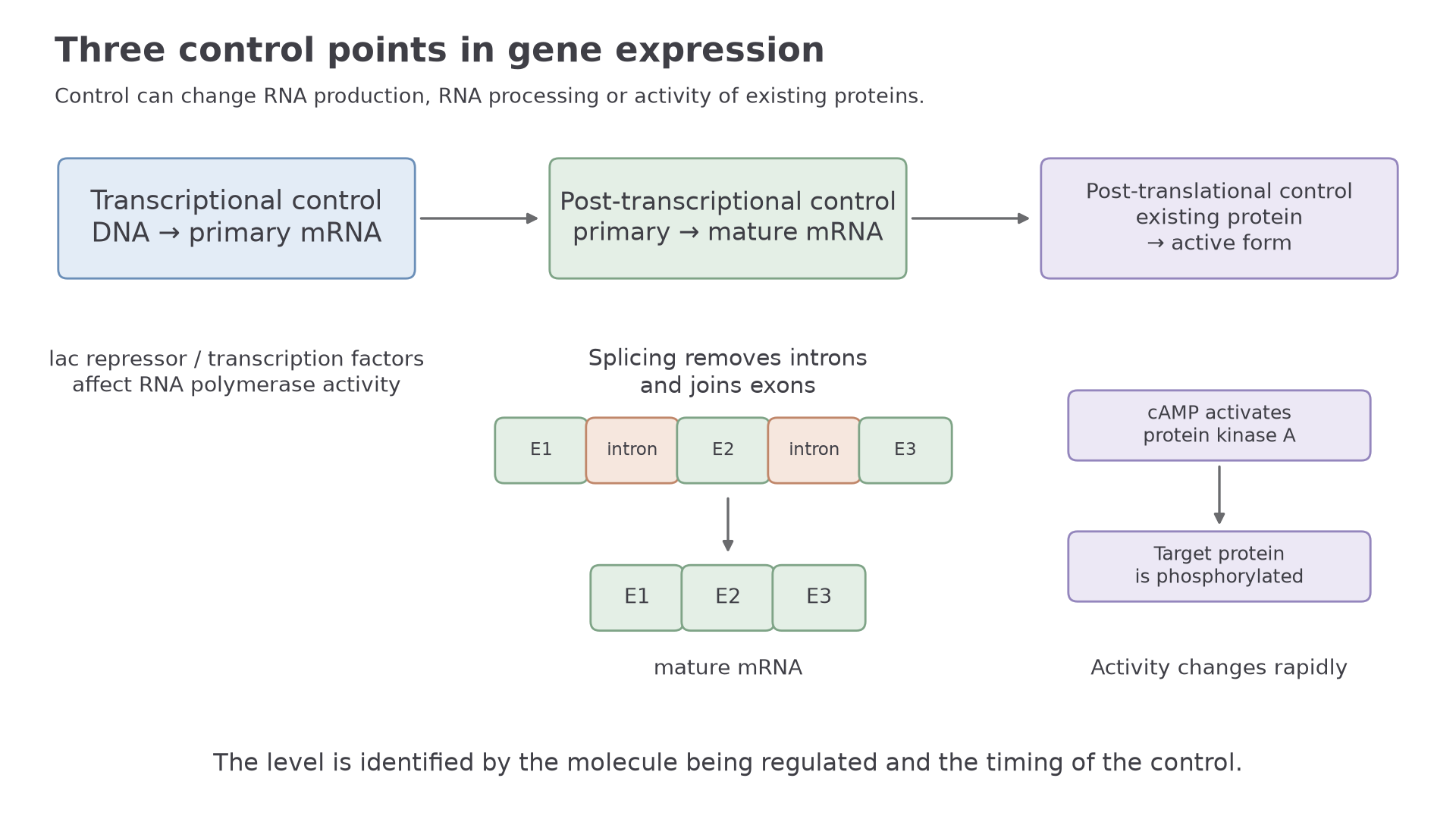
The diagram shows why the level matters. If a mechanism changes whether RNA polymerase makes RNA, it is transcriptional. If it changes the RNA after transcription, it is post-transcriptional. If it changes a protein after translation, it is post-translational.
The Lac Operon Switch
In this simplified lactose comparison, glucose is low in both conditions, so the diagrams isolate the role of the repressor.
The lac operon is a prokaryotic example of transcriptional control. It is found in bacteria such as E. coli and controls genes involved in using lactose as an energy source.
Operon
An operon is a group of structural genes controlled together by regulatory DNA sequences, so they can be transcribed as one unit.
The important parts are:
| Part | Role |
|---|---|
| Regulatory gene | Codes for the repressor protein. |
| Repressor protein | Binds to the operator when lactose is absent, blocking transcription. |
| Promoter | DNA region where RNA polymerase binds to start transcription. |
| Operator | Control region where the repressor protein binds. |
| Structural genes | Code for proteins needed for lactose use, including beta-galactosidase and permease. |
[DIAGRAM: lac_operon_off_on: Lesson 137: Regulation of gene expression - diagram 01; asset_slug: 137_m06_1_1_regulation_of_gene_expression__diagram_01; recommended_method: drawn_biology; description: A two-panel 16:9 drawn biology diagram of the lac operon with lactose absent and lactose present, showing regulatory gene, repressor protein, promoter, operator, lacZ/lacY/lacA structural genes, RNA polymerase blocked in the OFF state and transcription allowed in the ON state.]
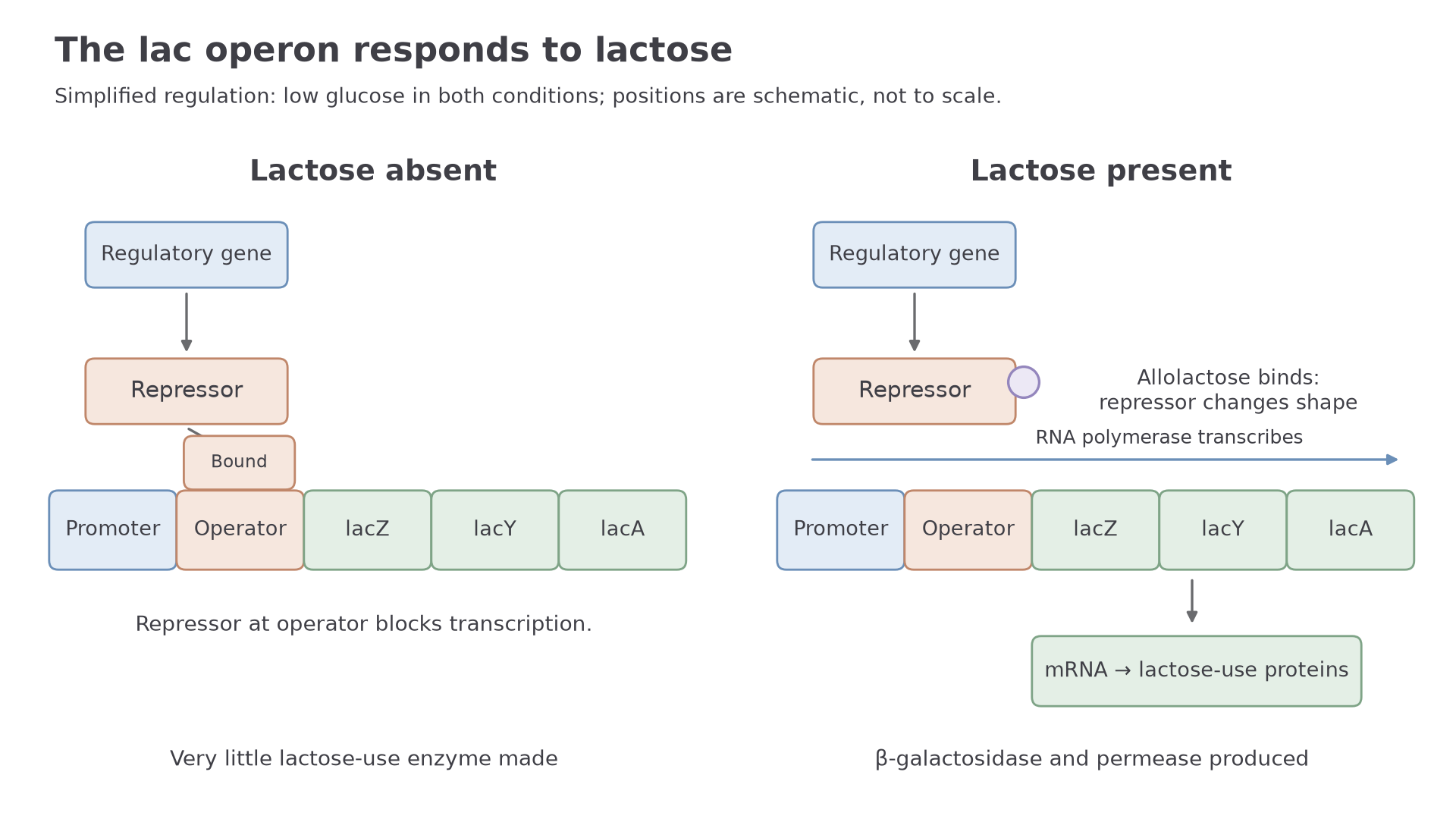
The regulatory gene has its own promoter and produces repressor protein whether lactose is present or absent. This avoids spending resources making large quantities of lactose-use enzymes when their substrate is unavailable. When lactose is absent, the repressor is active. The repressor protein binds to the operator. This prevents RNA polymerase from transcribing the structural genes, so the enzymes for lactose use are not made in significant amounts.
When lactose is present, its isomer allolactose acts as an inducer and binds to the repressor, changing its shape. This is often summarised as lactose binding to the repressor. The repressor protein can no longer bind to the operator. RNA polymerase can then bind at the promoter and transcribe the structural genes. The mRNA can be translated into proteins such as beta-galactosidase, which helps break down lactose, and permease, which helps lactose enter the bacterial cell.
Classifying The Lac Operon
The lac operon controls whether RNA polymerase can transcribe the structural genes.
That means the lac operon is an example of transcriptional control. The control point is before mRNA from those structural genes is made, not after protein synthesis.
Now apply that classification to the operon mechanism when lactose is present.
Continue this lesson.
You’re previewing NovaLearn without an account. Create a free account to read the rest.
Create free account