3.1.2(a)-(b) - Need for transport systems and circulatory designs
Large multicellular animals have a problem that single cells do not: many of their cells are too far from the outside environment for diffusion alone to supply materials and remove wastes fast enough. This lesson builds the need for transport systems from size, metabolic rate and surface area to volume ratio, then compares the required circulatory designs in insects, fish and mammals. The goal is not detailed heart anatomy yet; it is choosing the right design words and explaining why those designs fit the animal's demands.
Why Transport Is Needed
Every living cell needs a supply of useful substances and a way to remove waste. Animal cells need substances such as oxygen, glucose, amino acids, ions and water. They also produce wastes such as carbon dioxide and nitrogenous waste compounds.
In a very small organism, diffusion across the body surface may be enough because every cell is close to the environment. Diffusion is movement down a concentration gradient, so it is useful over short distances. It becomes too slow when the distance from the exchange surface to internal cells is large.
Transport System
A transport system is a mass-flow system that moves substances around an organism fast enough to supply cells and remove wastes.
The important word is mass. A transport system moves a fluid, such as blood or haemolymph, in bulk. That is different from relying on each molecule to diffuse all the way from the exchange surface to every cell.
For multicellular animals, the need for a transport system depends mainly on three linked factors:
| Factor | Why it increases the need for transport |
|---|---|
| Larger size | Many cells are farther from the external environment, so diffusion distances are longer. |
| Lower surface area to volume ratio | There is less exchange surface available per unit volume of living tissue. |
| Higher metabolic rate | Cells use oxygen and nutrients faster, and produce wastes faster. |
When a question asks why a transport system is needed, do not write only "the animal is big". Link size to diffusion distance, SA:V and metabolic demand.
Apply those links in the check below.
Mass flow moves fluid and its contents over long distances. Exchange with individual cells still depends on diffusion over a short final distance from the transport fluid.
Surface Area To Volume Ratio
Surface area to volume ratio, written as SA:V, compares the area available for exchange with the volume of tissue that must be supplied.
Surface Area To Volume Ratio
As a simple shape gets bigger, volume increases faster than surface area. For a cube, surface area is proportional to side length squared, but volume is proportional to side length cubed. This is why a larger animal usually has a lower SA:V than a smaller animal.
[DIAGRAM: surface_area_volume_transport_need: Lesson 059: Need for transport systems and circulatory designs - diagram 01; asset_slug: 059_m03_1_2_need_for_transport_systems_and_circulatory_designs__diagram_01; recommended_method: drawn_biology; description: deterministic 16:9 line diagram of 1 cm, 2 cm and 4 cm cubes showing surface area, volume and falling SA:V as size increases.]
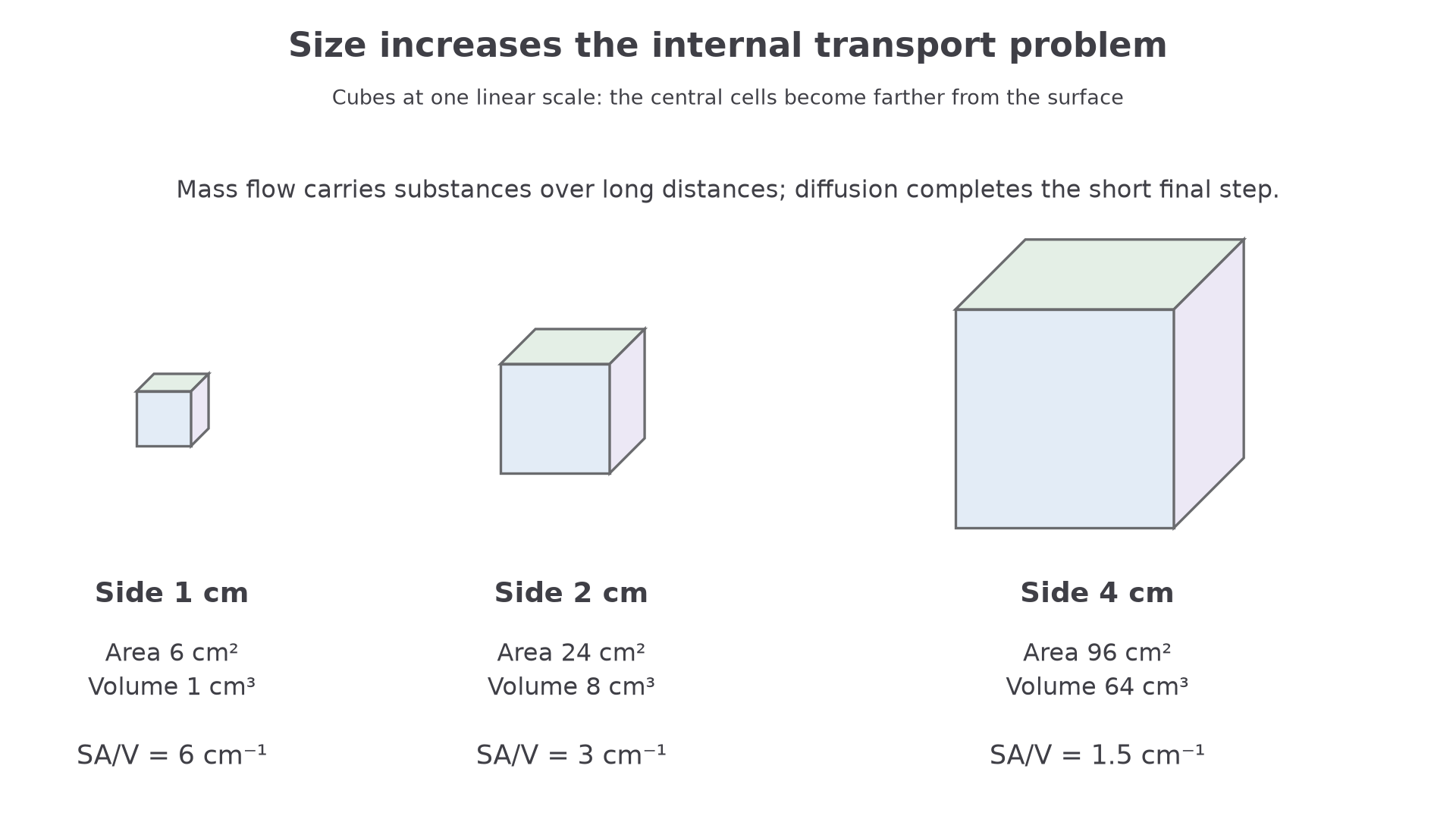
Calculating SA:V For A Cube
A cube-shaped animal model has side length 2.0 cm.
Surface area of a cube =
Volume of a cube =
SA:V = 24 : 8, which simplifies to 3 : 1.
Interpretation: this model has 3 cm² of surface area for every 1 cm³ of volume.
The calculation is only a model. Real animals are not cubes, but the model makes the principle visible: increasing size lowers the surface area available per unit volume, so exchange across the outer surface cannot keep up with the needs of all internal cells.
Metabolic Rate And Demand
SA:V explains the supply side of the problem: how much exchange surface is available compared with the volume being supplied. Metabolic rate explains the demand side: how fast cells use materials and produce wastes.
Metabolic Rate
Metabolic rate is the rate at which chemical reactions occur in the cells of an organism.
An active animal, or an animal maintaining a high constant body temperature, has a high demand for ATP. Its cells respire rapidly, so they need oxygen and respiratory substrates rapidly. They also produce carbon dioxide rapidly. A transport system helps maintain steep concentration gradients at exchange surfaces by carrying oxygen and nutrients away from the exchange surface and carrying carbon dioxide and other wastes away from cells.
This is why two animals of different size can have different transport demands, and why size alone is not enough. A small insect can have a relatively high SA:V, but active flight still creates intense metabolic demand in its tissues. A mammal has a lower SA:V than an insect and a high oxygen demand, so its circulatory design must deliver oxygen efficiently to tissues.
OCR warns against the misconception that insects have a lower SA:V than mammals. Insects are smaller, so they usually have a larger SA:V; their need for transport is linked to multicellularity, internal transport of materials and metabolic demand, not to having a mammal-like low SA:V.
Use that distinction to choose the most accurate statement.
Continue this lesson.
You’re previewing NovaLearn without an account. Create a free account to read the rest.
Create free account