2.1.3(c) - ADP and ATP as phosphorylated nucleotides
In this lesson you are learning the structure of ADP and ATP as OCR expects it: both are phosphorylated nucleotides made from adenine, ribose and inorganic phosphate groups. The focus is deliberately narrow. Later lessons use ATP in respiration, photosynthesis, active transport and muscle contraction, but this lesson is about recognising and describing the molecule accurately.
Phosphorylated Nucleotides
A nucleotide is built from three kinds of component: a nitrogenous base, a pentose sugar and at least one phosphate group. ADP and ATP are nucleotides because they have all three. They are described as phosphorylated because phosphate groups are part of their structure.
Phosphorylated nucleotide
A nucleotide that contains a nitrogenous base, a pentose sugar and phosphate group or groups.
For this specification point, the required components are very specific:
| Molecule | Nitrogenous base | Pentose sugar | Inorganic phosphate groups |
|---|---|---|---|
| ADP | Adenine | Ribose | 2 |
| ATP | Adenine | Ribose | 3 |
The letter “A” in ADP and ATP stands for adenosine, but the base inside adenosine is adenine. This distinction matters in exam answers. If a question asks for the nitrogenous base, the answer is “adenine”, not “adenosine”.
Use the exact component words: “adenine”, “ribose” and “inorganic phosphate”. Those three words are the core of this OCR learning outcome.
The first check is deliberately direct: it tests whether the component words are secure before you compare ADP with ATP.
Adenine And Ribose Core
ADP and ATP share the same core: adenine joined to ribose. Adenine is the nitrogenous base. Ribose is a pentose sugar, meaning it is a five-carbon sugar.
Adenosine
Adenosine is adenine joined to ribose. It is not the same as adenine alone.
The names become easier to decode once this is clear:
| Name part | Meaning |
|---|---|
| Adenosine | Adenine plus ribose |
| Diphosphate | Two phosphate groups |
| Triphosphate | Three phosphate groups |
So ADP is adenosine diphosphate: adenine + ribose + two phosphate groups. ATP is adenosine triphosphate: adenine + ribose + three phosphate groups.
Be careful with a common shortcut. Students sometimes say "ATP contains adenosine as its base." That is not precise enough. ATP contains adenosine as the base-sugar part of the molecule, but its nitrogenous base is adenine.
Phosphate Count
The phosphate groups form a chain attached to ribose. Hydrolysis of the terminal phosphate group converts ATP to ADP plus free inorganic phosphate, Pi; synthesis in the reverse direction requires an energy input. ATP hydrolysis releases energy overall because of the net changes in bonds and interactions, not because breaking a bond itself releases energy. This structural change connects the phosphate count to ATP-dependent processes elsewhere in the course.
The structural difference between ADP and ATP is the number of phosphate groups. ADP has two inorganic phosphate groups. ATP has three inorganic phosphate groups.
This is why their full names contain “di” and “tri”:
- “di” means two, so adenosine diphosphate has two phosphate groups.
- “tri” means three, so adenosine triphosphate has three phosphate groups.
[DIAGRAM: atp_adp_phosphate_count: Lesson 031: ADP and ATP as phosphorylated nucleotides - diagram 01; asset_slug: 031_m02_1_3_adp_and_atp_as_phosphorylated_nucleotides__diagram_01; recommended_method: drawn_biology; description: A clean 16:9 schematic comparing ADP and ATP. Both show adenine joined to ribose, with ADP carrying two inorganic phosphate groups and ATP carrying three. Labels identify adenine, ribose, inorganic phosphates, phosphorylated nucleotide, ADP and ATP.]
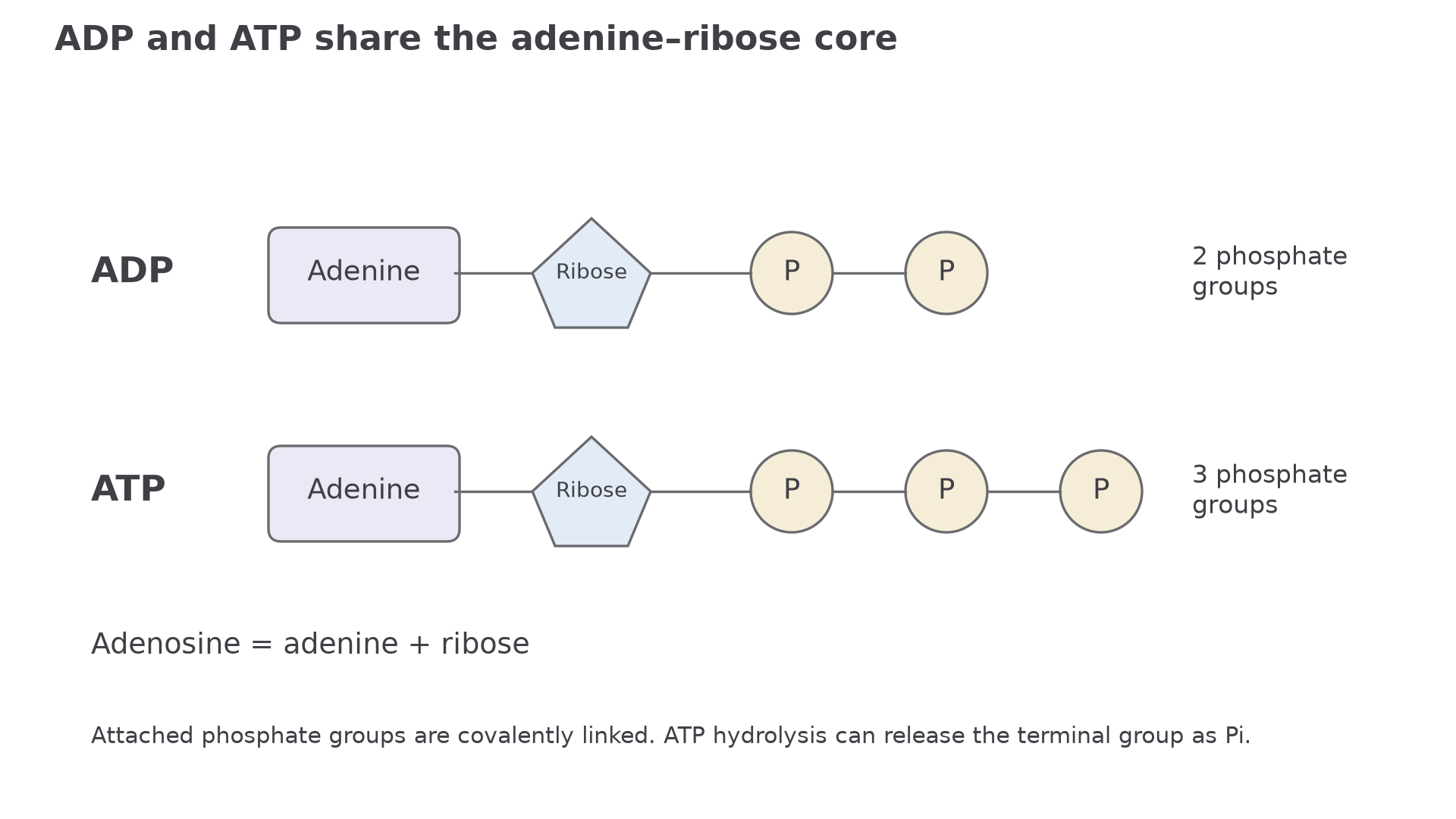
Use the diagram as a structure map rather than as a full chemical formula. OCR does not require you to draw the complete chemical structure here. The important learning decision is to see the shared adenine-ribose core and then count the phosphate groups.
Comparing ADP And ATP
Question: Compare the structure of ADP with the structure of ATP.
A strong answer starts with similarity, then gives the precise difference:
Both ADP and ATP contain adenine and ribose, so both are adenosine-based phosphorylated nucleotides. ADP has two inorganic phosphate groups, whereas ATP has three inorganic phosphate groups.
Now try the same comparison without the scaffold. Aim for shared components first, then the phosphate difference.
OCR describes these as inorganic phosphate groups. In ADP and ATP the groups are covalently attached within the nucleotide; they are not free phosphate ions. Free inorganic phosphate, Pi, is released during ATP hydrolysis.
Quick recap
ATP and ADP share adenine and ribose. ADP has two attached phosphate groups and ATP has three.