5.1.3(c) - Generation and transmission of nerve impulses
A nerve impulse is an action potential: a rapid, temporary change in the electrical potential difference across a neurone membrane. In mammals, this signal is generated by controlled ion movements and transmitted along axons quickly enough for coordinated responses. This lesson follows one impulse from a resting membrane, through positive-feedback depolarisation, along a myelinated neurone, and then asks how frequency carries information about stimulus strength.
Membrane potential and ion gradients
A neurone membrane has a potential difference because the inside and outside of the axon do not contain the same distribution of charged ions. The outside has a relatively high concentration of sodium ions, Na⁺. The cytoplasm has a relatively high concentration of potassium ions, K⁺, and also contains large negatively charged proteins and other anions that cannot diffuse out easily.
Resting potential
The resting potential is the potential difference across the membrane of a neurone when it is not transmitting an impulse; the inside is negative relative to the outside, often about -70 mV.
The resting potential is established and maintained by two linked features. First, the sodium-potassium pump uses ATP to move 3 Na⁺ out of the neurone and 2 K⁺ into it. This maintains steep concentration gradients for both ions. Second, the membrane is more permeable to K⁺ than to Na⁺ at rest, because there are more open K⁺ leak channels. K⁺ diffuses out faster than Na⁺ diffuses in, so the inside becomes more negative relative to the outside.
[DIAGRAM: resting_potential_ion_gradients: Lesson 104: Generation and transmission of nerve impulses - diagram 01; asset_slug: 104_m05_1_3_generation_and_transmission_of_nerve_impulses__diagram_01; recommended_method: drawn_biology; description: A labelled resting axon membrane diagram showing high Na⁺ outside, high K⁺ and large anions inside, the sodium-potassium pump moving 3 Na⁺ out and 2 K⁺ in using ATP, K⁺ leak channels, very little Na⁺ leak and the negative inside of the membrane.]
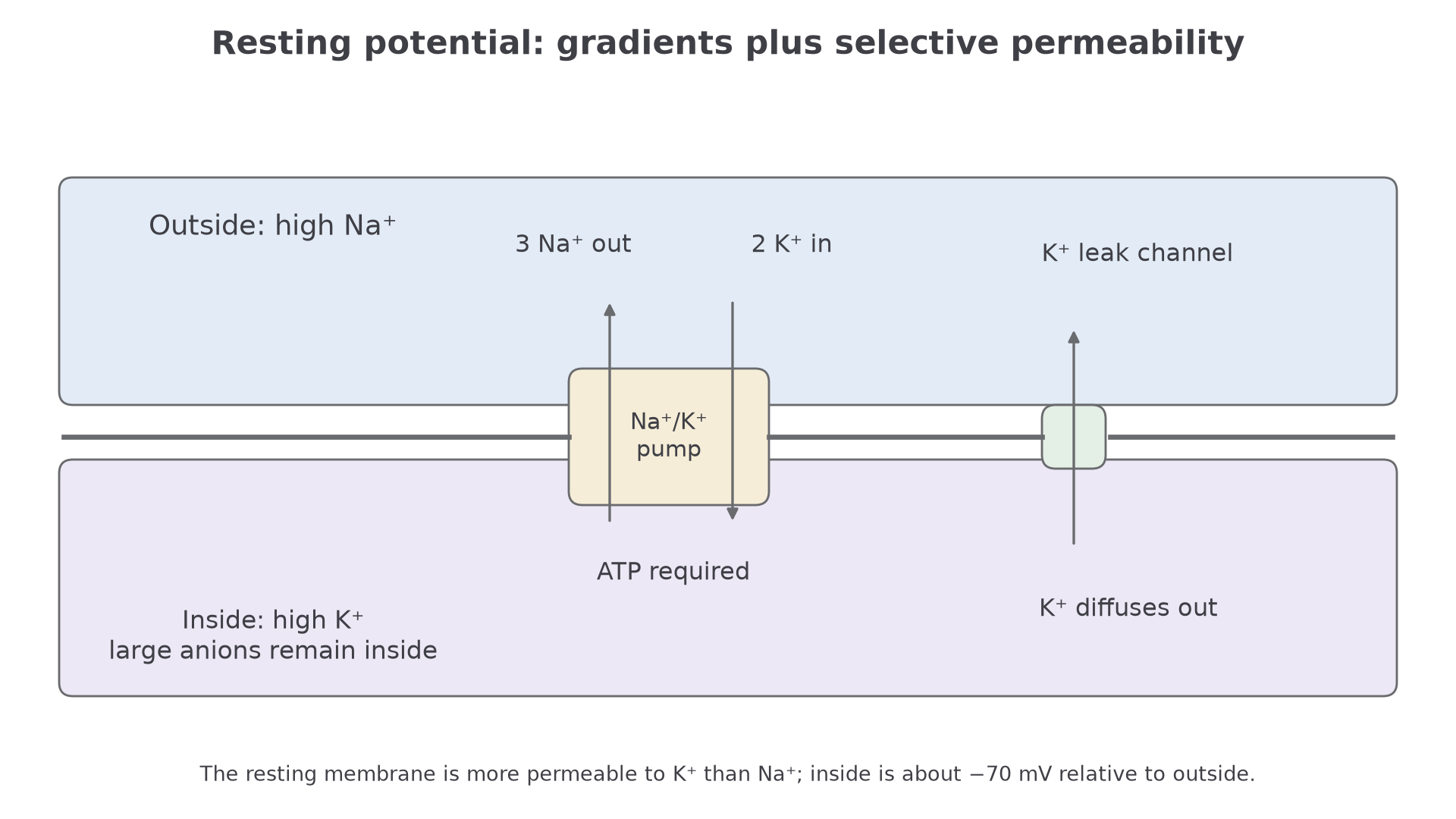
A common error is to say the pump alone "makes" the resting potential. The pump is essential because it maintains the gradients, but the immediate negative potential depends strongly on selective permeability: K⁺ leaves through leak channels more readily than Na⁺ enters.
Generating an action potential
An action potential begins when a stimulus depolarises the membrane enough to reach a threshold potential. Depolarisation means the inside of the membrane becomes less negative than it was at rest. If threshold is reached, voltage-gated Na⁺ channels open.
Na⁺ then diffuses into the neurone down its electrochemical gradient. Because Na⁺ is positively charged, this makes the inside still less negative and then positive. That extra depolarisation opens more voltage-gated Na⁺ channels, so even more Na⁺ enters. This self-amplifying loop is the required positive feedback in action-potential generation.
[DIAGRAM: action_potential_trace: Lesson 104: Generation and transmission of nerve impulses - diagram 02; asset_slug: 104_m05_1_3_generation_and_transmission_of_nerve_impulses__diagram_02; recommended_method: drawn_biology; description: A membrane-potential graph with time on the x-axis and membrane potential in mV on the y-axis, showing resting potential, threshold, rapid depolarisation from Na⁺ entry, positive feedback, repolarisation from K⁺ leaving, hyperpolarisation and return to rest.]
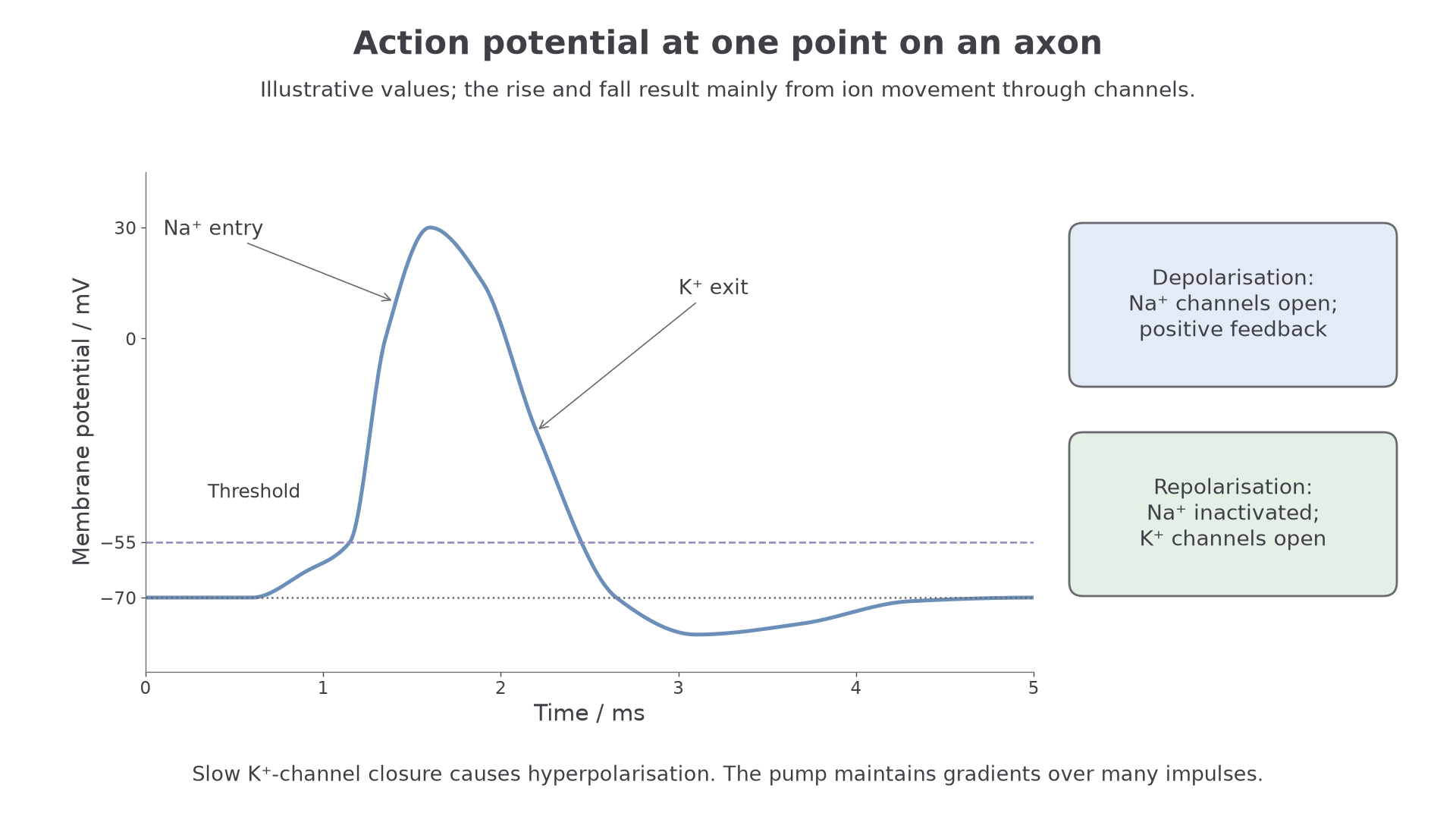
Once threshold is reached, the action potential is all-or-none: a stronger stimulus does not make a taller action potential.
This all-or-none idea matters because the size of an individual action potential is not used to represent stimulus strength. The action potential either happens with its characteristic change in membrane potential, or it does not happen.
Resetting the membrane
Depolarisation has to be brief. Near the peak of the action potential, voltage-gated Na⁺ channels become inactivated, so Na⁺ entry stops. Voltage-gated K⁺ channels open, and K⁺ diffuses out of the neurone. This loss of positive charge makes the inside of the membrane negative again: the membrane repolarises.
K⁺ channels may close slightly after the membrane has returned to the resting value. If extra K⁺ leaves during this delay, the inside becomes more negative than the resting potential for a short time. This is hyperpolarisation. The sodium-potassium pump and leak channels then help restore the resting distribution of ions.
The refractory period, while Na⁺ channels are inactivated and temporarily unavailable, also helps transmission move in one direction along an axon. The membrane just behind an action potential is temporarily unable, or less able, to fire again, while the membrane just ahead can be depolarised to threshold.
Continue this lesson.
You’re previewing NovaLearn without an account. Create a free account to read the rest.
Create free account