6.1.2(f) - Hardy-Weinberg allele-frequency calculations
Hardy-Weinberg calculations turn information about alleles and genotypes into estimates for a whole population. The biology is population genetics, but the skill is careful algebra: identify which frequency you have, substitute it into the provided equations, and interpret the answer. OCR provides the Hardy-Weinberg equations where they are needed, so your job is to use them accurately rather than memorise them.
Model And Symbols
An allele frequency is the proportion of all copies of a gene in a population that are a particular allele. In a diploid population, each individual has two alleles for a gene, so the gene pool contains twice as many allele copies as there are individuals.
Allele Frequency
Allele frequency is the proportion of all alleles for a particular gene in a population that are a specified allele.
For a simple two-allele locus, use:
- for the frequency of one allele, often the dominant allele in simple examples
- for the frequency of the other allele, often the recessive allele in simple examples
Because those two alleles make up all the alleles at that locus:
Hardy-Weinberg Allele Frequencies
The identity p + q = 1 holds for a two-allele locus even outside equilibrium. Under the Hardy–Weinberg model, random union of gametes predicts the following genotype frequencies:
Hardy-Weinberg Genotype Frequencies
For alleles A and a, the terms mean:
| Term | Genotype represented | Meaning |
|---|---|---|
| AA | expected frequency of homozygous dominant individuals | |
| Aa | expected frequency of heterozygous individuals | |
| aa | expected frequency of homozygous recessive individuals |
[DIAGRAM: hardy_weinberg_equation_map: Lesson 146: Hardy-Weinberg allele-frequency calculations - diagram 01; asset_slug: 146_m06_1_2_hardy_weinberg_allele_frequency_calculations__diagram_01; recommended_method: drawn_biology; description: A deterministic 16:9 flow diagram mapping allele frequencies p and q to genotype frequencies p^2, 2pq and q^2, with the two OCR-provided equations and labels for AA, Aa and aa.]
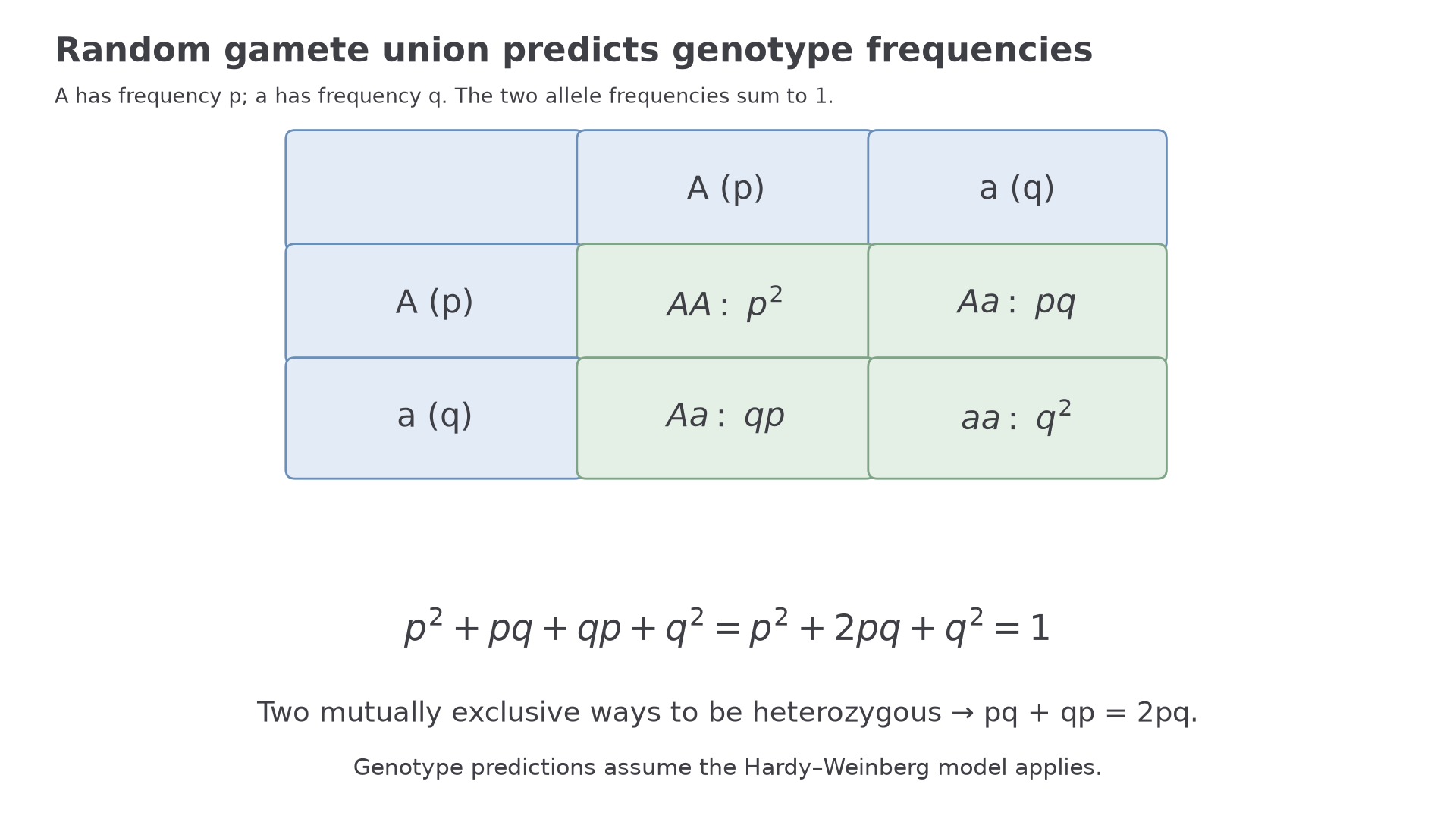
An Aa offspring can arise from A in the egg and a in the sperm (probability pq), or a in the egg and A in the sperm (qp). Adding these mutually exclusive outcomes gives 2pq. AA requires two A gametes, giving p², and aa requires two a gametes, giving q².
When genotypes are counted directly, count allele copies: the frequency of A is (2 × number of AA + number of Aa)/(2 × total individuals). Taking the square root of a recessive phenotype frequency instead requires the equilibrium model.
A frequency is a proportion, so it is usually written as a decimal between 0 and 1. A percentage is found by multiplying the frequency by 100. For example, a frequency of 0.04 is 4%.
The equations are provided where needed. Marks usually come from choosing the correct term, showing substitution, calculating accurately, and rounding as instructed.
Before using an equation, decide whether the information describes an allele frequency or an expected genotype frequency.
From Recessive Phenotype
Many Hardy-Weinberg questions start with the frequency of a recessive phenotype. In a simple dominant/recessive example, individuals with the recessive phenotype must be homozygous recessive, such as aa. That means the recessive phenotype frequency is , not .
The safe route is:
- Convert the recessive phenotype frequency into a decimal.
- Set this equal to .
- Take the square root to find .
- Use to find .
- Use the requested term, such as , and convert to a percentage if needed.
Finding heterozygotes from a recessive phenotype
In a large population of beetles, a recessive phenotype occurs in 9 out of 10 000 individuals. Estimate the percentage of beetles that are heterozygous.
The recessive phenotype frequency is:
Take the square root:
Find :
Find the heterozygote frequency:
Convert to a percentage:
So about 5.8% of the population are expected to be heterozygous, before any extra rounding instruction is applied.
The biggest trap is treating the recessive phenotype frequency as . If 9 in 10 000 show the recessive phenotype, 0.0009 is . The allele frequency is the square root of that value.
Continue this lesson.
You’re previewing NovaLearn without an account. Create a free account to read the rest.
Create free account