4.1.1(a)-(b) - Pathogen types and transmission
Communicable disease begins with two linked ideas: a pathogen must be able to cause disease, and it must be able to pass from one host to another. Different pathogen groups exploit different routes into hosts. Linking each route to the conditions that favour it explains why infection spreads in some settings more readily than others.
Pathogens and communicable disease
A pathogen is a disease-causing agent. It may be a cellular organism, such as a bacterium or fungus, or a non-cellular virus. A communicable disease is a disease that can be transmitted from one organism to another, either between animals, between plants, or from an environmental source into a host.
Pathogen
A disease-causing microorganism, virus or other infectious agent.
Communicable disease
A disease that can be transmitted from one host organism to another.
The important first step is to separate the type of pathogen from the name of the disease. Tuberculosis is a disease; the required pathogen type for TB is bacteria. Tobacco Mosaic Virus is both named as a plant virus and used as the example of a viral plant disease.
| Pathogen type | required examples | Main idea for this lesson |
|---|---|---|
| Bacteria | Tuberculosis (TB); ring rot in potatoes | Cellular prokaryotic pathogens can infect animals or plants. |
| Viruses | HIV/AIDS in humans; influenza in animals; Tobacco Mosaic Virus in plants | Viruses replicate only inside host cells and are transmitted by routes that bring virus particles to a new host. |
| Protoctista | Malaria; potato/tomato late blight | OCR places malaria and late blight here. Late blight is often described by plant pathologists as a water mould rather than a true fungus. |
| Fungi | Black sigatoka in bananas; athlete's foot in humans | Fungal pathogens may spread by contact, contaminated surfaces or spores, depending on the example. |
A disease is the condition in the host; its pathogen is the organism or virus that causes it.
Transmission as a route
Transmission is not just "being near a pathogen". A pathogen has to leave a source or reservoir, travel by a route that keeps it infective, and reach a susceptible host. That route can involve air, body fluids, contaminated tools, contaminated surfaces, spores, a vector, or living conditions that make contact between host and pathogen more likely.
[DIAGRAM: transmission_chain_map: Lesson 071: Pathogen types and transmission - diagram 01; asset_slug: 071_m04_1_1_pathogen_types_and_transmission__diagram_01; recommended_method: drawn_biology; description: A clean flow diagram showing pathogen source, route of transmission and susceptible host, with vectors, spores and living conditions as route modifiers, without categorising routes as direct or indirect.]
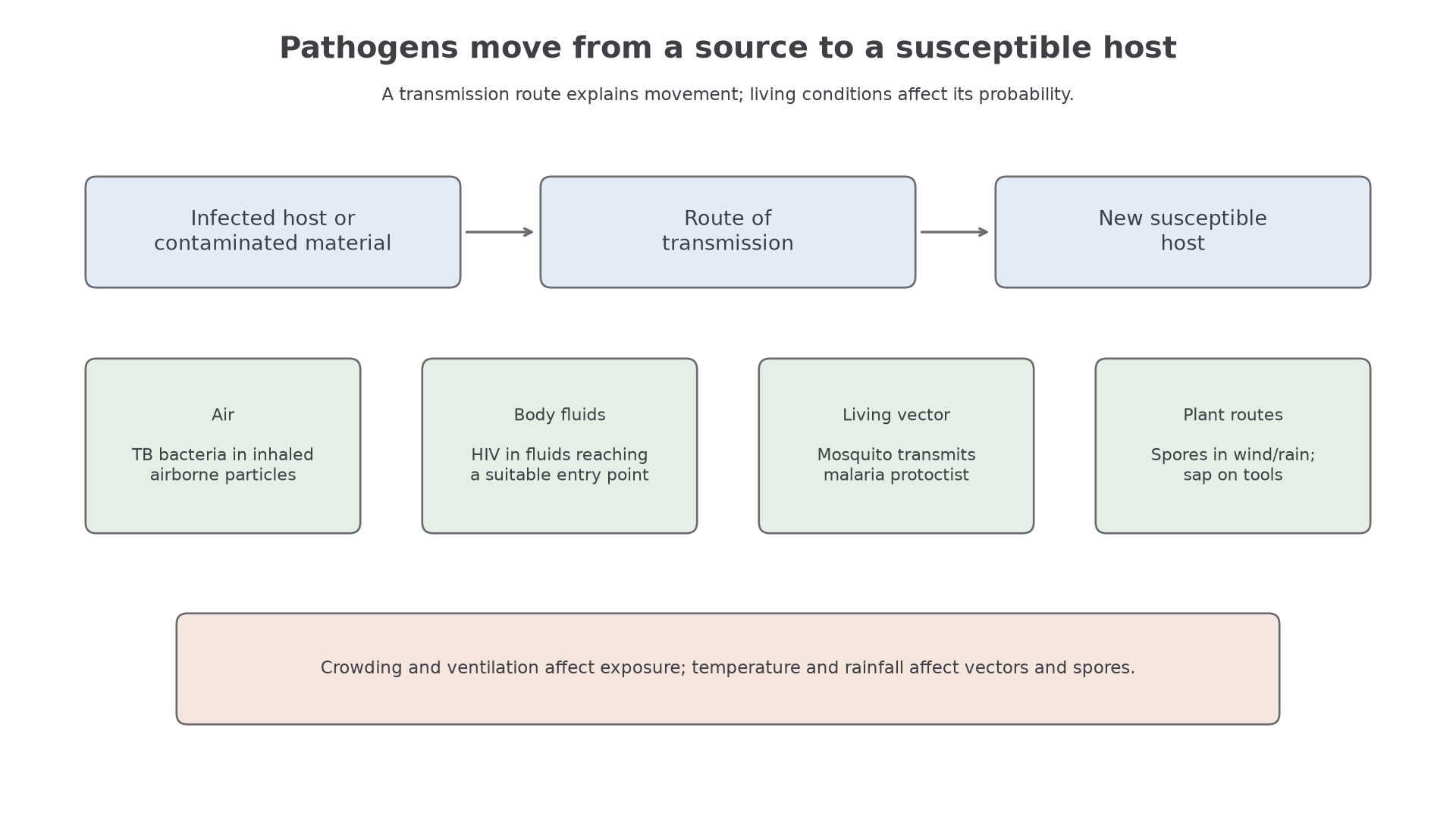
A vector is a living organism that transmits a pathogen between hosts. In malaria, the protoctist pathogen is transmitted by female Anopheles mosquitoes, so the mosquito is the vector. The mosquito is not the pathogen; it is the carrier that moves the pathogen to a new host.
Transmission also depends on living conditions. Poor ventilation, crowding and close contact can increase the probability that airborne or respiratory pathogens reach another host. Climate matters for many vector-borne diseases because rainfall, temperature and humidity affect vector survival and breeding. These factors do not create pathogens from nothing; they change how easily existing pathogens are transmitted.
A transmission explanation should link a pathogen source, a route of movement and a new susceptible host.
Animal and human examples
The required animal and human examples show that transmission routes are not the same for every pathogen type.
TB is a bacterial disease. The important transmission idea is that bacteria from active TB in the lungs or throat can be released into the air and inhaled by another person. This explains why social factors such as crowded housing, shelters or prisons, and environmental factors such as poor air circulation, can affect transmission.
HIV/AIDS is a viral example. HIV is transmitted when particular body fluids, such as blood, semen, vaginal or rectal fluids, or breast milk, reach a mucous membrane, damaged tissue or the bloodstream. It is not transmitted by ordinary touching, sharing air, or touching intact skin. For this lesson, you do not need the immune-system details of how HIV can lead to AIDS.
Influenza in animals is also viral. Animal influenza can spread between infected and susceptible animals through respiratory material, direct contact, contaminated environments, and in some cases droplets or dust in air. The central point is that animal influenza is a viral communicable disease and living conditions such as close contact in animal groups can affect transmission.
Malaria is the protoctist example in animals. The malaria pathogen is carried between humans by a mosquito vector. Climate can affect transmission because mosquitoes need suitable temperature, rainfall and breeding conditions. Social factors such as housing quality, bed-net use and access to mosquito control can also change exposure to vectors.
| Example | Pathogen type | Transmission emphasis |
|---|---|---|
| TB | Bacteria | Airborne bacteria from active lung/throat infection; ventilation and crowding matter. |
| HIV/AIDS | Virus | Specific body fluids must reach a suitable entry point. |
| Influenza in animals | Virus | Respiratory material, direct contact and contaminated environments. |
| Malaria | Protoctista | Mosquito vector; climate and exposure affect vector contact. |
Continue this lesson.
You’re previewing NovaLearn without an account. Create a free account to read the rest.
Create free account