5.1.4(d) - Regulation of blood glucose concentration
Blood glucose concentration must stay within a narrow enough range for cells to receive a reliable supply of respiratory substrate. In this lesson, you will follow the two main hormonal feedback branches: insulin lowers blood glucose concentration, glucagon raises it, and the liver is the main organ that switches between storing and releasing glucose. You will also learn the beta-cell ion-channel sequence that controls insulin secretion.
The Controlled Variable
Blood glucose concentration is the concentration of glucose dissolved in the blood plasma. Glucose matters because it is a respiratory substrate: cells can use it in respiration to produce ATP.
If blood glucose concentration rises too far, the internal environment is no longer stable. If it falls too far, cells may not receive enough glucose for normal metabolism. Regulation therefore works by detecting a deviation from the normal range and producing a response that reverses that deviation.
Negative Feedback
Negative feedback is a control mechanism in which a change from the normal value triggers responses that reduce the original change and return the variable towards the normal range.
In this control system, the pancreas detects changes in blood glucose concentration and secretes hormones into the blood. Two endocrine cell types in the islets of Langerhans are especially important:
| Cell type | Hormone secreted | Main condition for secretion |
|---|---|---|
| Beta cells | Insulin | Blood glucose concentration is too high |
| Alpha cells | Glucagon | Blood glucose concentration is too low |
The hormones are carried in the blood to target tissues. The liver is the key target organ in this lesson because liver cells can store glucose as glycogen and can also release glucose into the blood.
The Insulin Branch
After a carbohydrate-containing meal, glucose is absorbed from the small intestine into the blood. Blood glucose concentration rises above the normal range. Beta cells in the pancreas respond by secreting insulin into the blood.
Insulin is a hormone, so it affects only cells with suitable receptors. Its overall effect is to lower blood glucose concentration. It does this by increasing the movement of glucose from blood into cells and by changing liver metabolism so that more glucose is stored.
In the liver, insulin promotes glycogenesis.
Glycogenesis
Glycogenesis is the conversion of glucose molecules into glycogen for storage.
Glycogen is a compact storage polysaccharide. When liver cells convert glucose to glycogen, glucose is removed from the blood and stored in the liver. Insulin also reduces liver processes that would add glucose to the blood, such as glycogen breakdown and glucose production from non-carbohydrate substrates.
[DIAGRAM: glucose_negative_feedback_loop: Lesson 108: Regulation of blood glucose concentration - diagram 01; asset_slug: 108_m05_1_4_regulation_of_blood_glucose_concentration__diagram_01; recommended_method: drawn_biology; description: A two-branch negative feedback diagram showing high blood glucose stimulating beta-cell insulin release and low blood glucose stimulating alpha-cell glucagon release, with liver glycogenesis, glycogenolysis and gluconeogenesis returning blood glucose towards the normal range.]
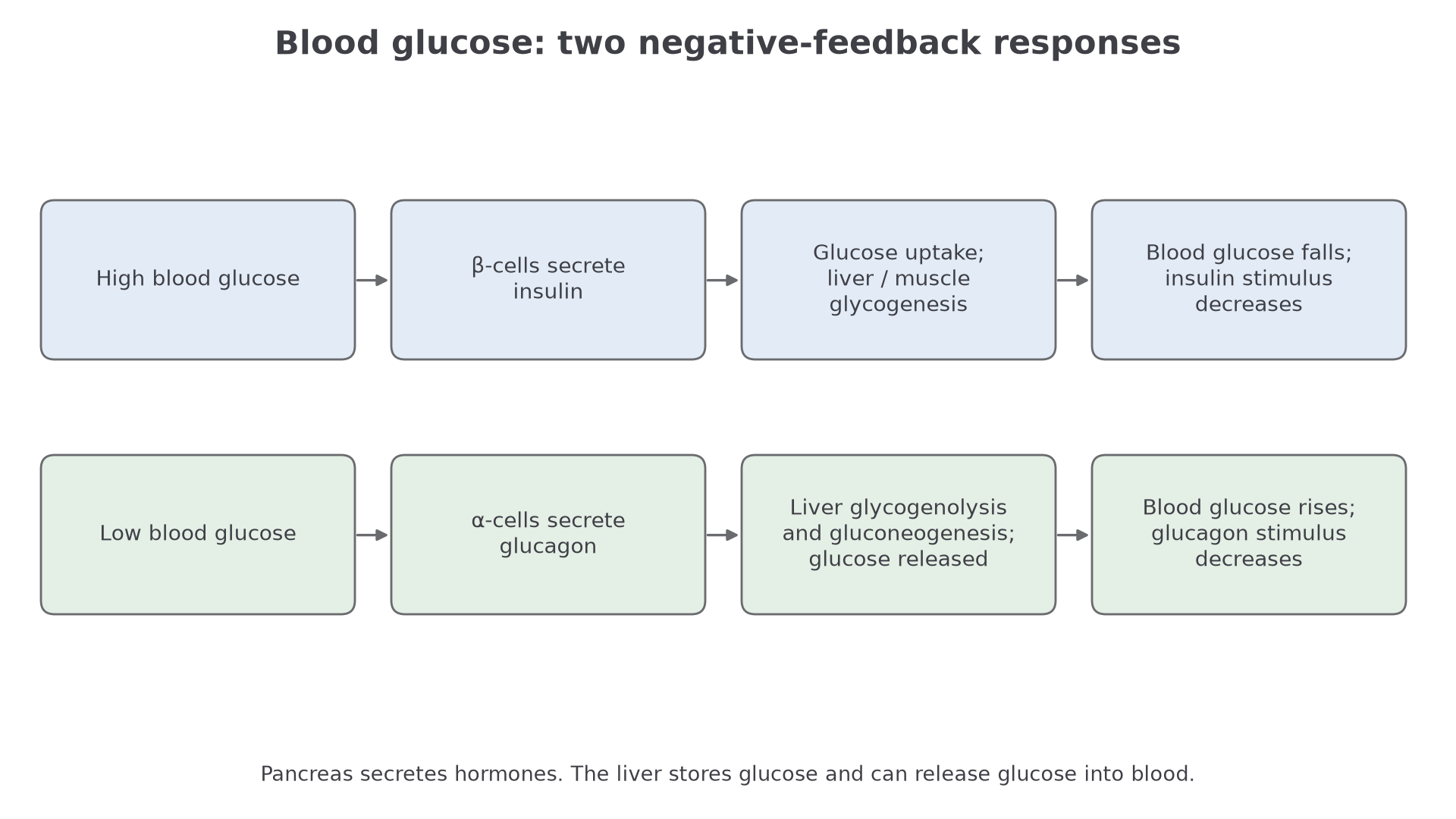
The important pattern is the direction of the response:
| Change detected | Hormone | Main liver response | Effect on blood glucose |
|---|---|---|---|
| Blood glucose too high | Insulin | Glucose converted to glycogen | Blood glucose falls |
| Blood glucose too low | Glucagon | Glycogen and other substrates used to release glucose | Blood glucose rises |
Insulin lowers blood glucose concentration, and the liver helps by converting glucose to glycogen.
In skeletal muscle and adipose cells, insulin signalling moves glucose-transporter proteins into the cell-surface membrane, increasing glucose uptake by facilitated diffusion. Liver glucose entry is not explained by this same insulin-dependent transporter insertion: insulin promotes glucose phosphorylation and storage and suppresses liver glucose output. Glycogenesis also occurs in muscle, but muscle glycogen mainly fuels that muscle; liver glycogen supports blood glucose for other tissues.
The Glucagon Branch
Between meals, or during exercise, blood glucose concentration can fall below the normal range. Alpha cells in the pancreas respond by secreting glucagon into the blood.
Glucagon mainly acts on the liver. Its effect is to raise blood glucose concentration by increasing the amount of glucose released from liver cells into the blood.
Two liver processes are especially important:
| Process | Meaning | Effect of glucagon |
|---|---|---|
| Glycogenolysis | Breakdown of glycogen to glucose | Stimulated |
| Gluconeogenesis | Production of glucose from non-carbohydrate substrates | Stimulated |
Glucagon also reduces glycogenesis, so the liver is not storing glucose as glycogen while blood glucose is already low. This is why the liver is central to the feedback loop: it is a store that can be filled when glucose is high and drawn on when glucose is low.
A common mistake is to say that glucagon makes the pancreas release glucose. The pancreas releases the hormone. The liver is the organ that releases glucose into the blood in response to glucagon.
Gluconeogenesis uses substrates such as amino acids and glycerol; it is distinct from breaking down an existing glycogen store. As blood glucose returns towards the normal range, the stimulus for glucagon secretion falls. Similarly, insulin secretion decreases after high glucose has been corrected. A feedback system therefore adjusts hormone secretion continuously, rather than switching a hormone permanently on.
Continue this lesson.
You’re previewing NovaLearn without an account. Create a free account to read the rest.
Create free account