6.1.2(g) - Isolating mechanisms and speciation
Speciation is the evolution of one species into two or more new species. Two routes involve geographical mechanisms in allopatric speciation and reproductive mechanisms in sympatric speciation. The big idea is that isolation reduces gene flow; over many generations, separated gene pools can diverge until individuals can no longer interbreed to produce fertile offspring.
Species, Gene Flow And Isolation
A useful A-level definition of a species is a group of organisms that can interbreed to produce fertile offspring. This works best for sexually reproducing organisms, which is the context needed for this lesson.
Gene Flow
Gene flow is the movement of alleles between populations when individuals interbreed.
When individuals from different parts of one population mate with each other, alleles can move through the whole population. That tends to keep the gene pool mixed. An isolating mechanism is any mechanism that prevents or reduces interbreeding between groups, so it reduces gene flow between their gene pools.
Reduced gene flow matters because the separated groups no longer share allele changes freely. Mutations can arise in one group and not the other. Natural selection can favour different alleles if the groups experience different selection pressures. Genetic drift can also change allele frequencies, especially in smaller groups. Over time, the groups may become genetically different enough that they can no longer interbreed successfully.
Do not jump straight from "isolated" to "new species". Isolation starts or maintains the split. Speciation is complete only when reproductive isolation means the groups cannot interbreed to produce fertile offspring.
Allopatric Speciation
Allopatric speciation is speciation that begins when populations are geographically isolated. The barrier might be a sea, river, mountain range, island separation, distance, or a stretch of unsuitable habitat. The key point is not the named barrier itself; it is that individuals from the separated populations no longer interbreed.
[DIAGRAM: allopatric_sympatric_routes: Lesson 147: Isolating mechanisms and speciation - diagram 01; asset_slug: 147_m06_1_2_isolating_mechanisms_and_speciation__diagram_01; recommended_method: drawn_biology; description: A deterministic 16:9 grey line diagram comparing allopatric speciation by geographical isolation with sympatric speciation by reproductive isolation, showing how each route reduces gene flow and can lead to reproductive isolation.]
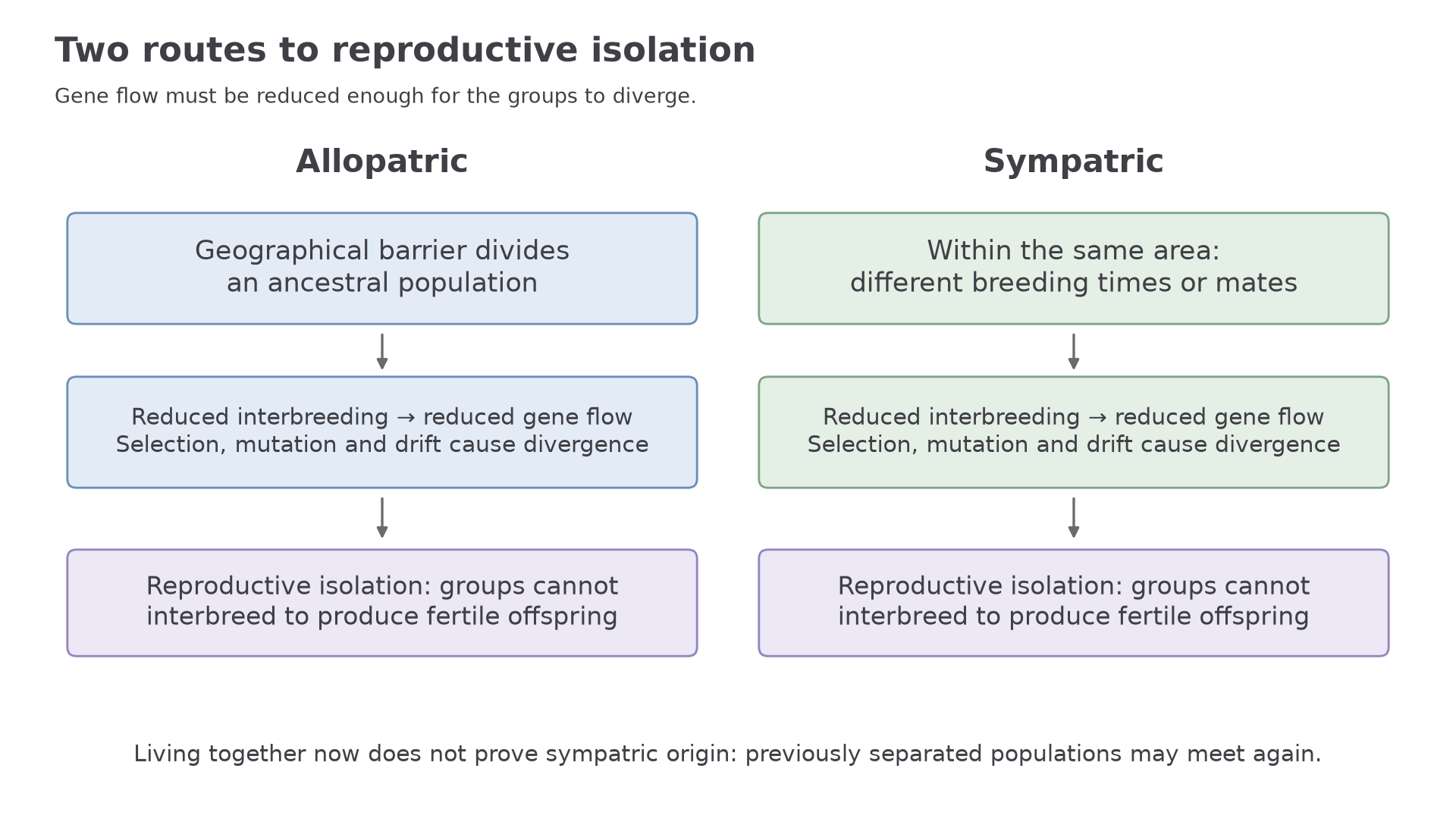
A possible allopatric sequence is:
- One population is split by a geographical barrier.
- Interbreeding between the separated groups stops or becomes very rare, so gene flow is reduced.
- Each group experiences mutation, selection and drift separately.
- Different selection pressures may favour different phenotypes in the two environments.
- Allele frequencies become increasingly different over many generations.
- Reproductive isolation evolves, so the groups cannot interbreed to produce fertile offspring if they meet again.
Island separation
An ancestral mammal population is split when an island becomes separated from the mainland. The island population now has little or no gene flow with the mainland population. If the island has different prey, competitors or climate, different features may improve survival and reproduction there. Individuals with advantageous alleles are more likely to reproduce and pass those alleles on. After many generations, the island population may be reproductively isolated from the mainland population, forming a new species.
Notice the wording in the worked example. The island does not "make" the organisms adapt because they need to. The barrier reduces gene flow; mutation provides variation; selection changes allele frequencies because some inherited features improve survival or reproduction in that environment.
Continue this lesson.
You’re previewing NovaLearn without an account. Create a free account to read the rest.
Create free account