5.1.5(c)-(d) - Auxin and gibberellin experimental evidence
Plant hormones are not accepted as important just because they are present in a plant. Biologists need experiments that change the hormone, measure a growth response, and use controls to show that the hormone is a likely cause. In this lesson, you will learn how to interpret evidence for auxin in apical dominance and gibberellin in stem elongation and seed germination.
Reading Hormone Evidence
This lesson is about experimental evidence, not memorising named historical experiments. The specification expects you to apply your knowledge to different experimental setups, so the skill is to read the method and results like an investigator.
Experimental Evidence
Experimental evidence is data from a controlled investigation that can support or challenge a biological explanation.
For plant hormones, a strong experiment usually changes one hormone-related factor and measures a growth response. The key question is: did the response change because of the hormone, or because of another part of the method?
| Evidence feature | What to look for | Why it matters |
|---|---|---|
| independent variable | hormone present/absent, hormone concentration, or hormone-deficient plant type | shows what the investigator deliberately changed |
| dependent variable | lateral bud growth, stem length, rate of elongation, percentage germination, or amylase activity | shows the measured response |
| control treatment | no hormone, plain agar, solvent only, or untreated plants | shows what happens without the active hormone treatment |
| controlled variables | plant species, age, light, temperature, water, time, soil or medium | prevents another factor explaining the result |
| repeats and means | several plants or seeds in each group | reduces the effect of individual variation |
Use experimental data to distinguish an association from evidence for a causal relationship. A correlation, such as taller plants also having more gibberellin, is useful but not enough by itself. A stronger causal case comes from changing gibberellin concentration and then seeing a consistent change in stem elongation while other factors are controlled.
When a question asks how results support a theory, do not describe the theory only. Compare the control and treatment results, then link the difference to the hormone that was changed.
Auxin and Apical Dominance
Apical dominance is the inhibition of lateral bud growth by the apical bud at the shoot tip. Auxin is produced near the shoot apex and moves down the shoot. Evidence for auxin's role comes from experiments that remove the apex, replace it with a control, or replace it with auxin.
The evidence pattern is easier to understand if you compare treatments rather than memorise a diagram:
- An intact shoot has an apical bud and lateral buds remain small.
- If the apical bud is removed, the main source of auxin is removed and lateral buds grow into side shoots.
- If the apical bud is removed but auxin is applied to the cut surface, lateral bud growth is inhibited again.
[DIAGRAM: auxin_apical_dominance_evidence: Lesson 112: Auxin and gibberellin experimental evidence - diagram 01; asset_slug: 112_m05_1_5_auxin_and_gibberellin_experimental_evidence__diagram_01; recommended_method: drawn_biology; description: 16:9 grey line diagram comparing intact apex, apex removed plus plain agar, and apex removed plus auxin agar, with lateral bud outcomes and causal evidence logic.]
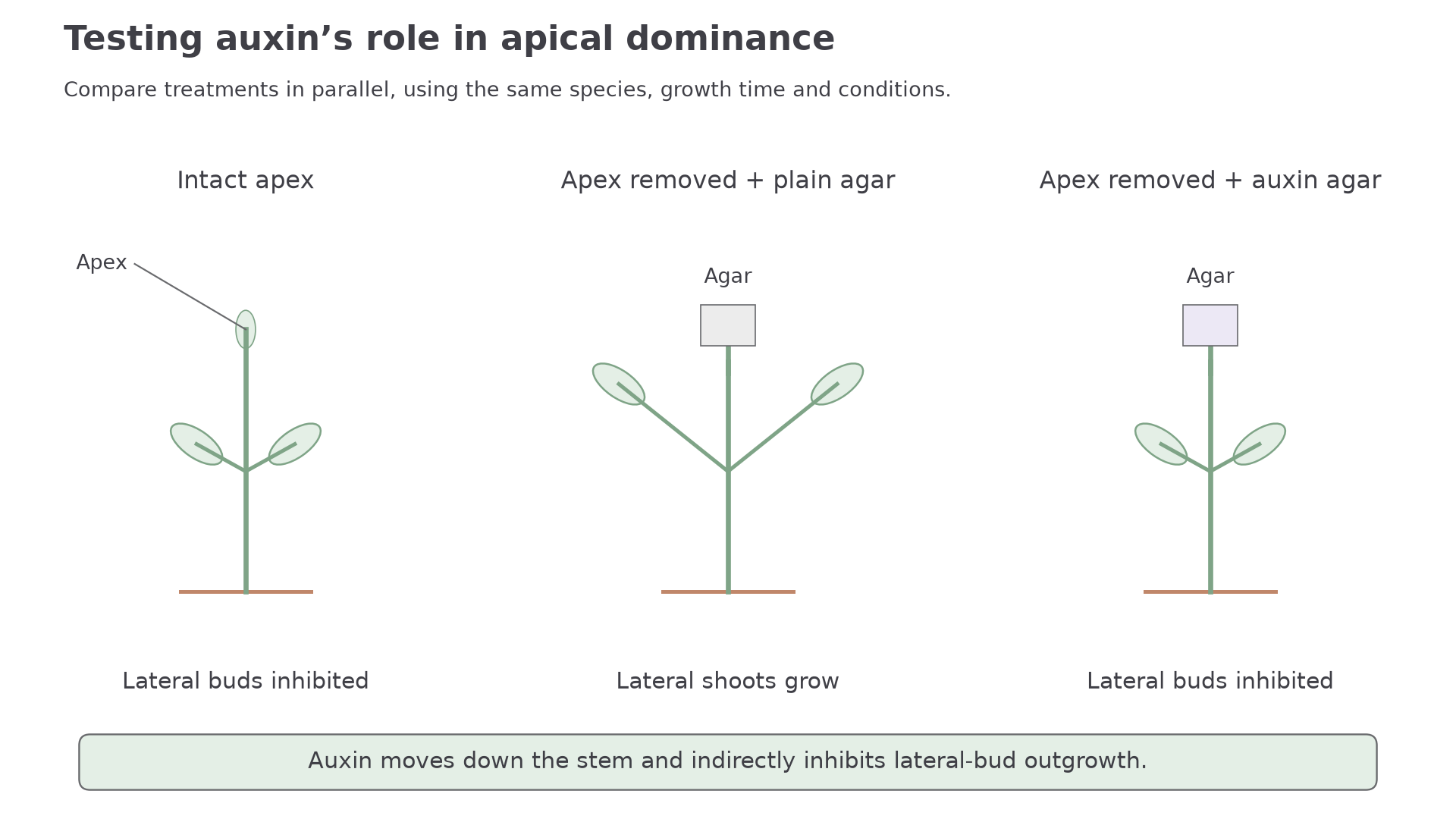
Auxin from the apex travels down the main stem. Its inhibition of lateral-bud outgrowth is indirect, involving other signals; this experiment does not show auxin entering the lateral buds themselves.
The plain agar or plain paste matters. It checks that the physical block, the cut surface, or the extra handling is not the reason lateral buds stay small. If plain agar allows lateral buds to grow but auxin-containing agar prevents lateral bud growth, the key difference is auxin.
Using results as evidence
A shoot has its apical bud removed. In plant A, plain agar is placed on the cut surface and lateral shoots grow. In plant B, agar containing auxin is placed on the cut surface and lateral shoots do not grow.
A strong conclusion is:
"Removing the apical bud allows lateral bud growth, but replacing auxin at the cut surface restores inhibition. Because the agar treatment is otherwise similar, this supports the idea that auxin from the apical bud helps maintain apical dominance."
Notice the wording "supports the idea". It is stronger than saying "proves", because biological experiments still depend on controls, repeats and possible alternative explanations.
Auxin is not just present or absent. Its concentration affects growth. In this lesson, you need the concentration idea for evidence interpretation: higher auxin concentration can maintain stronger apical dominance by inhibiting lateral bud growth, while lower concentrations may allow or stimulate lateral growth. Very high concentrations can inhibit growth, so do not write "more auxin always means more growth".
Auxin Concentration Data
Unfamiliar data can test the same biological explanation. For auxin, the data may compare apical shoot growth and lateral shoot growth across a concentration range.
The main skill is to keep three distinctions separate:
| Distinction | Why it matters |
|---|---|
| apical shoot versus lateral shoot | auxin can affect them differently |
| low concentration versus high concentration | concentration may be shown on a logarithmic scale |
| stimulation versus inhibition | positive growth is not the same as reduced growth |
Continue this lesson.
You’re previewing NovaLearn without an account. Create a free account to read the rest.
Create free account