3.1.3(c)(i)-(ii) - Transpiration, its factors and potometers
Transpiration is water loss from a plant, but the important A-level idea is why it happens: leaves need open gas-exchange surfaces for photosynthesis, and open stomata also let water vapour escape. In this lesson you will connect that process to environmental factors, then use a potometer to estimate transpiration rate and judge whether the investigation gives valid data.
Transpiration as gas exchange cost
Leaves need carbon dioxide from the air for photosynthesis. Most carbon dioxide enters through stomata, which are small pores in the epidermis of a leaf. When stomata are open, gases can diffuse between the leaf air spaces and the atmosphere.
That useful gas exchange has a cost. The surfaces of mesophyll cell walls inside the leaf are moist. Water evaporates from these moist cell walls into the leaf air spaces, then water vapour diffuses out through stomata into the surrounding air. This water vapour loss from the aerial parts of the plant is transpiration.
Transpiration
The loss of water vapour from the aerial parts of a plant, mainly through stomata in leaves.
The driving idea is a diffusion gradient. The air spaces inside a leaf are usually more humid than the air outside the leaf, so water vapour diffuses from inside the leaf to outside. If stomata are more open, the pathway for water vapour diffusion is easier. If stomata close, gas exchange decreases and transpiration falls.
This does not mean a plant "chooses" transpiration as the aim. The aim of opening stomata is gas exchange, especially carbon dioxide uptake. Transpiration is an unavoidable consequence of that open diffusion pathway.
Transpiration is best understood as the water-loss cost of opening stomata for gaseous exchange.
Environmental factors
An environmental factor affects transpiration rate if it changes either stomatal opening or the diffusion gradient for water vapour. The same factor can also affect how quickly the moist boundary layer of air is removed from the leaf surface.
| Factor | Typical effect on transpiration rate | Biological reason |
|---|---|---|
| Light intensity increases | Rate usually increases | Stomata tend to open in light to allow carbon dioxide uptake for photosynthesis. |
| Humidity increases | Rate decreases | The water vapour gradient from leaf air spaces to outside air becomes shallower. |
| Air movement increases | Rate increases | Moving air removes the humid boundary layer around the leaf, maintaining a steeper gradient. |
| Temperature increases within a suitable range | Rate usually increases | More kinetic energy increases evaporation and diffusion; warm air can also hold more water vapour. |
The temperature point needs careful wording. In a normal school-lab range, raising temperature often increases transpiration. At very high temperatures or during water stress, stomata may close to reduce water loss, so the rate may not keep increasing. A good answer states the trend and the mechanism, not just "heat speeds it up".
Leaf surface area is not an environmental factor, but it matters in potometer investigations because a shoot with more exposed leaf area may lose more water overall. That makes leaf area an important control variable, or a variable to standardise when comparing different shoots.
In practical design, environmental factors become variables. If light intensity is the independent variable, then temperature, humidity, air movement, leaf area and time should be controlled as far as possible. If temperature is being investigated, the same principle applies: the other factors must be controlled.
For "explain" questions, pair each factor with the gradient or stomatal reason. "Wind increases transpiration" is weaker than "wind removes humid air around the leaf, maintaining a steep water vapour gradient."
Potometer principle
A potometer is used to estimate transpiration rate by measuring water uptake by a leafy shoot. Water vapour loss through stomata draws replacement water into the shoot, linking uptake to transpiration. In a moving-bubble potometer, a bubble moves along a narrow capillary tube as the shoot takes up water. The distance moved by the bubble, together with the capillary diameter and the time taken, can be used to estimate the volume of water taken up per unit time.
[DIAGRAM: potometer_setup_rate_estimate: Lesson 067: Transpiration, environmental factors and potometers - diagram 01; asset_slug: 067_m03_1_3_transpiration_environmental_factors_and_potometers__diagram_01; recommended_method: drawn_biology; description: A 16:9 pale-colour labelled potometer setup with leafy shoot, sealed bung/tubing, water-filled capillary, air bubble, scale, reservoir/syringe, clamp stand, and notes showing cut shoot under water, keep leaves dry, seal joints, equilibrate, and reset bubble before readings.]
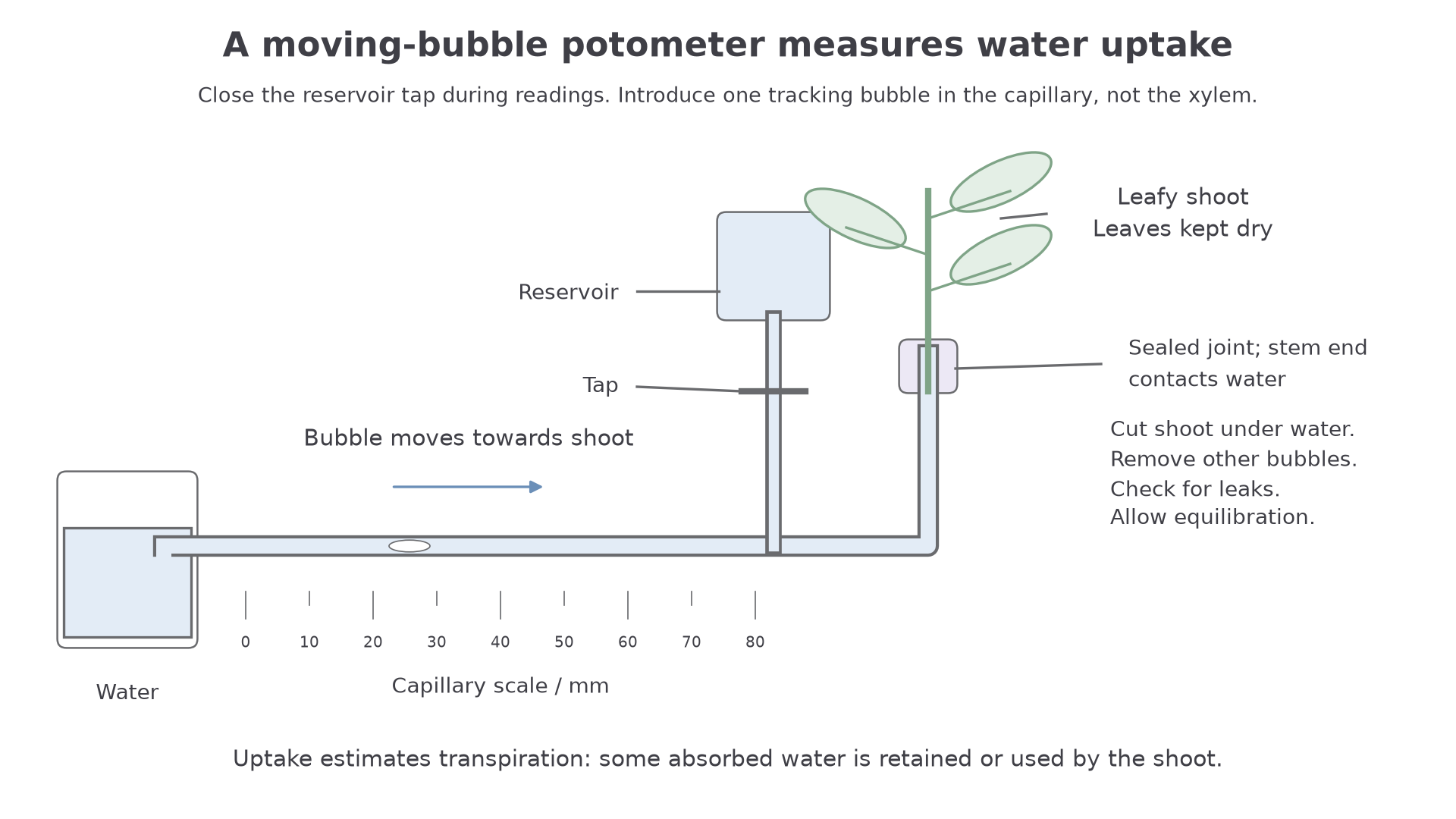
The potometer must be airtight and water-filled. If air enters the xylem or the apparatus, the continuous water column can be interrupted and the bubble movement will no longer represent water uptake reliably. This is why the shoot is cut under water, the apparatus is assembled under water where possible, and joints are sealed.
Good setup decisions have a biological reason:
| Setup decision | Why it matters |
|---|---|
| Cut the shoot under water | Reduces the chance of air entering xylem vessels. |
| Keep leaves dry | Surface water can cover stomata or change the local humidity, altering transpiration and hence water uptake. |
| Seal joints with grease or petroleum jelly | Prevents leaks and unwanted air entry. |
| Use a shoot with several leaves | Gives a measurable rate of water uptake. |
| Allow the shoot to equilibrate | Lets the shoot adjust before readings are taken. |
| Reset the bubble before each repeat | Gives a consistent start point for timing. |
The careful wording is "estimate", not "measure exactly". A moving-bubble potometer measures water uptake. A mass-loss setup instead measures the loss of mass; cover the soil or exposed water so evaporation from elsewhere does not contribute to that loss. Water uptake is close to transpiration over a short time in a leafy shoot, but it is not identical because some water may be used in photosynthesis, retained in tissues, or affect cell turgor.
Calculating rate
Rate means change in a measured quantity per unit time. For a potometer, the measured quantity may be distance moved by the bubble, volume of water taken up, or mass lost. Always use the unit requested in the question.
Rate
If the capillary tube is treated as a cylinder, the volume of water taken up is:
Volume Of Water Taken Up
Continue this lesson.
You’re previewing NovaLearn without an account. Create a free account to read the rest.
Create free account