5.1.2(f) - Diagnostic uses of excretory products
Urine is an excretory product, but it is also a useful biological sample. It can carry hormones, drugs and drug metabolites that give evidence about a person's physiological state or exposure to particular substances. In this lesson you will learn how urine samples are used in diagnostic tests, how monoclonal antibodies make pregnancy tests specific, and why test results need controls and careful interpretation.
Urine As A Diagnostic Sample
Urine forms when the kidneys filter blood, reabsorb useful substances and remove excess water, ions and soluble waste products. Because urine is made from filtered blood plasma, it can contain small molecules that reveal something about what is happening in the body.
The important point is not that every substance in urine is a waste product. For example, hCG is a hormone, not a metabolic waste. The diagnostic value comes from the fact that the substance is present in urine and can be detected reliably.
Diagnostic test
A diagnostic test is a test used to provide evidence about a condition, physiological state or exposure to a substance.
[DIAGRAM: urine_diagnostic_logic: Lesson 101: Diagnostic uses of excretory products - diagram 01; asset_slug: 101_m05_1_2_diagnostic_uses_of_excretory_products__diagram_01; recommended_method: drawn_biology; description: Flowchart showing urine sample collection, target substances such as hCG, drug molecules and anabolic steroid metabolites, testing methods, controls and cautious interpretation.]
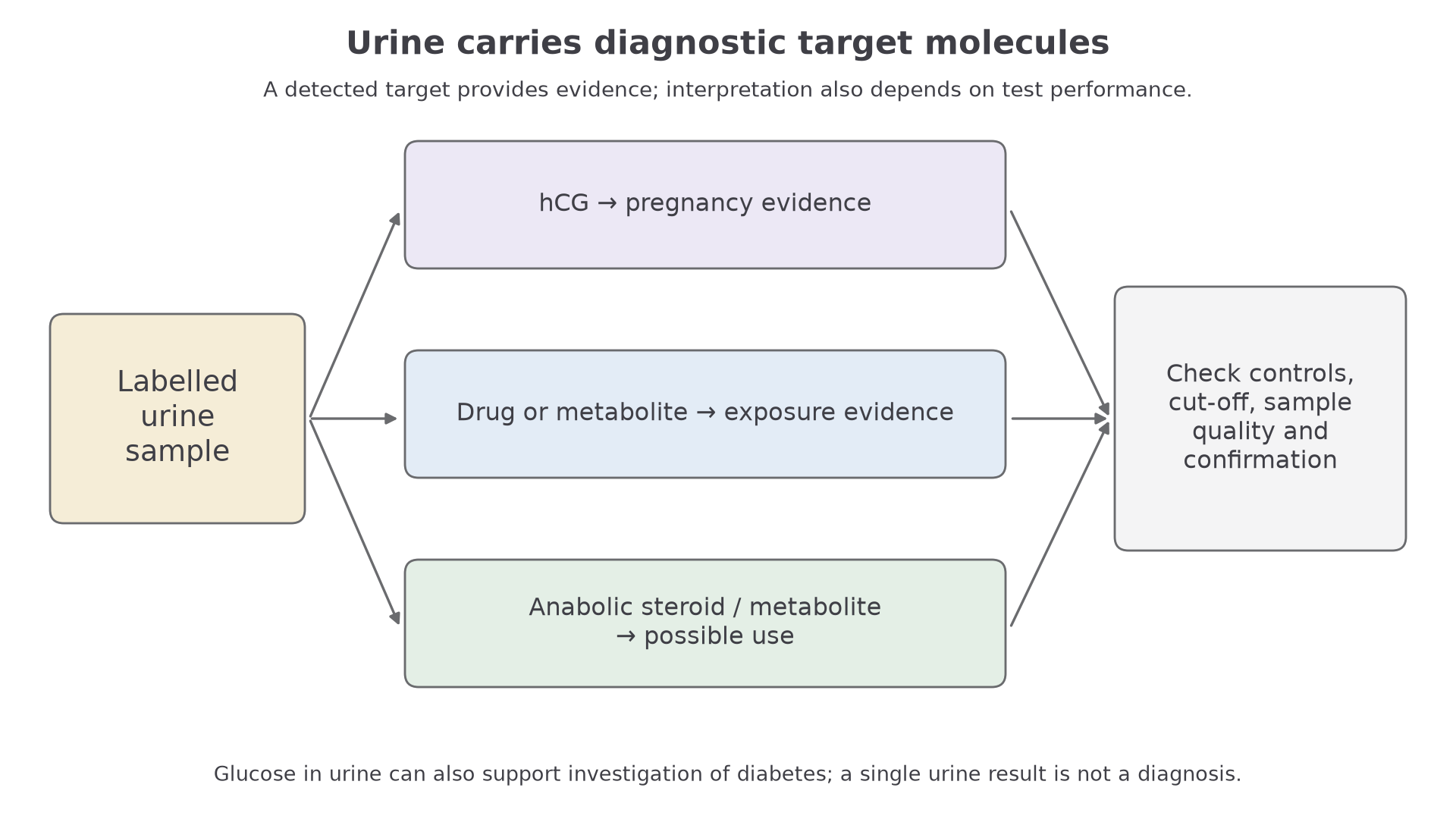
Urine is useful because it is usually easier and less invasive to collect than a blood or tissue sample. A urine sample can also contain breakdown products, called metabolites, after the body has processed a drug. This makes urine testing useful for detecting some drugs and anabolic steroids even when the original substance has been changed by metabolism.
However, a urine test is still evidence, not magic. A result depends on the sample quality, the concentration of the target substance, the specificity of the test and the threshold or cut-off used. A dilute sample, an invalid test strip or a substance present below the detection limit can all affect interpretation.
Pregnancy Testing With Monoclonal Antibodies
Pregnancy tests detect human chorionic gonadotropin, usually shortened to hCG. hCG is a hormone produced early in pregnancy and can be present in urine. A pregnancy test strip works because monoclonal antibodies bind specifically to hCG.
Monoclonal antibody
Monoclonal antibodies are identical antibodies produced by one clone of antibody-producing cells. Their binding sites recognise the same specific antigenic site on a target molecule.
Specificity is the key. A pregnancy test does not simply detect "any hormone". The monoclonal antibodies have binding sites complementary to hCG, so they form antibody-hCG complexes if hCG is present.
[DIAGRAM: pregnancy_test_lateral_flow: Lesson 101: Diagnostic uses of excretory products - diagram 02; asset_slug: 101_m05_1_2_diagnostic_uses_of_excretory_products__diagram_02; recommended_method: drawn_biology; description: Deterministic lateral-flow pregnancy test diagram showing urine hCG binding mobile labelled monoclonal antibodies, capture at the test line, and a control line showing the test has worked.]
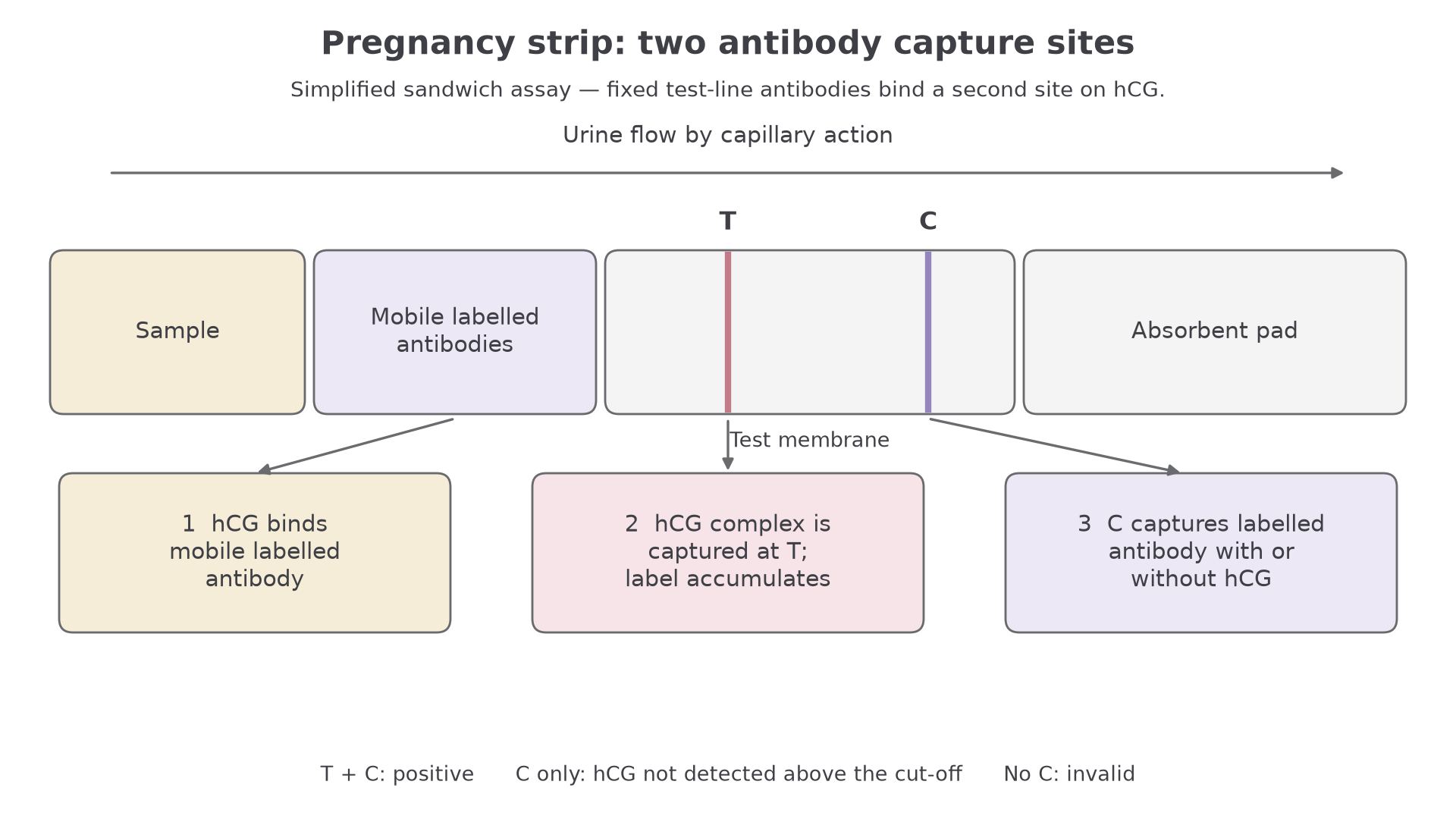
A simplified sequence is:
- Urine moves along the strip by capillary action.
- If hCG is present, it binds to mobile monoclonal antibodies that carry a visible label.
- The hCG-antibody complexes continue along the strip.
- Immobilised monoclonal antibodies at the test line bind the complexes, so the visible label accumulates and a coloured line appears.
- A separate control line should appear to show that the sample has flowed correctly and the strip has worked.
This is why a positive pregnancy test usually has both a test line and a control line. A negative result has the control line only. If the control line does not appear, the result is invalid because the strip has not shown that the test ran correctly.
At the test line, the fixed antibody binds a different exposed site on hCG, making a sandwich with the mobile labelled antibody. At the control line, fixed antibodies capture the labelled antibodies whether or not they carry hCG. Therefore the control line can appear in a valid negative test. A line forms because many coloured labels collect in one place; the antibody itself is not necessarily coloured.
Reading Results And Controls
A diagnostic test has to distinguish a real signal from a failed test. That is why a control line matters in a pregnancy test. It checks the test process, not the pregnancy status.
| Result pattern | Interpretation |
|---|---|
| Test line and control line | Positive: hCG has been detected and the strip has worked. |
| Control line only | Negative: hCG has not been detected above the test threshold, and the strip has worked. |
| No control line | Invalid: the result should not be used. |
There are two common reasoning errors to avoid. First, a negative result means the test did not detect hCG above its threshold; it does not prove that hCG is absolutely absent. Early testing or very dilute urine can produce a false negative. Second, a positive hCG result is strong evidence for pregnancy, but in medical settings it may still need to be interpreted with symptoms, timing and clinical history.
Continue this lesson.
You’re previewing NovaLearn without an account. Create a free account to read the rest.
Create free account